The Next Step: From LLM-First to Context-First
When we first started building Primed, our focus was on one idea: make the language model the heart of the system. But as AI systems became more capable and complex, prompts weren't enough. That's where context engineering comes in.

When we first started building Primed, our focus was on one idea: make the language model the heart of the system. Everything, from how data flows to how users interact, was designed around that core. We called it an LLM-first strategy.
In our last post, we looked at how tool use extended the model's reach. Tools let the model take action, fetch information, or connect to external systems, but they also introduced a new challenge. The model now had to know when and why to use those tools. That's not just about prompts anymore. It's about context.
That's where context engineering comes in.
Key takeaways
- Prompt engineering isn't enough as systems get more capable.
- Context engineering shapes what the model sees, not just what it's told.
- It curates inputs, retrieval, memory, and compression together.
- Bigger context windows make this more important, not less.
From Prompts to Context
Prompt engineering was a good first step, writing clearer instructions to get better responses. But as AI systems became more capable and complex, prompts weren't enough. Models now have to juggle more information: conversation history, goals, tools, and user data.
Context engineering is the next evolution. It's about shaping what the model sees, not just what it's told.
As Anthropic recently wrote, "context engineering" is the practice of managing the model's entire working environment, curating, structuring, and updating the information it uses to reason and act. It's not about clever wording. It's about intelligent framing.
Why Context Matters for Primed
Every AI interaction is shaped by context, the digital equivalent of memory, focus, and situational awareness.
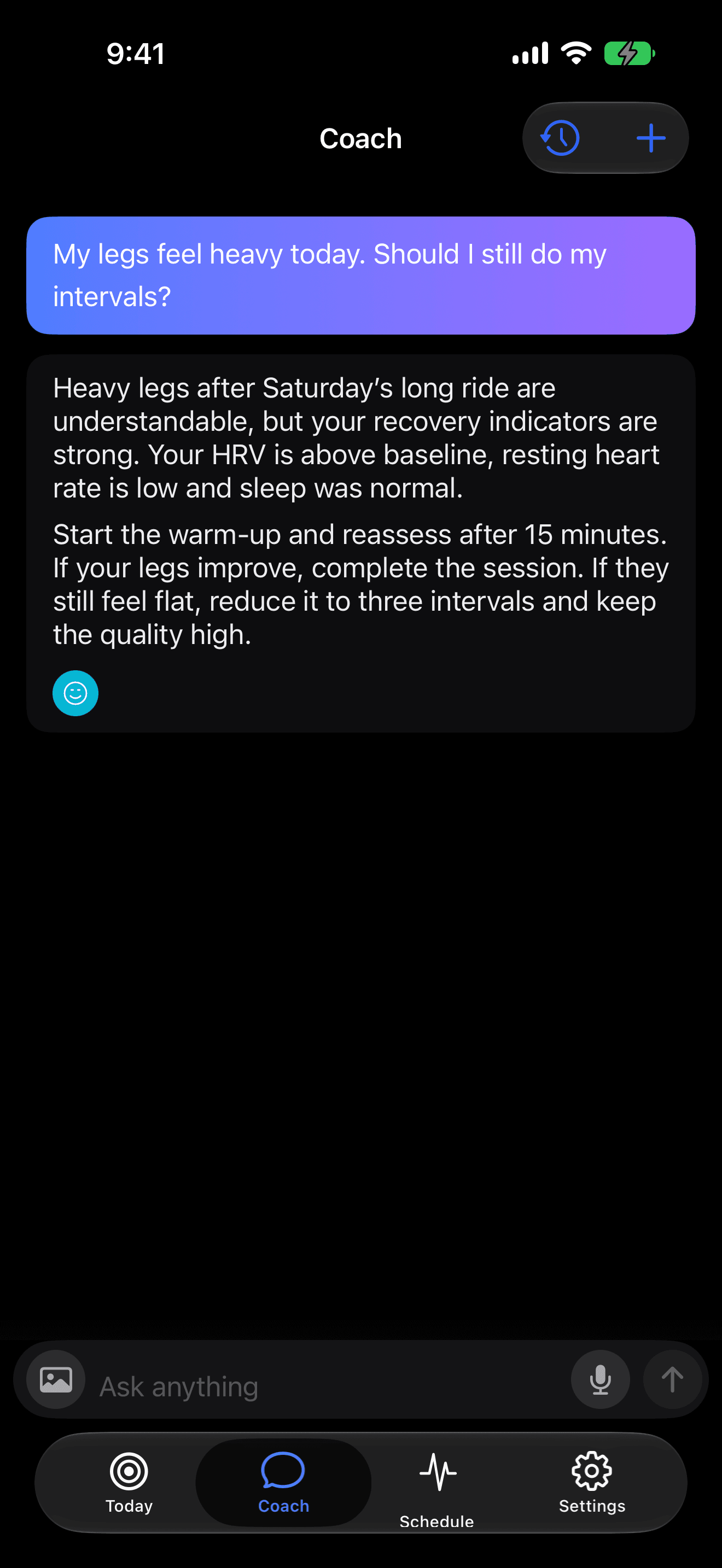
Primed's LLM-first design means the model doesn't just use context. It lives in it. Each feature — training plans, performance data, recovery metrics — feeds the model a different slice of information about what matters to the athlete right now.
Then come the tools. The app uses tools to fetch live data, summarise past activity, or trigger actions. But a tool is only useful if it's called in the right context. For example:
- If you're summarising a training week, the app needs workout data, but not your entire history.
- If you're creating a recovery plan, it needs recent fatigue markers, but not the entire database.
The art is in choosing the right mix of data for the moment, and that's exactly what context engineering does.
How Primed Uses Context Engineering
Inside Primed, every interaction goes through a small pipeline that decides what the model should see and how it should be structured.
Input framing: The system interprets your intent and filters out noise. This keeps responses focused and relevant.
Retrieval and tools: Only the information you need right now is fetched or summarised. This prevents the model from being overloaded.
Memory management: Key details and insights are stored for later use. This keeps long-term context alive without wasting space.
Compression: Older information is summarised into smaller, high-signal snippets. This maintains continuity over time.
Feedback loop: The model's responses help refine future context choices. The system learns what's useful and what isn't.
This flow ensures that the model stays sharp and responsive, not bogged down by irrelevant or stale data.
The Payoff
Getting context right makes a world of difference.
- Coherence: Training plans and coaching stay connected, even over time.
- Efficiency: The model processes fewer tokens but produces better answers.
- Reliability: Fewer hallucinations or off-topic replies.
- Scalability: As new tools and features appear, the system doesn't break, it adapts.
In short, context engineering makes Primed smarter without making it heavier.
The Hard Bits
Like anything worthwhile, context engineering isn't easy. You have to constantly decide what to keep and what to forget. If you compress too much, you lose detail. If you keep too much, the model slows down or starts to lose focus.
There's also the challenge of freshness. A tool might retrieve data that's technically correct, but contextually out of date. Balancing accuracy, speed, and relevance is an ongoing dance.
The Road Ahead
As models grow larger and gain bigger context windows, you might think this will become less important. But it's the opposite. Even the biggest models still have limited attention, and more data just means more to manage.
Future versions of Primed will lean even further into context engineering. You'll see better long-term memory, smarter context compaction, and more proactive assistance that feels like the app genuinely knows what you're training for.
Context isn't just a technical detail. It's what makes AI feel intelligent.
Summary
LLM-first design naturally leads to context-first systems. Primed isn't just about giving you a powerful language model — it's about engineering the environment that lets that model understand you and act with purpose.
In the end, intelligence isn't what an AI knows. It's what it pays attention to.