Primed has changed direction
Primed has shifted focus over the past few months, moving away from its original positioning as a productivity tool and towards something much more specific. It is now being built as an AI system for endurance training.

Primed has shifted focus over the past few months, moving away from its original positioning as a productivity tool and towards something much more specific. It is now being built as an AI system for endurance training. That shift wasn't just a change in features or audience. It forced a rethink of how the product should work at a fundamental level, particularly in how AI is used within it.
Key takeaways
- Primed is now an AI system for endurance training.
- Treats the athlete as one system, not separate metrics.
- Deterministic for safety; AI for context and reasoning.
- Generates and tests plan variations rather than fixing one.
The problem isn't a lack of science
Endurance training is already grounded in well-established concepts like VO2 max, lactate threshold, and heart rate variability. The issue is not that the science is missing, but that most systems struggle to apply it in a way that reflects the full picture of an athlete.
In practice, training load often lives in one platform, recovery signals in another, and sleep or broader health data somewhere else again. Even when all of this data exists, it is rarely evaluated together in a meaningful way. The result is a fragmented view, where decisions that look reasonable in isolation do not always hold up when considered in context.
Treating the athlete as a system
The core idea behind Primed is to treat the athlete as a system rather than a collection of independent metrics. Training load, recovery, sleep, and progression are all interdependent, and small changes in one area can have disproportionate effects elsewhere. While this sounds straightforward, most tools are not designed this way. They either rely heavily on static models or generate plans that remain largely unchanged once created.
What we are trying to build instead is something that continuously evaluates the athlete as conditions evolve. Rather than making decisions only at the start of a plan or at fixed checkpoints, the system should be able to adjust in response to what is actually happening.
Where AI actually fits
A lot of AI-driven products in this space focus on generation. You ask for a plan, and a plan is produced. That approach is appealing, but it tends to blur the line between areas that require consistency and those that benefit from flexibility.
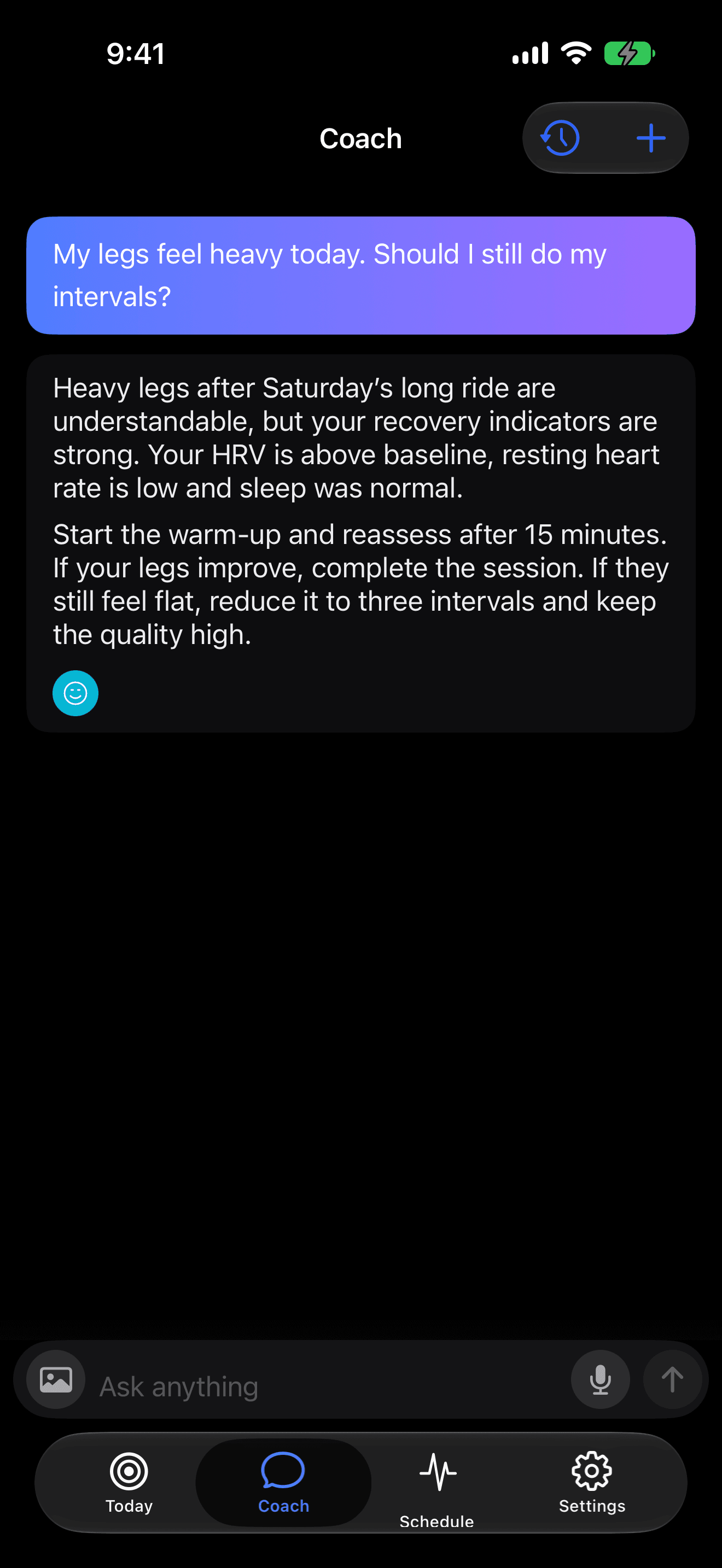
In Primed, parts of the system such as progression, fuelling, and safety constraints are handled deterministically so that they remain stable and explainable. AI is then used in areas where it adds genuine value, particularly in interpreting context, connecting signals across different sources, and explaining why certain decisions are being made. Over time, it can also contribute to shaping strategy, but it does so within a framework that preserves consistency rather than replacing it.
Learning from the plans themselves
Another shift has been in how plan quality is approached. Rather than trying to design a single "correct" way of generating plans, we have been experimenting with mutation-style approaches inspired by GEPA. This involves generating variations, evaluating them against structured criteria, and keeping or discarding them based on performance.
This creates a feedback loop where the system can gradually improve, not by guessing, but by iterating. In that sense, each plan becomes a hypothesis that can be tested and refined over time, rather than a fixed output.
Seeing more than one signal
An athlete cannot be understood through a single metric. Power, heart rate, sleep, and recovery all contribute to the overall picture, but their value comes from how they interact rather than how they perform individually.
Primed is being built to combine signals from platforms such as Garmin, WHOOP, and Oura, and to evaluate them together. This is where AI becomes practically useful, not as a layer that sits on top of the system, but as a way to reason across multiple inputs and identify patterns that would otherwise be difficult to see.
Coaches are still part of the system
This approach is not intended to replace coaches. If anything, it creates an opportunity to support them more effectively. Athletes should be able to use Primed independently, but also involve a coach where appropriate. Looking ahead, we are exploring how an athlete could share their AI-derived context with a coach, allowing them to see not just the activities themselves, but also the reasoning behind decisions.
That kind of shared understanding has the potential to reduce ambiguity and improve alignment between athlete and coach.
Where things are now
Primed is not publicly launched yet, and there is still work to do in areas such as plan quality, data integration, and overall reliability. These are the aspects that matter most at this stage, and they are being prioritised over rapid expansion of features.
Early access
We are opening early access to a small group of athletes who are training seriously and are interested in working with a structured plan, even while the system is still evolving.
If that sounds relevant, you can sign up here: https://beprimed.ai
Summary
Most tools optimise for what they can measure in isolation. Primed is built to optimise for the athlete as a whole system — combining training, recovery, sleep, and progression in one continuously evaluated picture rather than separate dashboards.
The shift isn't about more features. It's about how decisions get made.