Primed is live on the App Store
After nearly two years of building and testing, Primed is now available on iPhone, iPad and Mac. Here is what I have been trying to build, what it does today, and where it still needs to improve.

In my last update, I wrote that Primed had changed direction and was becoming an AI system for endurance training. At the time, it was still in development and being used by a small group of beta testers. Primed is now live on the App Store for iPhone, iPad and Mac.
That sentence makes the moment sound more dramatic than it has felt. There was no big launch day or sudden rush of users. I am building Primed as a solo founder, so the practical change was simply that an app which had previously only been available to me and a few testers became something anybody could download.
In that sense, Primed is probably more “available” than “launched”. Still, it is an important point to reach after nearly two years of building, changing direction, testing assumptions and, quite often, discovering that the difficult part was not where I thought it would be.
Key takeaways
- Primed is now available on iPhone, iPad, and Mac.
- Connects sleep, HRV, and workout data for context-aware coaching.
- Deterministic safety constraints paired with AI reasoning and explanations.
- Inviting endurance athletes to test and provide candid feedback.
An earlier experiment
The path to Primed actually started before Primed itself. At the end of 2023, I began a small experiment to see how far I could get using ChatGPT to help me build a reasonably complex application. This was well before the term “vibe coding” appeared, although that is probably how I would describe it now.
I also had a practical question I wanted the app to answer. Oura knew how I had slept and recovered, while Strava knew what training I had done, but neither could tell me much about the relationship between the two. I wanted to put the data together and see whether there were correlations that might explain how my training was affecting my recovery.
The resulting Next.js Health application connected directly to the Oura and Strava APIs. It combined sleep, HRV and activity data, displayed the information together, and used OpenAI to analyse the merged data. It was a fairly rough experiment, but the underlying idea stayed with me. The useful insight was in the relationship between the data sources, rather than inside either one on its own.
Primed started somewhere else
When I later began building Primed, however, it was not an endurance product. It started as a general productivity agent that could maintain context, connect to different tools and help carry work through. Products such as OpenClaw and Claude Cowork are now recognisable examples of that broader category, although neither existed when I started.
The idea was technically interesting, but it was also extremely broad. I kept coming back to the earlier health experiment because it addressed a concrete problem I understood personally. Changing direction allowed me to bring the two ideas together. Primed kept the memory, context and access to useful tools of the original agent, but applied them to helping an endurance athlete make better decisions from the data they already collect.
Why endurance training
I have trained consistently for years, mostly on the bike, and I use many of the devices and services that endurance athletes tend to accumulate. Between Garmin, Strava, Apple Health, Oura and WHOOP, I had more information about my training and recovery than any sensible person probably needs. What I did not have was much help interpreting it.
I could see my sleep, HRV, resting heart rate, training load, power and recent workouts. I could follow a structured plan and watch readiness scores move up and down. The useful questions were still left to me. Should I do the hard session today? Is the fatigue I am feeling expected, or am I starting to dig a hole? Is the training actually building towards my goal? What should change when work, sleep, illness or a missed session gets in the way?
A dashboard can show the evidence, but it cannot necessarily make a sensible judgement from it. A static plan has the opposite problem. It can tell you what was scheduled, but it does not know what has happened since the plan was written. Primed grew out of that gap.
What Primed does today
Primed brings together the training and recovery data an athlete already records and maintains an ongoing understanding of that athlete over time. It looks at the current day in the context of recent training, longer-term load, recovery, goals and the way the athlete has responded before.
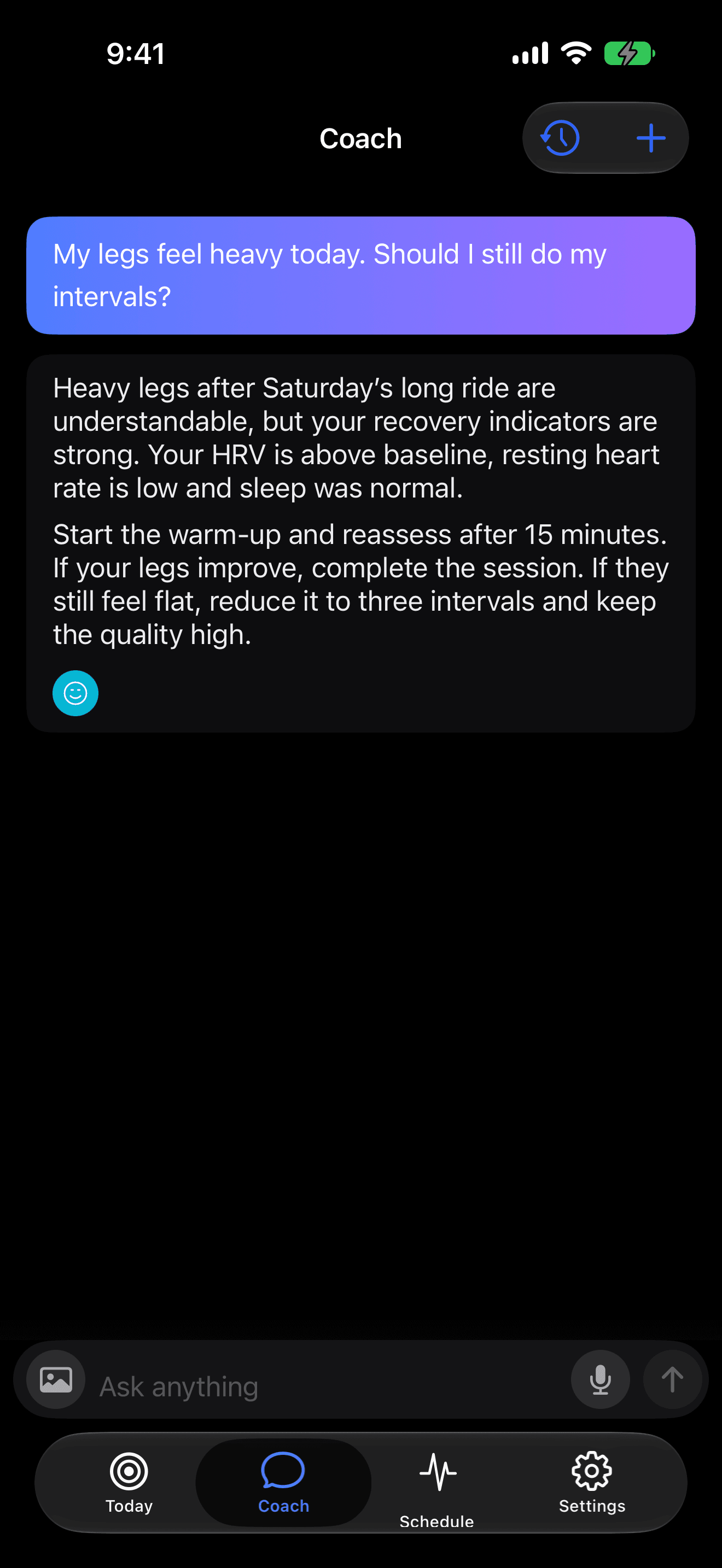
The Today screen gives you the session that currently makes sense and explains why. The schedule changes as your circumstances change. The Coach lets you ask the questions that do not fit neatly into a chart or readiness score, while keeping the context of your training rather than starting again with every conversation.
That continuity matters to me. A useful coach should know what you are training for, what you did last week, whether you have been sleeping poorly, what tends to happen after a hard block, and whether the session you are considering fits the larger direction of your training. Without that history, even a very capable AI is mostly responding to a snapshot.
Putting a chatbot on top of a collection of fitness data would have been relatively easy, but it would not have solved the problem I had. In Primed, training load calculations, progression and safety constraints are deliberately handled in a consistent and testable way. AI is used to reason across different signals, deal with incomplete or changing circumstances, and explain a recommendation in normal language. The point is to help an athlete decide what to do with the data they already have, rather than produce more of it.
What being live does not mean
Releasing the app does not mean that the problem is solved. If anything, it makes the real work clearer.
The difficult part of an AI coach is not generating a plausible training plan or a confident-sounding answer. It is earning enough trust that an athlete can act on its judgement. To do that, it needs to know when to push, when to hold back, when to challenge an assumption and when to admit that the available evidence is not enough.
It also means improving through real use. Endurance athletes are not interchangeable, and the interesting cases are rarely the tidy ones. People miss sessions, travel, get sick, sleep badly, change goals and respond differently to the same training. Primed needs to work when training stops following the ideal path, because that is when coaching becomes most useful.
I am now looking for athletes with meaningful training history who are willing to use Primed seriously over a real training block and tell me candidly what it gets right, what it gets wrong and whether it becomes more useful as it learns them. I am particularly interested in the point at which the advice starts to feel genuinely personal rather than merely plausible.
Where it goes from here
There is plenty still to build. The Android version is underway. I am continuing to improve how Primed understands different sports, how it explains changes to a plan, and how it uses longer-term patterns without over-claiming what the data can prove.
The broader ambition has not changed. I want to see how close we can get to a genuinely great personal coach by combining increasingly capable AI with a deep, persistent understanding of one athlete. That will take time, good data and a lot of candid feedback. Now that Primed is available, I can begin learning that from athletes beyond the small group who helped me during the beta.
Primed is free to start on iPhone, iPad and Mac. If you train regularly and already record your workouts or recovery, you can download it here. If you do try it, I would genuinely like to hear where it helps and where it falls short.