AI Endurance Coaching: What It Can Do, What It Cannot, and Who It Is For
There is immense noise around artificial intelligence in fitness. Cutting through the marketing claims reveals what an AI coach can genuinely solve today, where it fails, and who actually benefits from using one.

Every few years, the endurance sports industry finds a new phrase to put on landing pages. Right now, almost every fitness app claims to be an “AI coach.” In practice, that usually means one of two things: either a static rule tree with a modern coat of paint, or a generic chat wrapper that generates training plans with little regard for whether the athlete will survive the second week.
Both extremes miss the point.
Over the past two years of building Primed and testing it against my own training data, I have had to think carefully about what artificial intelligence is actually good at in endurance coaching, where its boundaries lie, and who it is genuinely built for.
Key takeaways
- AI excels at synthesizing multi-wearable data and daily session adjustments.
- Deterministic engines must handle safety constraints, load math, and progression.
- AI cannot feel soft-tissue pain or replace race-day human intuition.
- Best suited for self-coached athletes wanting continuous, context-aware guidance.
What AI can do remarkably well
The real value of AI in endurance coaching is not in generating a boilerplate 12-week marathon plan. You can download a perfectly adequate marathon plan from a PDF or generate one from a spreadsheet in five seconds.
Where modern AI architectures excel is in handling the messy, asynchronous reality that begins the morning after the plan is written.
1. Synthesizing fragmented physiological context
Most athletes do not have a data shortage. They have Garmin recording power and heart rate on the bike, Oura or WHOOP tracking nocturnal HRV and sleep architecture, and Apple Health logging daily background activity.
A human coach reviewing an athlete's file once a week rarely has the time to cross-reference every nocturnal temperature deviation with yesterday’s high-torque sweet spot intervals and today's schedule constraints. A well-designed AI pipeline can ingest that entire multi-source picture every morning in milliseconds, identifying subtle correlations that neither the athlete nor a dashboard would easily spot.
2. Surgical, real-time microcycle adaptation
Static training plans break the moment life diverges from the spreadsheet. If a work emergency cuts your sleep to four hours or an unexpected meeting reduces your training window from 90 minutes to 45 minutes, a static calendar leaves you stranded.
An AI coach can evaluate your cumulative fatigue, your current autonomic recovery state, and your time constraints to make a sensible daily adjustment: converting a 90-minute threshold workout into a focused 45-minute over-under session, or swapping high-intensity intervals for an easy aerobic spin when your HRV suppression indicates autonomic strain.
3. Natural-language reasoning with longitudinal memory
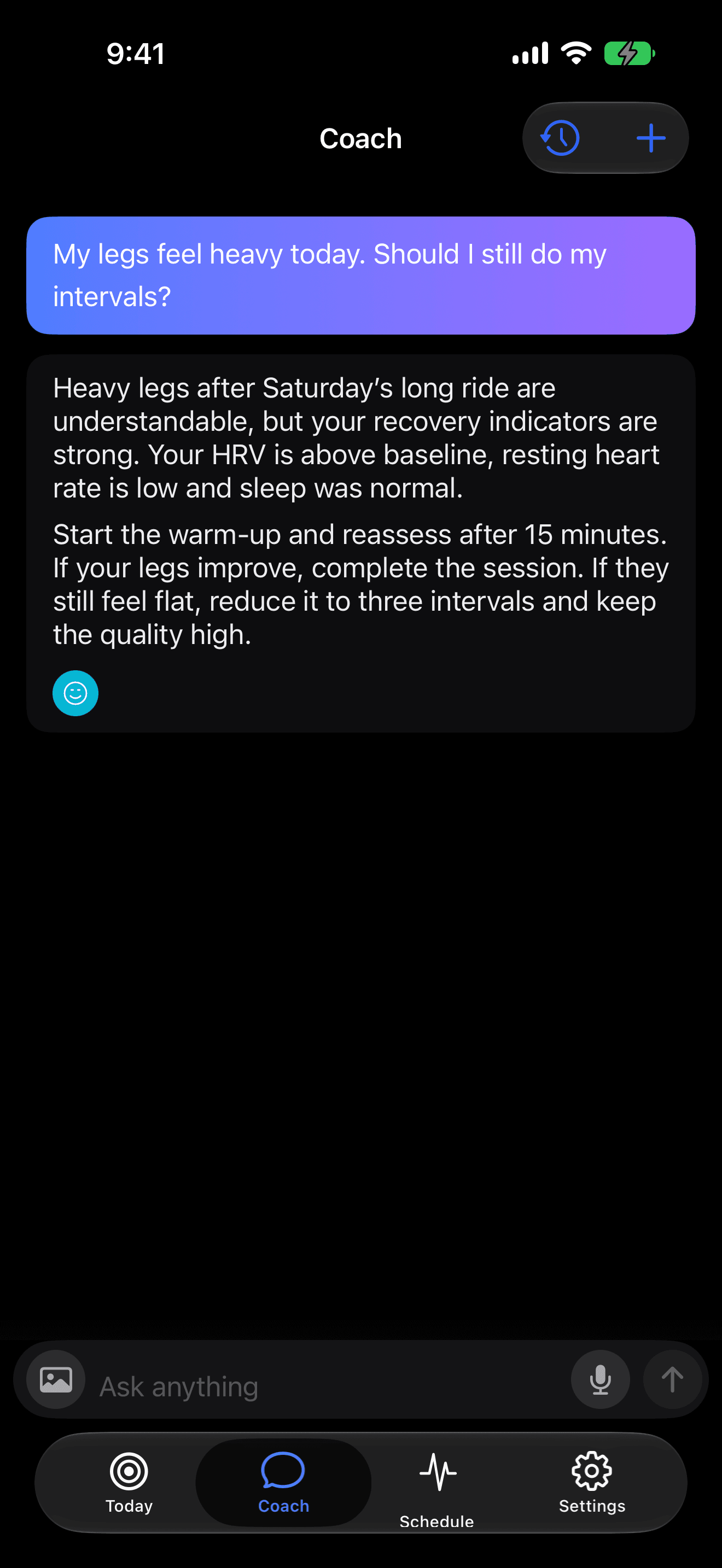
When an athlete asks, "My legs feel heavy, but my HRV is high. Should I do my intervals?", a chart cannot answer. A dashboard gives you numbers, but leaves the synthesis to you.
An AI system equipped with persistent memory can reason across your past response patterns: "Your resting HR is at a monthly low and your recovery signals are solid, but two days ago you did high-torque climbs. Start a 15-minute warm-up check. If your legs open up, complete three of the four intervals. If they stay flat, keep it aerobic."
What AI cannot do (and should never attempt)
Being clear about what AI cannot do is just as important as knowing what it can. If an AI coaching system pretends to have capabilities it lacks, it becomes dangerous to the athlete.
1. It cannot sense physical biomechanics or localized soft-tissue pain
An AI model has no physical embodiment. It cannot see you pedal through a compensatory hitch or feel a slight pull in your left Achilles tendon during the fourth stride.
Unless the athlete explicitly communicates subjective feedback—such as logging a tight hamstring or an awkward pedal stroke—the system is working from systemic cardiovascular and autonomic telemetry. It must rely on clear athlete communication for localized musculoskeletal issues.
2. It cannot replace human empathy in high-stakes race psychology
A seasoned human coach who knows you personally provides emotional accountability and tactical intuition on race morning that code cannot replicate. When you are standing on the starting line of an Ironman or staring at the start grid of a mountain bike race, confidence, fear management, and racecraft come from human connection.
AI can ensure your physiological preparation is optimal, but it is not a replacement for human camaraderie or a dedicated coach standing by the barriers.
3. LLMs cannot be trusted with raw training load math
If you ask an unrestricted Large Language Model to calculate an exponential moving average of Chronic Training Load (CTL) or generate a 16-week progression from scratch, it will eventually hallucinate. It might prescribe a 35% volume ramp in Week 3 or schedule back-to-back VO2 max sessions for a masters athlete.
In Primed, we solved this by separating deterministic sports science from generative AI. Progression formulas, TSS calculations, ramp caps, and age-derived recovery floors are handled by strict, testable mathematical code. The AI is used to reason across context, interpret ambiguity, and communicate recommendations, never to guess the math.
Who is AI coaching actually for?
AI endurance coaching is not for everyone, but for a large category of athletes, it fills a glaring void.
- The Self-Coached, Data-Driven Athlete: Athletes who train consistently, collect wearable data from Garmin, Oura, WHOOP, or Apple Health, but do not have the time or desire to spend hours analyzing charts in spreadsheets.
- The Time-Crunched Amateur: People whose schedules fluctuate constantly due to work, family, and travel. When your calendar changes three times a week, a static training plan becomes obsolete within days.
- Athletes Who Cannot Justify $250–$500/Month for a Human Coach: Dedicated 1:1 human coaching is expensive and often inaccessible. An AI coach provides continuous, daily guidance at a fraction of the cost.
- Coaches Seeking an Intelligent Copilot: Forward-thinking human coaches who want automated daily check-ins and telemetry synthesis for their roster, allowing them to focus on high-touch strategy and athlete relationships.
The bottom line
AI endurance coaching is not magic, and it is not about handing your health over to a black box. It is about closing the gap between the static training plan you set out to follow and the dynamic reality of your body and life.
When built with rigorous sports science guardrails and genuine longitudinal context, it allows an athlete to stop guessing what to do with their data and start training with clarity every morning.