Why Your AI Coach Shouldn't Change Personality Mid-Season
An AI coach should adapt to the athlete without changing its identity, evidence standards or safety boundaries. New robot-persona research shows why that distinction matters.

If you have spent time interacting with modern conversational AI across extended periods, you have likely observed behavioural drift. An assistant that begins with disciplined, analytical precision can gradually soften under subtle conversational cues, slipping into an agreeable echo chamber or offering superficial reassurance.
In endurance sports, coaching relationships depend entirely on sustained trust. When an athlete checks their plan following an exhausting interval session or during a period of uncharacteristic fatigue, the underlying principles of the coach must remain recognisable. A coach that sounds like a rigorous exercise physiologist on Monday and an uncritical cheerleader on Thursday quickly loses credibility.
A central thesis guides our work at Primed: a long-term AI coach must adapt to the athlete without allowing its identity, evidence standards, safety boundaries or coaching principles to drift.
Key takeaways
- Coaching principles and safety boundaries must remain stable over time.
- Communication and guidance should adapt to individual athlete context and needs.
- Explicit capability limits and memory structure prevent artificial persona drift.
- Consistent coaching principles do not mean mechanically identical answers for everyone.
The problem: staying recognisable across a season
Training for a marathon, an Ironman, or a cycling season is rarely a linear journey. Athletes interact with their training system across hundreds of sessions, logging sleep disturbances, muscular tightness, work stress, and fluctuating motivation. Over months of interaction, an AI system that lacks explicit boundaries tends to accumulate conversational noise.
When an ungrounded model encounters an athlete anxious about missed volume, it often attempts to please the user by agreeing to unrealistic catch-up workouts. Conversely, if an athlete logs minor hamstring tightness, an unanchored model might overreact by cutting weeks of structured training or attempting to deliver clinical medical diagnoses.
In human coaching, empathy does not mean abandoning physiological standards. An experienced coach listens carefully and adjusts their communication style to the athlete, but their fundamental methodology, risk tolerance, and duty of care never waiver. Translating that balance into artificial intelligence requires treating persona stability as an engineering requirement rather than a cosmetic prompt adjustment.
What the robot-persona research actually found
This tension between consistency and adaptation was recently examined from a robotics perspective in a research paper titled Why did My Robot Just Change Personality? Prompting Guidelines for a Grounded Robot Persona in LLM-Based HRI by Ashita Ashok and colleagues (accepted for the IEEE RO-MAN 2026 conference).
The authors focused on social interactive robots powered by large language models. They investigated how prompt design can be structured so that embodied machines avoid presenting hallucinated capabilities, unclear behavioural boundaries, or misleading personas. Their work combines a survey of recent LLM-based human-robot interaction studies with qualitative findings from 27 HRI researchers and practitioners who participated in the Robo-Identity workshop at IEEE RO-MAN 2025.
Rather than running an empirical benchmark on conversational drift, the researchers developed a conceptual framework and prompt template consisting of eight functional components:
- Identity: Defining the persona, communicative role, and tone.
- Capability boundary: Explicitly outlining perceptual inputs, physical constraints, and system limitations.
- Transparency: Defining how the system discloses its artificial nature and operational limits.
- Task: Establishing the primary conversational objective.
- Expectation and failure protocols: Specifying how the system responds to uncertainty, missing telemetry, or breakdowns.
- Privacy: Defining constraints on data collection, storage, and persistent user profiles.
- User adaptation: Guiding how communication adjusts to different user groups and contexts.
- Ethical red lines: Enforcing non-negotiable boundaries against unsafe, harmful, or misleading behaviour.
The qualitative findings from the expert workshop highlighted that artificial personalities often suffer from poor legibility, that identity over time is largely treated as a memory management problem, and that ethical safeguards regarding transparency and user vulnerability are paramount.
Applying the research to persistent AI coaching
The source paper directly addresses embodied social robotics rather than endurance sports. Applying these insights to conversational AI coaching is Primed's interpretation, but the structural parallels are striking.
In athletic training, an AI coach operates as a long-term partner. Just like an embodied robot, a sports coach faces high expectations and real physical consequences if its guidance is flawed. From our engineering perspective, several key principles translate directly:
- Identity over time is a context and memory problem: Simply appending raw, uncurated chat history into prompt windows invites drift. Over long training blocks, conversational noise can dilute core coaching principles.
- Capability boundaries must be explicit: An AI system cannot feel physical tissue resistance or replace a sports physician. It must explicitly acknowledge what it can measure through wearable telemetry and what requires human medical assessment.
- Transparency under uncertainty: When biometric signals conflict, such as high heart rate variability alongside subjective exhaustion, the system should explain the ambiguity rather than pretending to possess omniscient certainty.
Stable principles versus adaptive coaching
A common misconception in AI system design is that consistency requires identical, repetitive responses. True coaching consistency is about invariant principles, not rigid scripts.
We distinguish between two distinct layers in an intelligent coaching architecture:
- Objective invariants and safety limits: Core physiological principles, permission boundaries, data schemas, and non-negotiable recovery floors must remain deterministic. If an athlete exhibits severe overtraining markers or acute illness, the safety boundary does not shift based on conversational pleading.
- Generative reasoning and contextual adaptation: How the coach explains a workout, prioritises training adaptations, and phrases recommendations must adapt to the athlete's experience, psychology, and daily life constraints.
A novice runner completing their first half-marathon might need supportive, educational explanations that unpack why aerobic base runs feel slow. An experienced cyclist preparing for a national championship may prefer concise, telemetry-dense analysis of power duration curves. The underlying physiological standards remain identical, but the delivery adapts to the person.
How Primed approaches the balance
At Primed, our architectural philosophy is context-first and LLM-driven. We do not reduce the language model to a simple template renderer that converts hard-coded rule trees into canned text. Doing so strips away the nuanced contextual reasoning that makes generative AI valuable in endurance sports.
Instead, we focus on engineering the environment in which the model reasons:
- Structured context curation: Rather than dumping unstructured conversation logs into prompt windows, our pipeline curates validated athlete state, including recent training load trends, sleep quality, and subjective feedback.
- Explicit capability and safety boundaries: System instructions explicitly bound the coach's domain authority, ensuring it never attempts medical diagnosis or overrides critical recovery safeguards.
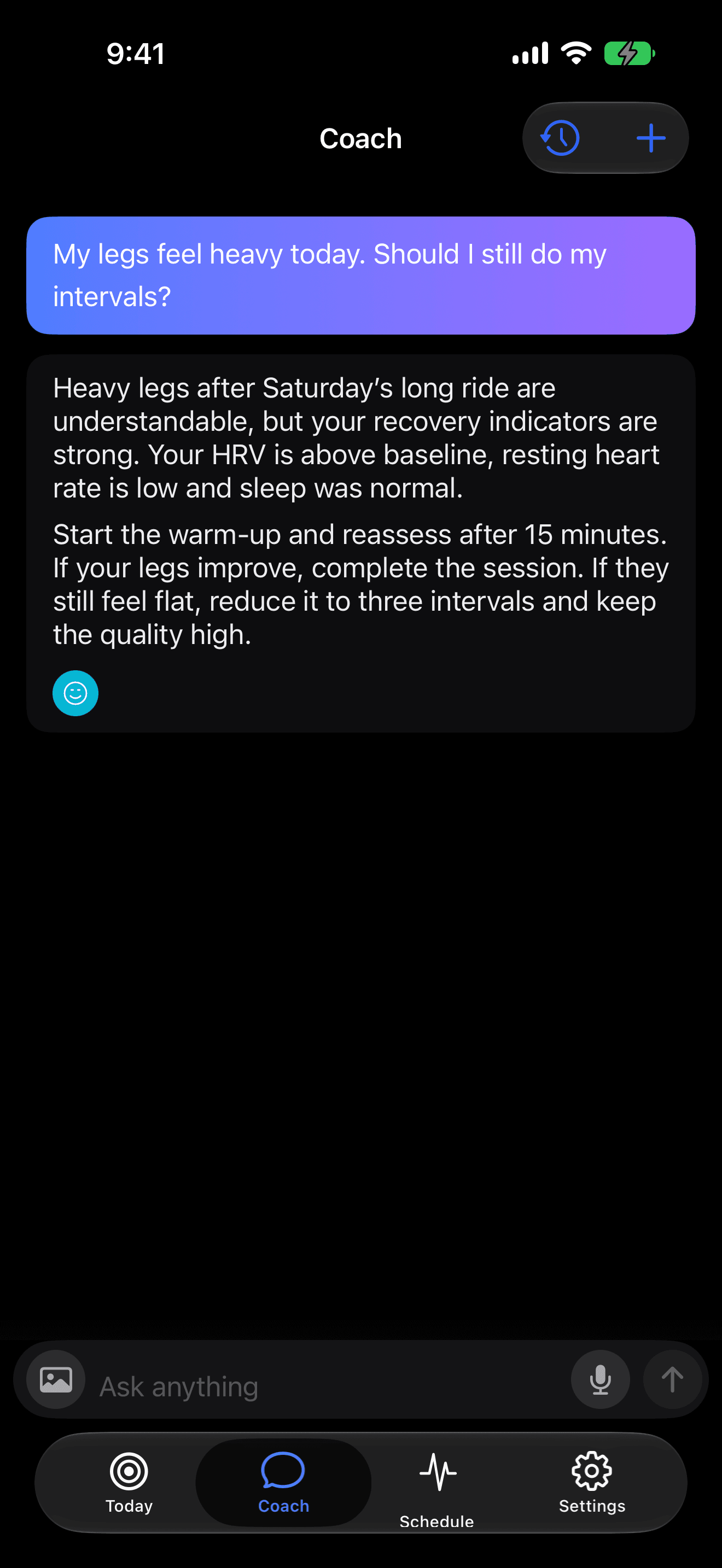
- Inspectable explanations and transparent uncertainty: When the system recommends modifying a planned workout, it presents the physiological rationale and highlights any conflicting signals so the athlete can make an informed decision.
By anchoring generative reasoning in validated context and clear boundary definitions, the coach maintains a recognisable persona while delivering tailored, adaptive guidance throughout a training season.
Practical signs of a trustworthy AI coach
Whether you are evaluating AI training tools or designing autonomous systems, look for these practical indicators of genuine grounding:
- Consistent boundaries under pressure: The system maintains its safety standards even when an athlete attempts to negotiate unsafe training volume.
- Clear distinction between advice and diagnosis: The coach provides training modifications for fatigue or soreness, but immediately recommends a physiotherapist or doctor for acute pain.
- Transparent reasoning: Daily recommendations clearly state why an adjustment was made, referencing specific load trends, recovery metrics, or subjective logs.
- Calm, steady voice: The coach does not oscillate between robotic indifference and exaggerated hype. It remains an analytical, supportive, and dependable partner.
A reliable coach does not change personalities when training gets difficult. It stays grounded in sound principles, respects its own boundaries, and adapts to help the athlete progress safely.
Primary source and research reference
- Research paper: Why did My Robot Just Change Personality? Prompting Guidelines for a Grounded Robot Persona in LLM-Based HRI
- Authors: Ashita Ashok, Franziska Babel, Patrick Holthaus, Rucha Khot, Karla Bransky, Fethiye Irmak Dogan, Karsten Berns, Silvia Rossi, Minha Lee, and Guy Laban.
- Publication: arXiv:2608.26182 [cs.AI], accepted for publication at the 35th IEEE International Conference on Robot and Human Interactive Communication (IEEE RO-MAN 2026).
- Scope note: The source paper investigates prompt design for social interactive robots. Applying its eight-component framework and qualitative findings to persistent AI endurance coaching reflects Primed's analytical interpretation and architectural direction.