Why Your Training Plan Isn't Working (Even If It Looks Perfect)
Most training plans fail. Not because they're bad — because they ignore what's actually happening in your body. You can have a beautifully structured plan and still feel flat, fatigued, or like you're going backwards.

Most training plans fail.
Not because they're bad. Because they ignore what's actually happening in your body.
You can have a beautifully structured plan. Perfect zones. Clean progression. The kind of thing that looks like it came straight from a professional coach.
And still feel flat. Fatigued. Or like you're going backwards.
Key takeaways
- Static plans break the moment your body diverges from them.
- Fatigue, life stress, and recovery aren't in any plan.
- Adaptation matters more than adherence.
- AI helps most when it adjusts today, not when it generates plans.
The illusion of a "perfect plan"
A good training plan usually includes:
- Structured workouts
- Progressive overload
- Periodisation
- Recovery weeks
On paper, it looks right. The problem is that it assumes something that isn't real: that your body behaves the same way every day.
It doesn't.
What actually breaks most plans
Over time, I've realised most plans fail for a few consistent reasons.
1. You're training through fatigue
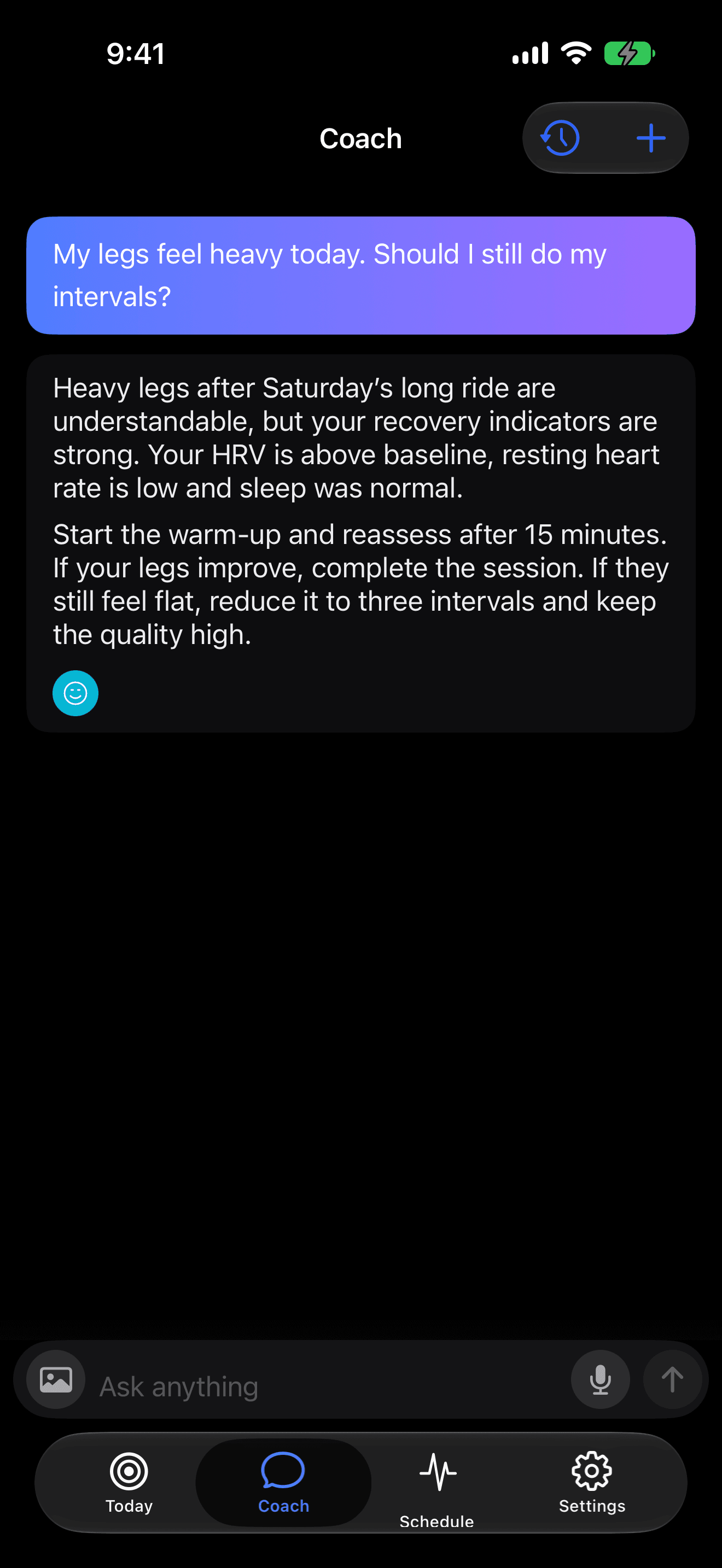
You wake up tired. Your HRV is suppressed. Your body is telling you something is off. But the plan says: intervals. So you push through. You complete the session, but you dig a deeper hole.
2. Life stress isn't accounted for
Work. Family. Travel. Poor sleep. None of that is in your training plan. But it all affects your ability to absorb training.
3. The plan doesn't adapt when you don't follow it perfectly
You miss a session. Or move one. Now everything is slightly off. But the plan keeps going like nothing changed.
4. You ride the wrong intensity
Easy days become a bit too hard. Hard days aren't quite hard enough. Over time, this flattens your progress.
What great coaches actually do
The best coaches don't just write plans. They adjust. Constantly. They:
- Read your fatigue and recovery signals
- Modify sessions based on how you're actually responding
- Override the plan when needed
- Simplify decisions so you don't have to second guess
Most importantly, they don't treat the plan as fixed. They treat it as a starting point.
What I didn't realise about my own training
This is where things got interesting for me. I've been training consistently for years. Structured. Disciplined. Doing all the "right" things. But I kept running into the same pattern:
- Periods of good progress
- Followed by fatigue that didn't quite make sense
When I started working with the Primed Coach, one thing became very clear: my recovery wasn't what I thought it was.
In particular, sleep. I hadn't fully appreciated how much sleep apnea was impacting my training. Not just sleep quality, but:
- Recovery
- HRV
- Fatigue accumulation
- Ability to handle load
It explained a lot. Sessions that felt harder than they should. Days where I couldn't hit numbers. Fatigue that didn't line up with the plan. No static plan could have picked that up.
Why this is where coaching needs to change
Most training systems still revolve around the plan. Follow the plan. Adjust occasionally. But in reality, the plan should not be in control. Your current state should be.
That means:
- Looking at what's happening today
- Understanding your recovery and load
- Making a call on what actually makes sense
Not what was written two weeks ago.
Where AI actually helps (and where it doesn't)
There's a lot of noise about AI in training. Most of it focuses on generating plans. That's not the interesting part.
The real shift is this:
- Determining what you should do today based on real context
- Making safe, sensible adjustments
- Framing that as clear, simple coaching
That's where things start to feel different.
The simple truth
The best training plan isn't the one you follow perfectly. It's the one that adapts when you can't.
Summary
A training plan is a hypothesis, not a contract. Its job is to be revised by what your body is actually doing — fatigue, sleep, life stress, recovery — not blindly executed. Coaching value isn't in the plan; it's in the adjustment.
If your training isn't adapting, it's guessing.