AI Coach vs TrainingPeaks, TrainerRoad, WHOOP Coach and ChatGPT
The endurance technology ecosystem is crowded with platforms claiming to guide your training. Here is a clear, objective breakdown of how a purpose-built AI coach compares to TrainingPeaks, TrainerRoad, WHOOP Coach, and generic LLMs.

If you are an endurance athlete trying to navigate the current software landscape, you have never had more options—or more confusion.
You can manage your training in TrainingPeaks, execute adaptive indoor cycling plans in TrainerRoad, chat with WHOOP Coach on your phone, or paste your workout history into ChatGPT and ask it to write a plan.
Each of these tools does something very well. But they also have distinct architectural limitations. Understanding those differences is essential if you want to know how an integrated AI coach like Primed fits into the picture.
Key takeaways
- TrainingPeaks excels at data archiving but lacks automated daily adaptation.
- TrainerRoad provides excellent power progressions but ignores external recovery signals.
- WHOOP Coach provides biometric chat but cannot write structured training plans.
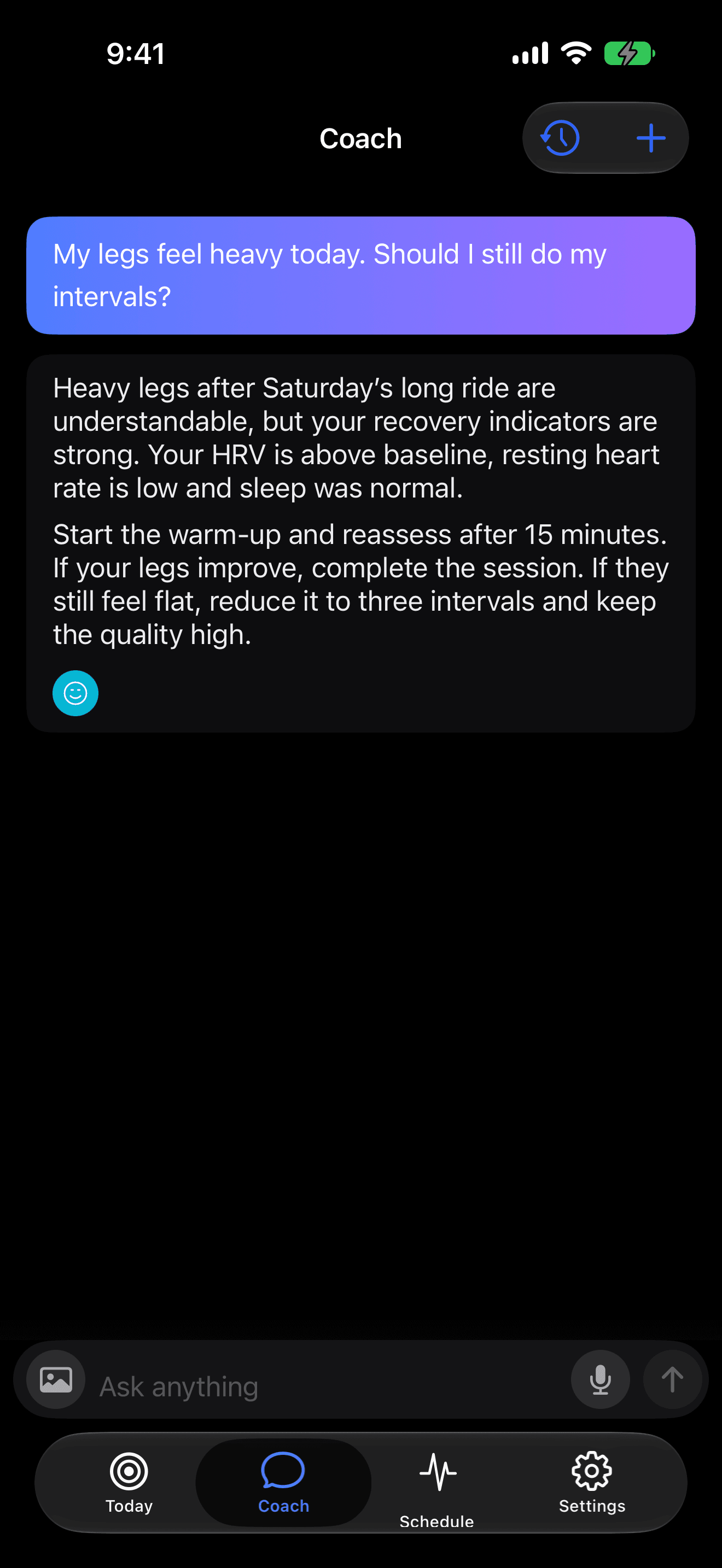
- Primed combines multi-wearable telemetry, deterministic guardrails, and persistent AI coaching.
1. TrainingPeaks: The Gold Standard Dashboard (Without the Daily Coach)
TrainingPeaks pioneered modern endurance sports analytics. Concepts like Training Stress Score (TSS), Chronic Training Load (CTL / Fitness), Acute Training Load (ATL / Fatigue), and Training Stress Balance (TSB / Form) are the backbone of endurance science.
- Where it shines: TrainingPeaks is unparalleled as an analytical archive and a communication conduit between a dedicated human coach and an athlete. The Performance Management Chart (PMC) is still the benchmark for macro-load tracking.
- The limitation: TrainingPeaks is fundamentally passive. Unless you pay hundreds of dollars per month for a private human coach to review your files every morning, the platform will not adjust your calendar when you wake up sick, sleep three hours, or miss your Tuesday session. The plan sits on your calendar unchanged.
2. TrainerRoad: Outstanding Power Progression (Within a Closed Ecosystem)
TrainerRoad revolutionized structured interval training on the bike with its Workout Levels and Adaptive Training engine.
- Where it shines: If you are on an indoor smart trainer doing power-based cycling workouts, TrainerRoad’s progression algorithms are superb. If you nail a 4.5 Sweet Spot workout, it advances you to a 5.0. If you struggle, it pulls you back.
- The limitation: TrainerRoad lives primarily inside its own ecosystem. It knows everything about your power curve on the bike, but historically knows very little about your nocturnal HRV from Oura, your daily stress from WHOOP, your non-cycling athletic load, or your real-world lifestyle disruptions. It adapts workouts based on your performance in the previous workout, rather than your systemic physiological state this morning.
3. WHOOP Coach: Great Wearable Chat (Without Training Periodization)
WHOOP introduced an LLM-powered chat interface that allows members to query their physiological data in plain language.
- Where it shines: WHOOP Coach is great at explaining immediate recovery metrics. You can ask why your recovery was low or how your sleep was affected by alcohol, and it provides clear, conversational explanations based on your WHOOP band telemetry.
- The limitation: WHOOP Coach is not a sports coach. It does not understand macro-periodization, power-duration curves, VO2 max progression blocks, or structured interval design. It cannot export a structured
.zwofile to your bike computer or build an 80/20 polarized training plan targeting a gran fondo six months away.
4. ChatGPT / Generic LLMs: Brilliant Reasoning (Without Guardrails or Live Telemetry)
Many tech-savvy athletes have tried pasting their Strava or Garmin data into ChatGPT or Claude to get training advice.
- Where it shines: Generic foundation models have encyclopedic knowledge of sports science literature and can draft eloquent explanations of physiological concepts.
- The limitation: Generic LLMs are dangerous when left alone with training prescription:
- Zero live telemetry: They cannot connect directly to your Garmin webhook or Oura API; you must manually copy-paste data every time.
- Stateless memory: They forget who you are between chat sessions or suffer from context window degradation over weeks of training.
- Math and safety hallucinations: LLMs are notorious for miscalculating training load math, prescribing unrealistic volume ramps, and violating basic recovery constraints.
5. Primed: The Integrated Endurance Intelligence Layer
Primed was designed from the ground up to synthesize these separate capabilities into a single, cohesive system:
┌────────────────────────────────────────────────────────────────────────┐
│                          THE PRIMED DIFFERENCE                         │
├────────────────────────────────────────────────────────────────────────┤
│ 1. Multi-Wearable Telemetry   │ Garmin (FIT power) + Oura + WHOOP +    │
│                               │ Apple Health ingested via MCP servers. │
├───────────────────────────────┼────────────────────────────────────────┤
│ 2. Deterministic Guardrails   │ Strict math engines calculate load,   │
│                               │ CTL/ATL, and age-derived safety floors.│
├───────────────────────────────┼────────────────────────────────────────┤
│ 3. Real-Time Daily Adaptation │ Evaluates every morning: execute,      │
│                               │ modify, or swap based on true recovery.│
├───────────────────────────────┼────────────────────────────────────────┤
│ 4. Persistent Memory          │ Retains longitudinal history of how    │
│                               │ you respond to fatigue across seasons. │
├───────────────────────────────┼────────────────────────────────────────┤
│ 5. Native Platform UI         │ iPhone, iPad, and Mac app with direct  │
│                               │ workout exports (ZWO / FIT).           │
└───────────────────────────────┴────────────────────────────────────────┘
Rather than forcing you to act as the integrator—interpreting TrainingPeaks charts, cross-referencing Oura scores, and guessing whether to complete TrainerRoad intervals—Primed connects the telemetry, enforces sports science rules, and gives you a clear, personalized recommendation every day.
Comparison Matrix
| Capability | TrainingPeaks | TrainerRoad | WHOOP Coach | ChatGPT | Primed |
|---|---|---|---|---|---|
| Multi-wearable telemetry (Garmin/Oura/Apple/WHOOP) | Partial | ❌ | ❌ (WHOOP only) | ❌ | ✅ Full |
| Structured interval generation & ZWO export | ✅ | ✅ | ❌ | Partial (fragile) | ✅ Full |
| Autonomous daily session adaptation | ❌ | Partial (power only) | ❌ | ❌ | ✅ Full |
| Deterministic physiological safety guardrails | Manual | ✅ | ❌ | ❌ | ✅ Full |
| Conversational coaching with long-term memory | ❌ | ❌ | Partial (no plans) | Partial (no state) | ✅ Full |
| Age-adapted master athlete constraints | Manual | Partial | ❌ | ❌ | ✅ Full |
Summary
The point of an AI coach is not to replace your favourite hardware or dismiss the platforms that paved the way.
The point is to provide the missing layer of intelligence: a system that watches your health, your training, and your life continuously, and makes sure today’s workout always matches the athlete you are today.