Primed vs Strava: How They Compare for Endurance Training
A fair comparison of Strava and Primed: understanding the differences between social activity tracking and AI endurance coaching, how to interpret load-derived models like CTL and ATL, and connection options.

How do Strava and Primed compare, how should you interpret your training load numbers, and can you connect Strava to your coaching app? Strava and Primed serve two complementary but fundamentally different roles in an endurance athlete's routine. Strava is the world's leading social fitness network, designed for logging workouts, exploring routes, competing on segments, and sharing accomplishments with friends.
Primed is an AI endurance coach designed to answer a practical coaching question every morning: What should I do today, and why? Primed does not focus on social feeds or leaderboards; instead, it synthesises your multi-wearable telemetry and training history into daily, context-grounded workout decisions.
Key takeaways
- Strava connects athletes through social community, segments, and route sharing.
- Primed is a dedicated AI coach delivering daily, context-grounded workouts.
- Primed does not currently offer a direct Strava connection.
- CTL and ATL model training load rather than measuring fitness directly.
Important Note on Integrations: Connecting Strava to Primed
A common question from athletes is: How do I connect Strava to my coaching app?
To be completely clear and honest: Primed does not currently offer or advertise a direct Strava connection.
Primed connects directly to primary hardware, training, and health platforms via official integrations—including Garmin Connect, Wahoo, WHOOP, Oura, Withings, Intervals.icu, Apple Health, and FatSecret. If you record your workouts on a Garmin or Wahoo device, sync via Intervals.icu, or track activities in Apple Health, those activities flow directly into Primed from those supported sources, independent of Strava.
What Strava Is Designed to Do
Strava is built as an activity platform and social hub for athletes worldwide.
Strava excels at:
- Social Community & Motivation: Giving kudos, commenting on friends' rides or runs, joining clubs, and participating in global challenges.
- Segments & Leaderboards: Tracking your personal records (PRs) over specific stretches of road or trail, and measuring yourself against historical efforts or peers.
- Route Planning & Exploration: Using global heatmaps to discover and build cycling, running, and trail routes anywhere in the world.
- Activity Aggregation: Serving as a central social record of your physical activities across running, cycling, swimming, hiking, and winter sports.
For athletes who find motivation in community, peer encouragement, and route exploration, Strava is a benchmark platform.
What Primed Is Designed to Do
Primed is built to serve as an adaptive, conversational coaching copilot for your training.
Primed excels at:
- Daily Contextual Decision-Making: Instead of asking you to pick a workout from a static calendar, Primed looks at recent training load, overnight biometrics (HRV, resting heart rate, sleep continuity), and today's schedule to recommend a specific session.
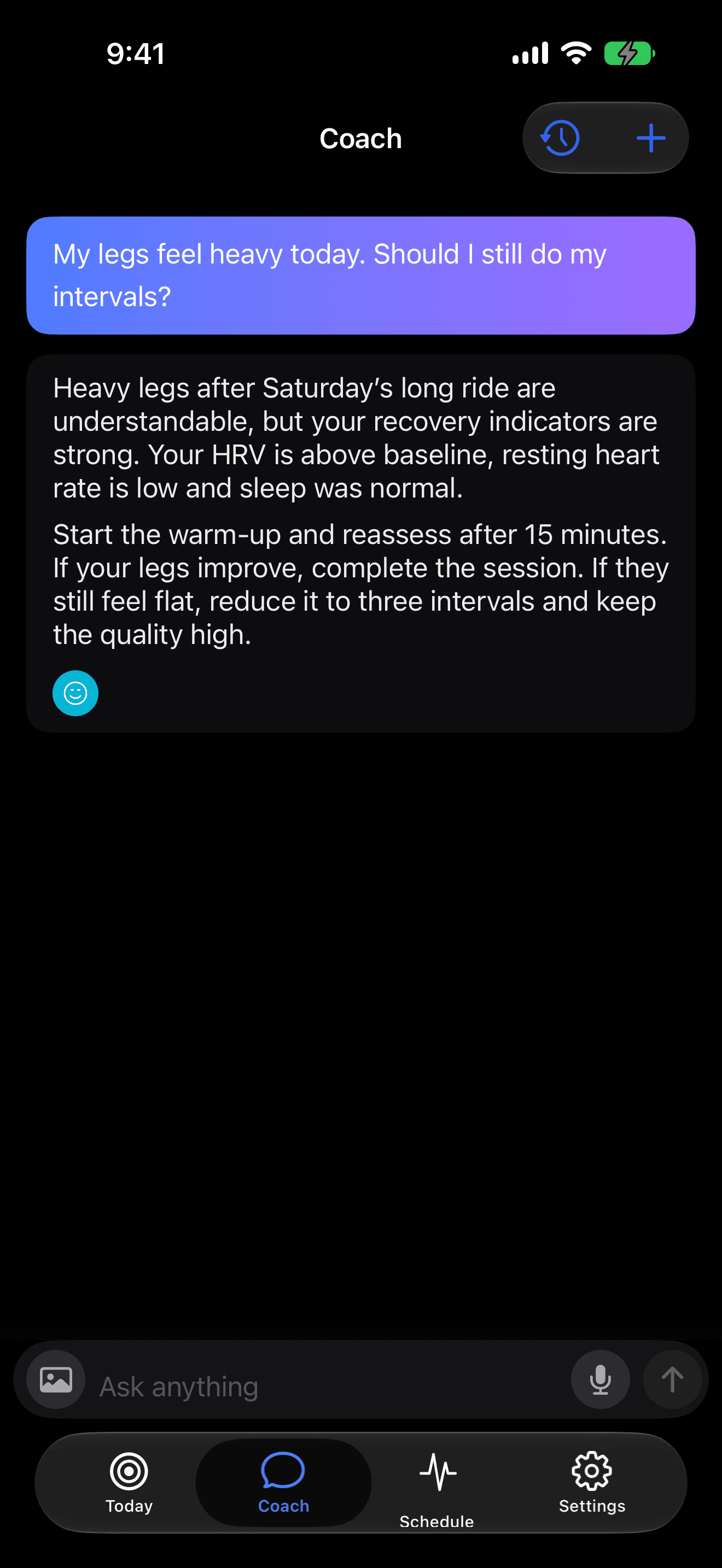
- Conversational Reasoning: You can talk to your coach. When your legs feel heavy or your schedule changes, Primed explains the trade-offs, adjusts workout duration or intensity, and helps you manage fatigue.
- Cross-Wearable Synthesis: Many athletes record rides on Garmin or Wahoo, sleep with Oura or WHOOP, and wear an Apple Watch during the day. Primed normalises these separate data streams into one coaching context.
Interpreting Training Load Numbers: Load Models vs Physiological Fitness
A central reason athletes compare training platforms is to understand training load: How do I interpret my training load numbers?
Both Strava and Primed display workload trends, and in both cases it is important to understand what these numbers actually represent. As we explain in depth in Training load isn't fitness: what your wearable's numbers actually mean, training-load metrics are mathematical models of the work you have completed—not direct physiological measurements of your aerobic fitness.
Strava's Relative Effort and Fitness & Freshness
Strava Subscription includes a Fitness & Freshness chart and assigns a Relative Effort (or power-based Training Load) score to activities:
- Relative Effort: Estimates the cardiovascular demand of a session based on time spent across heart-rate zones (or perceived exertion) relative to your recent history.
- Fitness & Freshness Chart: Applies an impulse-response model over time so you can visualise how your training volume has risen or tapered across a season.
How Primed Uses Canonical Load Models (and Their Limits)
Primed computes the standard Banister impulse-response / Coggan load metrics from your power, pace, and heart-rate streams:
- Chronic Training Load (CTL / often labelled "Fitness"): Typically modelled as a 42-day exponentially weighted moving average of daily Training Stress Score (TSS). Important distinction: CTL reflects your historical training load over the past six weeks, not your actual $\text{VO}_2\text{ max}$, lactate threshold, or race readiness. Two athletes with the same CTL—or the same athlete accumulating junk volume vs. well-spaced polarised training—can have very different real-world performance.
- Acute Training Load (ATL / often labelled "Fatigue"): Typically modelled as a 7-day exponentially weighted moving average of daily TSS, reflecting recent external workload over the past week.
- Training Stress Balance (TSB / often labelled "Form"): Calculated as $\text{TSB} = \text{CTL} - \text{ATL}$. Common coaching heuristics treat TSB ranges as general context rather than rigid physiological thresholds:
- Moderately Positive TSB (e.g. roughly +5 to +20): Often targeted during a taper before an event when acute load has been reduced faster than chronic load.
- Slightly Negative to Neutral TSB (e.g. roughly -10 to +5): Common during steady maintenance or gradual build weeks.
- Substantially Negative TSB (e.g. below -20 to -30): Indicates heavy recent training load relative to your 6-week average; whether you are adapting well or accumulating excessive fatigue depends on sleep, nutrition, life stress, and individual recovery capacity.
- Weekly Ramp Rate: The week-to-week change in load or volume. Primed uses conservative age- and sport-adjusted weekly ramp guardrails as a starting guardrail against abrupt workload spikes.
How Primed Combines Load With Recovery: Because CTL, ATL, and TSB only know what work you did—not how your body responded—Primed never uses training load in isolation. It pairs your load history with overnight biometric trends (HRV, resting heart rate, sleep) and your subjective feel to decide whether today is appropriate for intervals, endurance, or rest.
Where Strava May Be the Better Choice
Strava is the right choice when:
- You want social connection and community: Interacting with friends, giving kudos, joining clubs, and sharing photos from the road or trail.
- You enjoy segment competition: Competing on leaderboards or tracking your personal times up local climbs.
- You need route discovery and mapping: Using global heatmaps to plan running, road, and gravel routes.
- You want a single social activity feed: Keeping all of your outdoor and indoor activities in one shared log.
Where Primed May Be the Better Choice
Primed is the right choice when:
- You want specific daily coaching guidance: Knowing what interval session, endurance ride, or recovery day fits your schedule and readiness today.
- You need adaptive flexibility: Having your plan adjust when you sleep poorly, travel, or have a compressed time window.
- You want conversational coaching: Talking through tired mornings, schedule conflicts, and event preparation in plain English.
- You combine multiple wearables and platforms: Bringing Garmin or Wahoo workout data together with Oura, WHOOP, Withings, Intervals.icu, or Apple Health recovery metrics.
Can Strava and Primed Coexist?
Absolutely. In practice, many endurance athletes use both side by side for different jobs.
Strava serves as the social, route-planning, and community layer, while Primed serves as the private coaching and training-plan layer.
When you record a ride or run on a Garmin device, Wahoo computer, or Apple Watch, your device can upload the activity to Strava for clubs, kudos, and segments while simultaneously syncing to Primed (directly via Garmin Connect, Wahoo, Intervals.icu, or Apple Health) so your coach can evaluate the session and update tomorrow's training plan.
Which Should You Choose?
- Choose Strava if you are looking for social motivation, club connectivity, segment leaderboards, and route discovery.
- Choose Primed if you are looking for an AI endurance coach that synthesises your training load and recovery signals into adaptable daily workouts.
- Use Both if you enjoy Strava's community and route tools alongside Primed's day-to-day coaching and plan adaptation.
Learn more about Primed’s coaching capabilities, explore our training load and recovery features, view our supported integrations, read why training load isn't fitness, or check our training load FAQ.