Apple Watch Series 12: More Data, Better Training?
Apple Watch Series 12 and Ultra 4 bring richer heart-rate, HRV and readiness data. Here’s what the changes mean for endurance athletes.

At Apple’s “Surprise and Shine” event on 9 September 2026, the company introduced a significant leap forward in how its wearables capture and categorise physiological data. While the new foldable iPhone Duo captured much of the mainstream attention, the more interesting announcements for endurance athletes were Apple Watch Series 12, Apple Watch Ultra 4 and the redesigned Health app.
iOS 27 and watchOS 27 arrive in Australia on 15 September, while the overhauled Health app will follow later in 2026, initially launching only in U.S. English. That distinction matters for Australian athletes: much of the new sensing hardware arrives immediately, but some of Apple’s more ambitious interpretation and guidance features will come later.
Historically, consumer wearables have had to balance battery life against data resolution. With this generation, Apple is leaning harder into higher-frequency passive telemetry. But as wearables collect more physiological data, the problem for athletes shifts from gathering information to understanding what it actually means.
Key takeaways
- Apple Watch Series 12 introduces higher accuracy heart-rate and ECG sensing.
- Apple Watch Ultra 4 extends workout battery life up to 45 hours.
- Higher frequency telemetry requires thoughtful context rather than isolated recovery scores.
- Staged software rollouts mean Australian athletes receive hardware improvements first.
What just changed
Apple Watch Series 12 and Ultra 4 are powered by the S11 chip and introduce what Apple calls the Health Sensing System. Apple says this delivers its most accurate heart-rate sensing yet in a wearable, using larger and more power-efficient green LEDs, a redesigned ring arrangement of photodiodes, and increased electrode surface area for better skin contact during ECG measurements.
The most significant change is sampling frequency. Rather than relying primarily on periodic background measurements, the new watches can passively measure heart rate every five seconds throughout the day.
For endurance events, Apple Watch Ultra 4 offers up to 25 hours of full GPS and heart-rate recording in Extended Workout mode. A 45-hour Max Extended Workout mode is also available for outdoor runs, walks and hikes, although it switches on Low Power Mode and disables some alerts, splits and metrics.
Later in 2026, Apple will also roll out a redesigned Health app powered in part by Apple Intelligence. The major changes include:
- Higher-frequency HRV: Heart-rate variability can now be measured up to 24 times more frequently, as often as every five minutes. Apple separates this into Recovery HRV, intended to provide day-to-day context around stress and recovery, and Overall HRV, which provides a broader view of cardiovascular health.
- Readiness: A new score based on recent activity, training load, vitals and sleep score. Unlike a simple once-a-day recovery number, Apple says Readiness can change during the day as new information arrives.
- Personalised recommendations: The Health app’s For You experience will use Apple Intelligence to provide recommendations based on an individual’s health and fitness data. Apple has used the example of suggesting intervals to someone trying to improve cardiorespiratory fitness.
- Movement Evaluations: The iPhone camera can guide assessments of mobility and physical function, combining vision models with physiological information from Apple Watch.
- Health Age and lab integration: A new Longevity tab will estimate a Health Age using long-term biometric trends. In the U.S., users will also be able to purchase a 50-biomarker Quest Diagnostics blood panel through the Health app for US$119.
The reality behind the data
When a manufacturer says it has built its “most accurate” sensor, the useful question is what has actually changed underneath that claim.
More efficient optical sensing and heart-rate measurements every five seconds should give Apple considerably denser longitudinal data. That does not automatically eliminate measurement noise, but it provides more observations from which to identify trends and changes around an athlete’s individual baseline.
The increase in HRV sampling is particularly interesting. HRV can vary considerably depending on sleep stage, stress, training, illness, alcohol and measurement conditions. Taking more observations does not make every individual measurement more meaningful, but it gives the system more information from which to build and monitor a baseline over time.
That context is important because metrics such as Readiness and Recovery HRV are signals, not diagnoses.
A low Readiness score does not automatically mean an athlete is overtraining, nor does it necessarily mean they should take a rest day. The same physiological response can have different implications depending on the athlete’s training block, recent workload, sleep, race calendar and normal response to training.
For Australian users, there are also practical limitations. The new watch hardware is available globally, but the redesigned Health app initially launches only in U.S. English. The Quest Diagnostics integration is also U.S.-only at launch, so international athletes will continue to rely on their existing pathology providers for laboratory testing.
From data collection to coaching
Apple’s move towards personalised recommendations highlights a broader shift in fitness technology: wearables are moving beyond measurement and increasingly trying to answer the question, “What should I do next?”
That is a much harder problem.
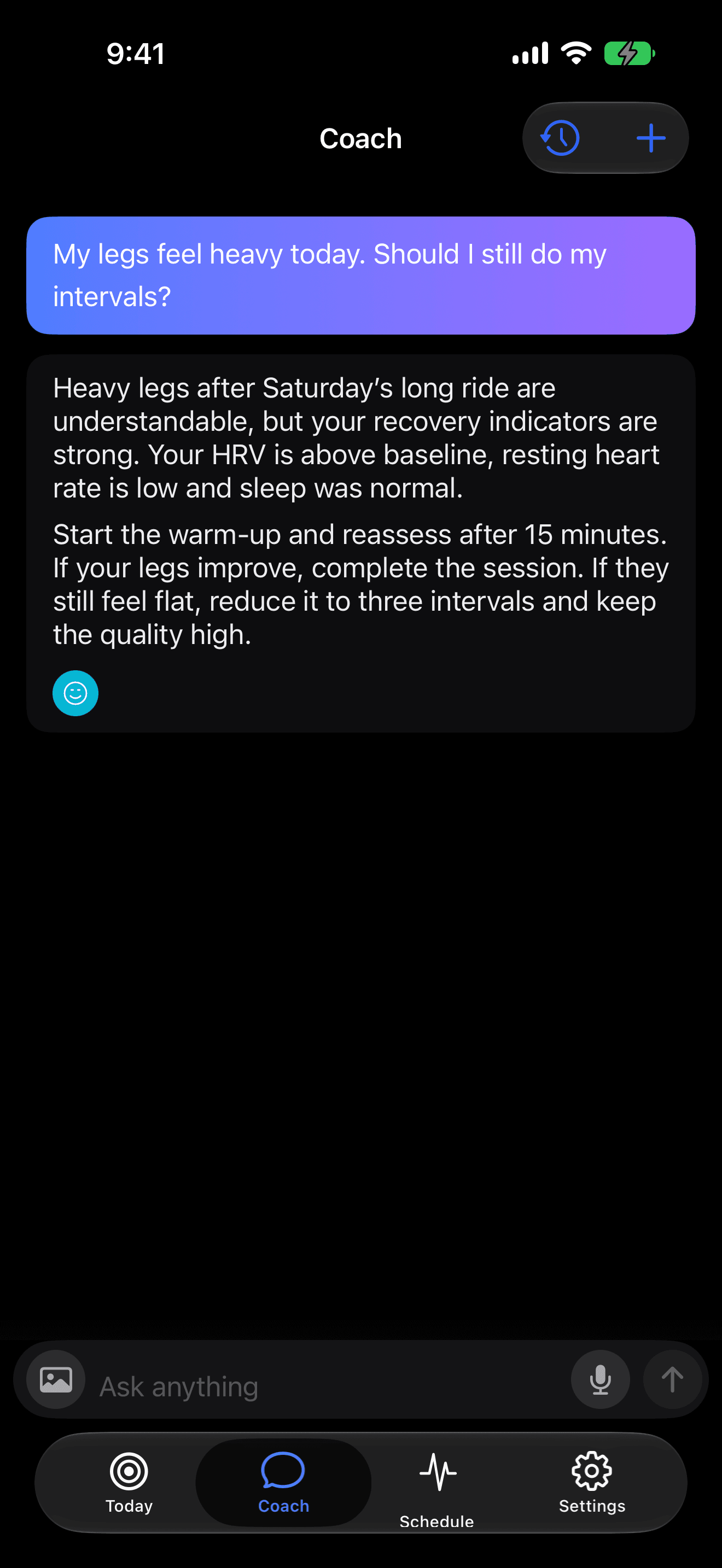
Suggesting intervals to improve cardiorespiratory fitness is physiologically reasonable. But whether an athlete should actually do intervals today depends on much more than the goal itself.
A runner three weeks out from a marathon taper may need a very different session from someone at the beginning of a base phase. An athlete returning from illness, carrying unusual fatigue, or responding poorly to recent training may need something different again.
This is where longitudinal context matters.
For endurance athletes, much of the value in Apple’s update lies in the richer underlying telemetry. Movement Evaluations could provide another useful way to track mobility, physical function and progress during recovery from injury. Recovery HRV adds another daily signal that may help athletes understand short-term changes, while Overall HRV provides a broader view of longer-term trends.
But neither should be interpreted in isolation.
What this means for your training
For athletes already using Apple Watch for running, cycling or general training, Series 12 and Ultra 4 provide a stronger physiological data foundation than previous generations.
The Ultra 4’s 25 hours of full-featured workout tracking will cover the vast majority of single-day endurance events. For longer efforts, the 45-hour Max Extended Workout mode provides additional range for ultra-runners and hikers willing to sacrifice some metrics and functionality.
The more important development, though, is what happens to the data after it is collected.
If Apple exposes newer signals such as higher-frequency heart-rate data, Recovery HRV or Readiness to third-party apps through HealthKit, they could become useful inputs for adaptive coaching platforms such as Primed. But a metric appearing in Apple Health does not automatically mean third-party apps can access it, so those capabilities depend on what Apple ultimately exposes through its developer APIs.
Primed is designed to interpret multiple signals in the context of an athlete’s training history rather than treating any single daily score as the answer.
Where higher-frequency physiological data is available, it can provide additional context for identifying changes from an athlete’s normal baseline and understanding how those changes relate to training load, recovery and performance over time.
That is the more interesting opportunity created by Apple’s new hardware.
The next generation of endurance technology will not be defined simply by who collects the most data. It will be defined by who can work out which changes actually matter for a particular athlete, at a particular point in their training.