Beyond FTP: What Modelled Power Reveals About Your Cycling
Two cyclists can have the same FTP but perform very differently in a race. A power-duration model helps explain why, and how understanding your strengths, weaknesses and ability to resist fatigue can lead to better training decisions.
If you've been cycling with a power meter for a while, you probably know your FTP. You might also know your best five-minute power, your sprint power and perhaps how many watts per kilogram you can sustain on a climb.
These are useful numbers. But they don't tell the whole story.
Two cyclists with an FTP of 260 watts might look almost identical on paper. Put them into a Zwift race, though, and one might comfortably follow repeated attacks while the other gets dropped after the third acceleration. Put them into a long sportive, and the result might be reversed.
The difference isn't necessarily fitness. It's the type of fitness each cyclist has developed, and how that fitness holds up as they become tired.
This is where modelled power becomes interesting.
Rather than judging performance from a handful of numbers, we can use the power data collected during training and racing to build a more complete picture of what an athlete is capable of.
And once we understand that picture, we can start making better decisions about what they should train.
Key takeaways
- FTP alone doesn't describe sprint power, repeated hard efforts or endurance durability.
- A power-duration curve describes how much power you produce across different durations.
- Critical Power (CP), W′ and Pmax help explain different aspects of performance.
- Fresh best power may differ substantially from power after hours of riding.
- Primed combines power models with training history, fatigue, recovery and session outcomes.
What is a power-duration curve?
Imagine taking every ride you've recorded over the past few months and finding your best average power for different durations.
Your best five seconds. Fifteen seconds. One minute. Five minutes. Twenty minutes. An hour.
Plot those results on a graph, with time along the horizontal axis and watts on the vertical axis, and you get a power-duration curve.
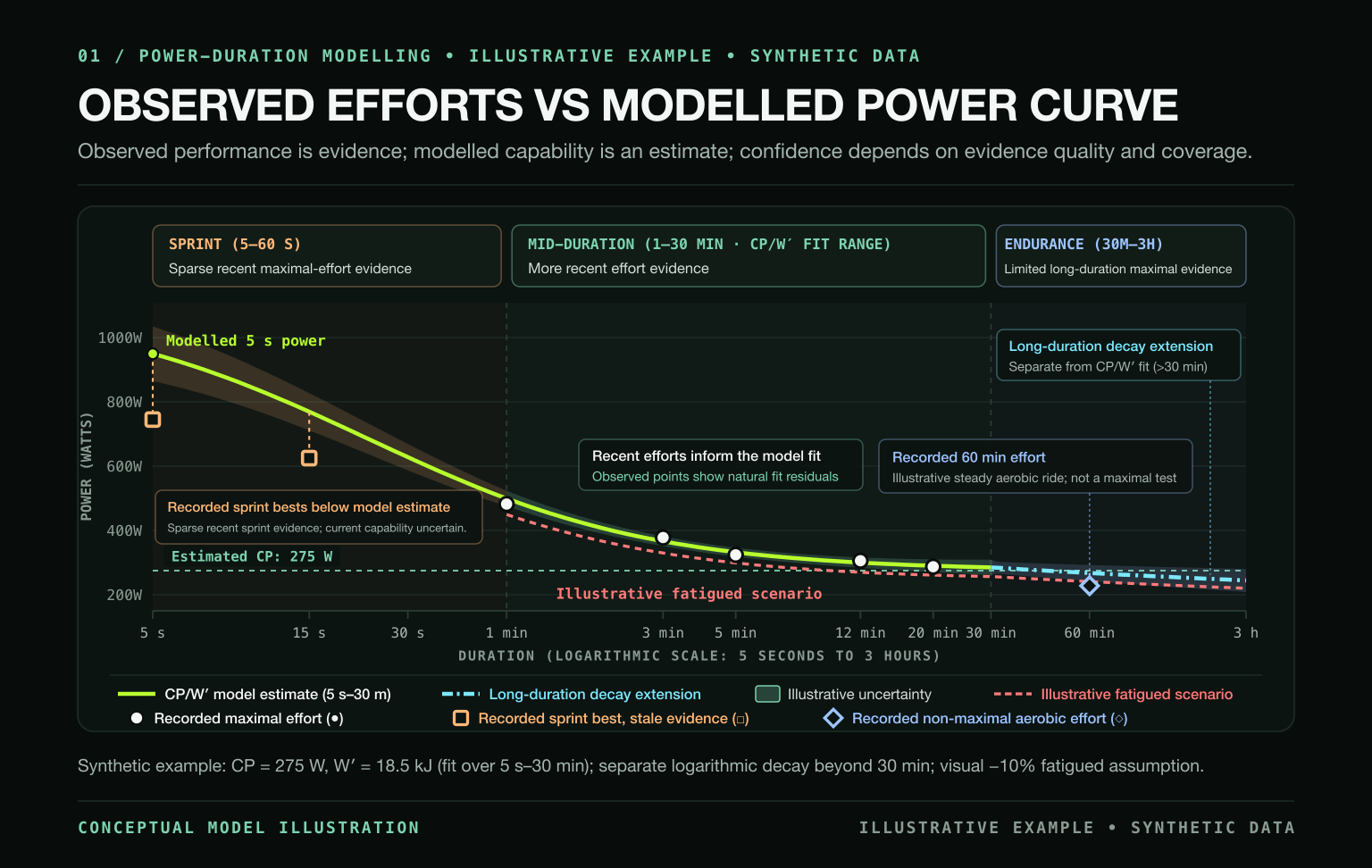
The curve starts high, reflecting the enormous power you can produce during a short sprint. It then drops sharply as the duration increases, before gradually flattening towards the longer efforts that depend primarily on your aerobic system.
The important distinction is that these are your best observed efforts, not necessarily your maximum physiological capabilities.
If you haven't sprinted in three months, your five-second number probably underestimates what you could do. If all your recent riding has been steady Zone 2, your twenty-minute best might be well below your actual ability.
This is the problem modelling attempts to solve.
By fitting a mathematical model to the available power data, we can estimate the relationship between power and duration, rather than relying on a few individual performances.
It isn't a new concept. Coaches and sports scientists have been studying the relationship between power and exercise duration for decades. TrainingPeaks has a useful explanation of its modelled power approach, including why looking beyond FTP provides a more useful understanding of an athlete.
The interesting part is what we can do with the model.
Three things FTP doesn't tell you
FTP remains a useful training benchmark. It provides a practical reference for setting intensity zones and tracking aspects of aerobic fitness.
But it reduces a complicated physiological system to one number.
There are three other characteristics worth understanding.
1. Critical Power: Your aerobic boundary
Critical Power, or CP, is a modelled boundary associated with the transition into the severe exercise intensity domain.
Below CP, the body can maintain a more stable physiological response under appropriate conditions. Above it, fatigue-related disturbances progressively accumulate, limiting how long an effort can continue.
CP and FTP describe related aspects of endurance performance, but they aren't the same measurement.
FTP is a practical functional threshold estimate. CP is derived from a mathematical model of the power-duration relationship.
For many athletes the numbers may be relatively close, but they shouldn't automatically be treated as interchangeable.
Nor does CP represent a power you can sustain indefinitely. Even at CP, real athletes eventually become exhausted. The mathematical model simplifies what is happening in the body.
2. W′: Your capacity for hard efforts above CP
W′, pronounced W prime, represents a modelled amount of work that can be performed above Critical Power.
It's measured in joules, usually expressed as kilojoules.
Think about a race where the pace suddenly increases. You might need to produce substantially more power than your CP to follow an attack, get over a short climb or stay with a group.
Those efforts draw on your finite capacity to perform work above CP.
W′ helps describe that capacity.
A cyclist with a relatively high W′ may be better equipped for short, demanding efforts. Another cyclist with a similar CP but lower W′ may be more suited to sustained, steady riding.
W′ isn't literally a battery, and it isn't a direct measurement of the body's total anaerobic energy stores. It's a parameter that helps describe performance. How much capacity remains during repeated efforts also depends on the recovery between those efforts.
For someone racing on Zwift, this is particularly relevant. Surviving repeated accelerations can matter just as much as maintaining a high average power.
3. Pmax: Your short-duration power ceiling
Pmax is an estimate of an athlete's maximum instantaneous power, derived from the model.
It helps describe the short-duration end of the power curve, where neuromuscular ability becomes especially important.
In Primed, this is calculated using a three-parameter model associated with sports scientist Hugh Morton.
The additional parameter allows the model to represent short-duration power more realistically than the simpler two-parameter Critical Power model.
It is still an estimate, not a substitute for measuring an actual maximal sprint.
Together, CP, W′ and Pmax provide a more complete picture of an athlete than FTP alone.
Different models and platforms use different terminology and methods. For example, TrainingPeaks discusses modelled FTP (mFTP) and Functional Reserve Capacity (FRC), which are related to, but not identical to, Primed's CP and W′ parameters.
The underlying principle is the same: understanding how an athlete produces power across different durations is more informative than relying on a single threshold number.
What happens after you've been riding for three hours?
There is another part of the power-duration story that I think deserves much more attention: durability.
Imagine two cyclists who can both produce 300 watts for twenty minutes when fresh.
After three hours of riding, one can still produce close to that number. The other struggles to hold 250 watts.
A traditional power profile built around fresh maximal efforts might make these athletes look quite similar.
But their ability to perform after accumulating fatigue is very different.
This is what researchers call durability, or fatigue resistance.
A 2025 study of amateur cyclists found that five-minute and twenty-minute power declined by approximately 10% after a standardised bout of prior work. Importantly, the researchers did not find a significant relationship between durability and the riders' relative FTP or VO₂max.
In other words, having a high FTP doesn't necessarily mean you're good at maintaining that performance when tired.
That matters for long road races, gravel events, gran fondos and even the final part of a hard group ride.
It's also useful for training.
If you're preparing for a five-hour event, improving fresh twenty-minute power might be worthwhile. But improving your ability to maintain power after four hours could be more important.
How Primed looks at durability
Primed's Digital Twin maintains two related but different views.
The first is how power declines across longer durations. Its model includes a long-duration decay parameter, helping describe the shape of the curve beyond the shorter, high-intensity efforts.
The second looks at performance after accumulated work.
Primed records power retention after substantial riding, including efforts performed after at least 20 kilojoules of work per kilogram of body mass. This allows the system to assess how much performance has been retained under fatigue.
That 20 kJ/kg point is an analysis reference, not a universal threshold at which every cyclist suddenly becomes fatigued.
The amount and intensity of the work both matter. A recent systematic review of cycling durability found that high-intensity work could produce larger performance reductions than lower-intensity work, even with less total accumulated work.
This means the total number of kilojoules is only part of the explanation.
For coaching, the distinction matters. A rider who fades after repeated attacks may have a different limitation from one whose power gradually declines during a long, steady ride.
What kind of cyclist are you?
Power modelling also helps identify an athlete's relative strengths.
Some cyclists are naturally better at short accelerations. Others are good at sustaining power for long periods. Some are reasonably capable across everything, without being exceptional in one area.
Traditionally, we might call them sprinters, puncheurs, time triallists, climbers or all-rounders.
In Primed, we use a more detailed approach.
The Digital Twin maintains a continuous physiological profile describing characteristics such as sprint bias, anaerobic capacity, VO₂max-related performance, threshold sustainability, durability and pacing stability.
These are represented as scores, allowing the coach to see relative strengths without forcing every athlete into a rigid category.
Primed can also suggest a provisional rider archetype, such as a sprinter, puncheur, sustained-power rider, climber or all-rounder.
The word provisional is important.
You aren't permanently a particular type of cyclist because a model says so. Your abilities change with training, and the model changes as new evidence becomes available.
There is also a difference between being good at producing absolute power and being good at producing power relative to body mass.
A heavier rider might produce considerably more watts on flat terrain, while a lighter rider with better watts per kilogram performs better on a sustained climb.
Primed records the body-mass measurement and its source when calculating W/kg, so the model isn't silently comparing power using an outdated weight.
The goal isn't to give every cyclist a label.
It's to understand which abilities are currently stronger, which are weaker, and which matter most for the events they're training towards.
Turning the model into useful coaching
This is where things get more interesting for Primed.
A power-duration curve is already a valuable analysis tool. You can inspect it, identify weaknesses and compare performances over time.
But the curve doesn't know why you've been training, how well you've recovered or whether you struggled through your last interval session.
Primed's Digital Twin provides that additional context.
Alongside the power model, it maintains information about training load, recent session execution, fatigue, recovery, longer-term adaptation and the athlete's goals.
Consider three situations.
A rider who keeps failing short, hard intervals
An athlete has a reasonable CP and can complete threshold sessions, but repeatedly struggles with three-minute efforts.
Their power-duration model suggests that performance in the three-to-five-minute region is relatively weak. Recent interval evaluations also show excessive power fade.
That gives the coach something useful to investigate.
Perhaps the athlete needs more development around maximum aerobic power. Perhaps the targets are too aggressive. Or perhaps fatigue is interfering with otherwise achievable sessions.
The model provides evidence, but it doesn't make the decision by itself.
A rider training for a long gran fondo
Another athlete has been improving their twenty-minute power, but their performance falls substantially after several hours of riding.
For their event, that might matter more than another small FTP improvement.
The coach can consider whether their training needs more long-duration work, whether their recent volume supports that progression, and how consistently they're recovering from longer sessions.
The aim is to improve the performance required for the event, not simply make one number bigger.
A rider preparing for Zwift racing
A third cyclist has good sustained power but struggles when the group repeatedly surges above threshold.
The power model might suggest relatively limited capacity for repeated high-intensity efforts.
Combined with race history and interval results, that could point towards a different training emphasis.
It might also change the advice the coach gives about racing: avoiding unnecessary accelerations, being more selective about attacks or managing position to reduce the energy spent responding to changes in pace.
Of course, a power model alone can't account for drafting, positioning, tactics or the decisions other riders make.
But it can help explain the physiological cost of those decisions.
The importance of knowing when the model is wrong
There is a problem with modelling that can be easy to overlook.
A model can produce a very precise-looking number from incomplete information.
Suppose you haven't done a maximal sprint in months. Or your longest recent hard effort is eight minutes. Or most of your cycling has been on a trainer at controlled intensities.
The model can still attempt to estimate your full power-duration relationship.
But some parts of that estimate will be much less reliable than others.
This is why Primed doesn't simply store the calculated parameters.
It also records the actual observed power efforts, including when and where they occurred. For the model itself, it retains fit-quality measures and separate confidence assessments across sprint, anaerobic, VO₂max, threshold and endurance durations.
That distinction is important.
A cyclist might have excellent data around twenty-minute power but very little evidence about their sprinting ability. The coach shouldn't treat both estimates as equally trustworthy.
Primed also records whether information is measured, estimated or missing, together with the freshness of connected data sources.
When there isn't enough evidence, the appropriate answer may be that we don't know yet.
A future maximal effort, a race or a well-executed interval session might provide the missing information.
An AI coach should be able to acknowledge that uncertainty rather than pretending it has a complete understanding of the athlete.
A model that learns from your training
One of the useful things about power modelling is that it doesn't have to depend entirely on formal tests.
A hard climb, a race or an unusually strong interval session may provide new evidence about what you're capable of.
Primed retains observed maximal mean power efforts across durations from five seconds to sixty minutes, with the activity and date associated with each result.
It also evaluates completed interval sessions.
Did you complete the prescribed work? Did you have more capacity than expected? Did your power fade? Did you stop early?
Those outcomes help put the physiological model into context.
An improved five-minute power result is useful. So is discovering that you can now repeat five-minute intervals more consistently, with less deterioration across the set.
They tell us different things.
Over longer periods, Primed can compare recent physiological changes with previous training blocks and assess whether an improvement appears meaningful, whether progress is slowing, or whether the athlete may be approaching a plateau.
And the performance model is only one part of the Digital Twin.
If the model indicates that an athlete is capable of a hard session, but their recent training load, recovery patterns or an active injury indicate otherwise, that additional context matters.
What you're capable of doing isn't necessarily what you should do today.
The same modelling approach extends beyond cycling. Primed also maintains Critical Speed and distance-capacity estimates for running, and Critical Swim Speed for swimming, using models appropriate to those disciplines.
The idea is to build an understanding of the athlete that develops with the evidence, rather than treating each sport, workout and recovery measurement as an isolated piece of information.
Do we still need FTP tests?
For some athletes, regular maximal testing remains useful, particularly when establishing a baseline or checking whether model estimates agree with real performance.
But the more representative the data becomes, the less dependent we need to be on a single test.
A well-populated power-duration curve can help reveal changes that a twenty-minute FTP test might miss.
It can also reveal when more testing would be useful.
If your curve has plenty of evidence at short durations but almost nothing beyond fifteen minutes, a properly paced longer effort could improve confidence in the endurance portion of the model.
That doesn't mean every training session should become a test.
It means we can make better use of the data we're already collecting and be more deliberate about gathering the evidence we're missing.
Beyond the numbers
Modelled power isn't new, and Primed didn't invent it. The mathematical foundations are well established, and tools such as TrainingPeaks and WKO have made power-duration modelling increasingly accessible to coaches and cyclists.
What interests me is what happens when we combine these models with everything else we know about an athlete.
A power curve can tell us something about what you can do. Your completed sessions tell us how consistently you can do it. Your durability profile tells us what happens when fatigue accumulates. Your recovery and training history provide context for how you might respond to the next session.
A coach needs to consider all of those things together.
That's the direction we're taking with Primed: using established sports science models as part of a continually evolving understanding of the athlete, then making that information available to an AI coach that can explain its reasoning and help make training decisions.
The objective isn't to replace FTP with three or four new numbers to worry about.
It's to get beyond the numbers and understand what they mean for your training.
And ultimately, to help answer a much more useful question: what should I work on next, and why?
References and further reading
- TrainingPeaks – The Power Duration Curve: A Deep Dive Into Modeled Power. An overview of power-duration modelling, mFTP, FRC and Pmax.
- Power Profiling and the Power-Duration Relationship in Cycling: A Narrative Review. A scientific review of cycling power models, their applications and limitations.
- Durability as an Independent Parameter of Endurance Performance in Cycling. Research examining the relationship between fatigue resistance and conventional performance measures.
- Is Intensity the Most Important Factor in Determining the Amount of Prior Work Accumulated That Affects Cyclists' Acute Durability?. A systematic review of how prior exercise intensity affects power retention.
- Primed – From 12 Weeks of Data to Today's Workout. How training history and recovery information can contribute to daily coaching decisions.
Primed is an AI endurance coach that brings together training, recovery and athlete context. Explore Primed.