Can an AI Coach Train a Masters Cyclist? A Documented Case Study
Training past 45 requires a different physiological rulebook. Here is how Primed’s age-adapted constraints and recovery algorithms guided a 52-year-old cyclist to a 22W FTP increase and a PR Gran Fondo.
Most generic training plans are written for 24-year-old athletes with infinite recovery capacity.
They prescribe Tuesday VO2 max intervals, Wednesday sweet spot, Thursday tempo, and a four-hour hammerfest on Saturday. If you are in your twenties, your body can often absorb that barrage through sheer hormonal and metabolic resilience.
If you are 45, 52, or 60, following that plan is a fast track to tendonitis, chronic autonomic suppression, and burnout.
When designing Primed’s training engine, ensuring it understood the unique physiology of the masters endurance athlete was a personal and technical priority. Here is how the system adapts for masters athletes, illustrated through a 6-month case study.
Key takeaways
- Masters athletes (45+) have distinct recovery and physiological adaptation curves.
- Mandatory 48-hour gaps between high-intensity sessions prevent chronic fatigue.
- Load ramp rates capped at 5-7% preserve connective tissue and joint health.
- Case study: A 52-year-old cyclist achieved a 22W FTP gain without injury.
The Physiology of the Masters Athlete (45+)
Aging does not mean you cannot get faster. Masters athletes win world championships and set astonishing records every year. However, the biological rules change in three critical ways:
- Slower Muscle Protein Synthesis & Glycogen Resynthesis: It takes 48 to 72 hours for a 50+ athlete to fully repair muscular micro-damage and restock muscle glycogen following a hard eccentric or glycolytic session, compared to 24–36 hours for a younger athlete.
- Decline in VO2 Max (Mitigated by Polarized Training): Peak cardiac output declines naturally with age. To maintain aerobic capacity, masters athletes require regular, high-quality high-intensity stimulus (Zone 5), but in shorter, highly focused doses with complete recovery between sets.
- Connective Tissue Vulnerability: Tendons and ligaments lose elasticity and blood flow with age. Sharp ramp rates in volume or intensity frequently lead to overuse injuries like Achilles tendonitis or patellar tracking issues.
How Primed Adapts: The Masters Engine Constraints
In Primed, entering an age of 45+ triggers deterministic constraints inside AdaptationEngine:
┌────────────────────────────────────────────────────────────────────────┐
│                   MASTERS TRAINING CONSTRAINT ENGINE                   │
├────────────────────────────────────────────────────────────────────────┤
│ 1. Mandatory 48h Intensity Gap │ No back-to-back Zone 4/5 days. Every  │
│                                │ hard session is buffered by Z1/Z2.    │
├────────────────────────────────┼────────────────────────────────────────┤
│ 2. Conservative Volume Ramp    │ Weekly volume ramp capped at 5–7% max │
│                                │ (vs 10–12% for younger athletes).     │
├────────────────────────────────┼────────────────────────────────────────┤
│ 3. 3:1 or 2:1 Periodization    │ 2 or 3 weeks of progressive loading   │
│                                │ followed by a mandatory recovery week.│
├────────────────────────────────┼────────────────────────────────────────┤
│ 4. Sleep & HRV Weighting       │ Higher sensitivity to nocturnal HRV   │
│                                │ drops and sleep fragmentation.        │
└────────────────────────────────┴────────────────────────────────────────┘
The Case Study: "Mark" (Age 52)
- Athlete: Mark, 52, management consultant and lifelong recreational cyclist.
- Starting FTP: 245 Watts (3.14 W/kg at 78 kg).
- Target Event: 160km Amy's Gran Fondo (climbing-heavy).
- Historical Problem: Every time Mark tried to increase his training from 6 to 9 hours a week, he would develop knee pain or catch a cold by Week 4, resetting his progress.
Phase 1: Base & Polarized Distribution (Weeks 1–8)
Instead of the sweet-spot-heavy approach Mark had tried in previous years, Primed prescribed a strict 80/20 polarized model:
- 80% Low Intensity: Dedicated Zone 2 endurance rides kept strictly below 72% of max heart rate to build mitochondrial density and capillary beds without autonomic stress.
- 20% High Quality: One weekly session of short 30/30 or 40/20 VO2 max micro-intervals to stimulate cardiac output without generating overwhelming systemic lactate load.
- Strength Gaps: A mandatory 48-hour gap between heavy resistance work and cycling intervals.
Result at Week 8: Mark's aerobic decoupling during 3-hour endurance rides dropped from 8.2% to 2.8%, indicating massive cardiovascular efficiency gains. Zero joint pain or immune setbacks.
Phase 2: Build & Threshold Extension (Weeks 9–18)
As the event approached, Primed transitioned to threshold durability workouts (e.g., 3x12 min @ 95–98% FTP).
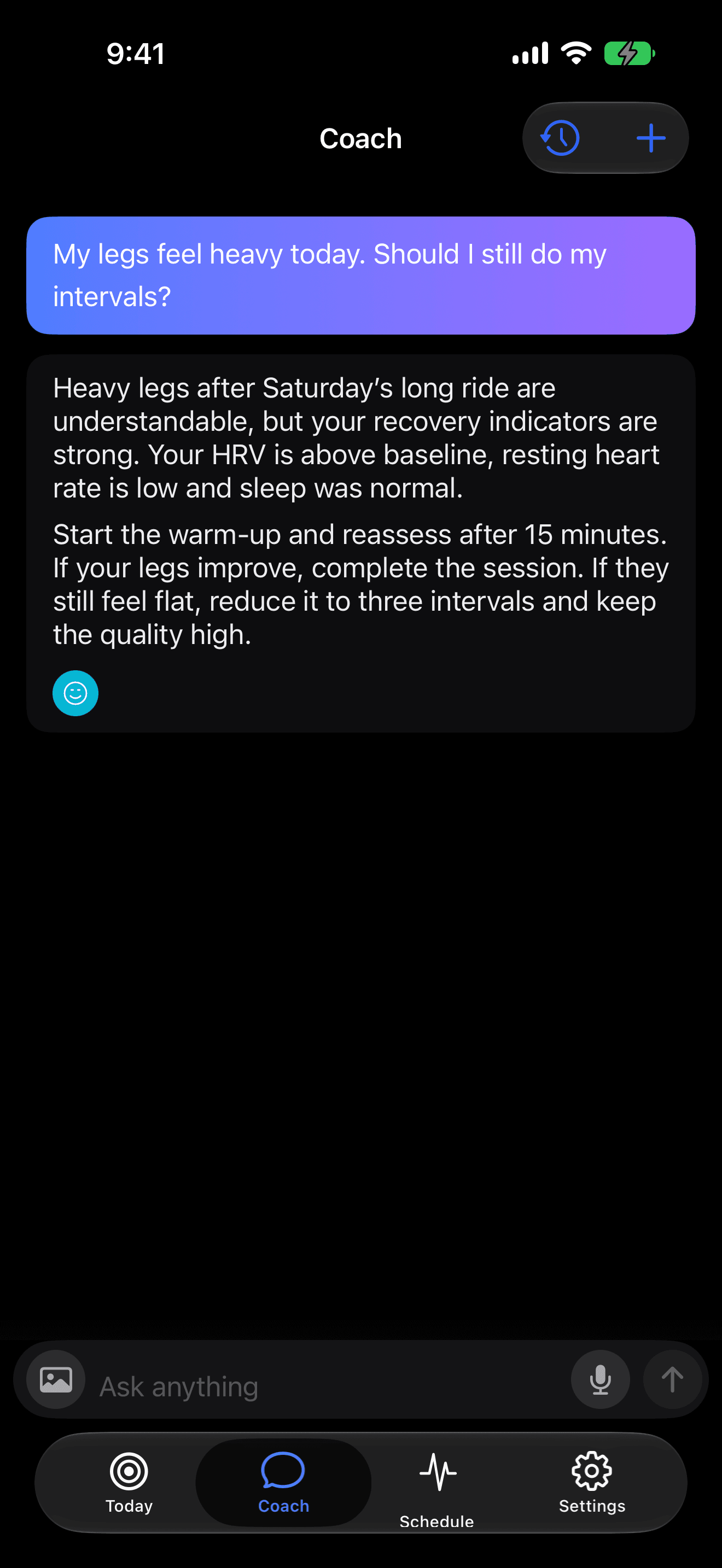
Whenever Mark’s Oura Ring registered suppressed HRV or elevated resting HR on an interval day, Primed automatically shifted the workout 24 hours back, ensuring Mark never performed high-intensity intervals in a compromised state.
Result at Week 18: Mark re-tested his 20-minute power and achieved an FTP of 267 Watts (3.46 W/kg)—a 22-Watt increase at age 52.
Phase 3: The 160km Event (Week 24)
On event day, Mark paced the Gran Fondo with precision, setting personal bests on every major climb and finishing 34 minutes faster than his previous attempt two years earlier.
The Takeaway
Masters athletes do not need to train less; they need to train smarter.
The secret to masters endurance performance is not suffering more—it is avoiding the wasted fatigue and chronic inflammation that derail consistency.
When an AI coach respects your recovery timeline, age is no longer a barrier to your best performance.