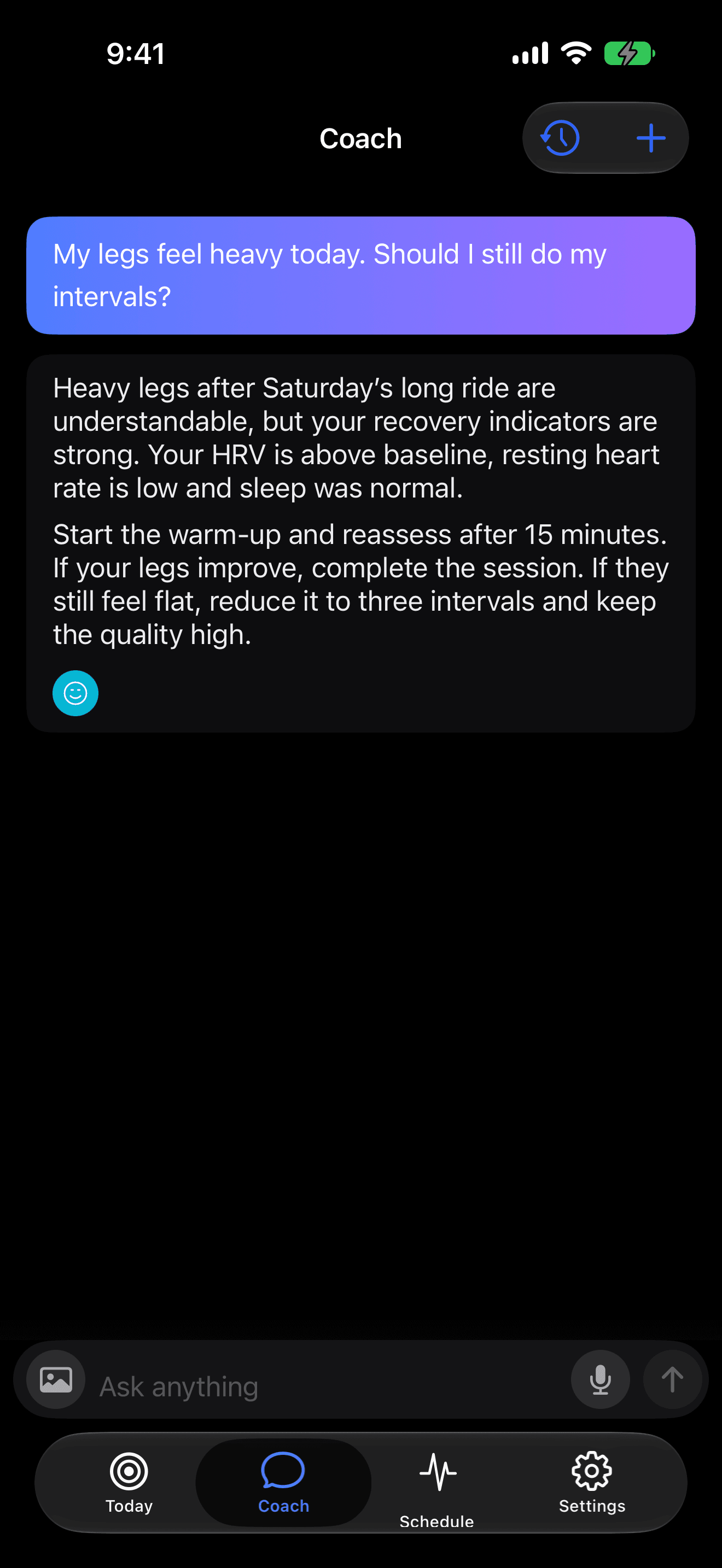
My HRV Is High but My Legs Feel Heavy: Should I Train?
You wake up to a pristine green recovery score and elevated HRV, but stepping out of bed feels like walking through wet cement. Here is the autonomic physiology behind conflicting signals and how to make the right call.

Almost every endurance athlete has experienced this morning dilemma:
You check your wearable. Your Heart Rate Variability (HRV) is 15% above your baseline, your resting heart rate is at a 30-day low, and your device crowns your morning with a bright green readiness score. On paper, you are ready to set a personal record.
Then you walk down the stairs. Your quads ache, your calves feel wooden, and the thought of clipping into your pedals for 4x8-minute threshold intervals sounds miserable.
Why does this contradiction happen, and more importantly, should you still do the planned interval session?
Key takeaways
- High HRV does not always mean you are ready for intensity.
- Parasympathetic hyperactivity can artificially elevate HRV after deep systemic exhaustion.
- Autonomic recovery often outpaces local muscular and glycogen replenishment.
- Use an exploratory 15-minute warm-up check rather than forcing intervals.
Understanding the autonomic nervous system
To understand why your wearable and your legs disagree, it helps to look at what Heart Rate Variability actually measures.
HRV is a proxy for the balance between the two branches of your autonomic nervous system (ANS):
- The Sympathetic Branch (“Fight or Flight”): Mobilizes energy, elevates heart rate, suppresses variability, and drives physical performance under stress.
- The Parasympathetic Branch (“Rest and Digest”): Slows heart rate, enhances beat-to-beat variability, and directs resources toward cellular repair and tissue recovery.
When you are well-rested and recovered, your parasympathetic tone is dominant, resulting in higher HRV. But when your body is pushed to the edge of severe fatigue, the autonomic system can behave in non-linear ways.
Trap 1: Parasympathetic hyperactivity / saturation
The most common reason for an abnormally high HRV paired with dead legs is a phenomenon known in sports science as parasympathetic hyperactivity or parasympathetic saturation.
When you undergo an exceptionally deep training block, severe caloric restriction, or prolonged high-volume stress, the autonomic nervous system can overcompensate. The body desperately attempts to force you into recovery mode by clamping down on heart rate and maximally activating the vagus nerve.
The result is a deceptively high HRV score. Your wearable looks at the mathematical variability and assumes you are in pristine shape. In reality, your cardiovascular system is in a state of exhaustion, unable to mobilize a normal sympathetic response.
If you attempt a VO2 max or threshold session in this state, you will usually notice an inability to elevate your heart rate to target zones, accompanied by high perceived exertion and flat power output.
Trap 2: Autonomic recovery vs. peripheral muscular fatigue
The second reason for the mismatch is simpler: the autonomic nervous system recovers faster than skeletal muscle tissue.
Your heart rate variability might normalize within 24 to 36 hours after a grueling weekend block. However:
- Glycogen stores in your working muscles may still be partially depleted.
- Micro-trauma and eccentric muscle damage (contractile protein disruption) take 48 to 72 hours to repair.
- Delayed Onset Muscle Soreness (DOMS) and localized inflammation do not always suppress systemic nocturnal HRV.
Your central autonomic engine is ready to go, but the peripheral chassis (your legs) is still under active reconstruction.
The Primed Decision Framework: How to handle today's session
When this mismatch occurs, forcing the planned high-intensity workout is usually a mistake. But staying on the couch completely is often unnecessary.
Here is the decision protocol Primed uses to evaluate conflicting signals:
                  High HRV + Heavy Legs
                            │
               ┌────────────┴────────────┐
               ▼                         ▼
      Acute Muscle Tightness    Parasympathetic Saturation
      (Recent heavy session)   (Deep multi-week load / low RHR)
               │                         │
               ▼                         ▼
       15-min Warm-Up Check      Swap for Z1/Z2 Recovery
       "Exploratory Protocol"     (Block high intensity)
               │
      ┌────────┴────────┐
      ▼                 ▼
  Legs open up?     Legs flat / sluggish?
  (Do 3/4 intervals) (Spin easy, shut it down)
1. The 15-Minute Exploratory Warm-Up Check
Do not make the final decision standing in your kitchen. Put on your kit, get on the bike or start an easy jog, and commit to exactly 15 minutes at a strictly easy, conversational pace (Zone 1/2).
- Scenario A (Legs open up): If blood flow clears the initial stiffness, your cadence becomes fluid, and your heart rate responds normally, proceed into the main set. Consider stopping after 3 intervals instead of 4 to preserve quality without digging a hole.
- Scenario B (Legs remain heavy): If 15 minutes of spinning still feels sluggish, cadence feels forced, or your heart rate refuses to rise naturally into Zone 2, your body is signaling peripheral exhaustion. Shut the workout down immediately.
2. Modify, Do Not Force
If your legs fail the warm-up check, convert the remainder of the session into an easy 45-minute Zone 1 active recovery spin.
You still get the benefits of blood flow, metabolic clearance, and cardiovascular consistency without imposing the deep neuromuscular and autonomic strain that compromises the rest of your training week.
Summary
Heart rate variability is a powerful metric, but it is not infallible. An elevated HRV is an invitation to evaluate your training state, not a mandate to blindly suffer through a bad workout.
When your wearable says yes and your muscles say no, respect the peripheral feedback. Use the 15-minute warm-up check, protect session quality, and let the system adapt.