How an Adaptive Training Plan Changes After Poor Sleep, Illness or Missed Sessions
When real life disrupts your schedule, static plans force bad decisions. Here is how Primed’s adaptation engine surgically adjusts training when you experience poor sleep, impending illness, or a missed workout.

Anyone can follow a training plan when life is perfect: when you get eight hours of unbroken sleep every night, work never runs late, children never get sick, and travel never interrupts your routine.
In the real world, that perfect scenario rarely lasts more than a few days at a time.
When disruptions hit, static training plans force athletes into two equally flawed choices: either stubbornly grind through the scheduled workout despite systemic exhaustion, or abandon the plan entirely out of frustration.
In Primed, we built a dedicated daily adaptation engine (DailyAdaptationService) that treats life disruptions not as plan failures, but as expected inputs. Here is how the system handles three of the most common training disruptions.
Key takeaways
- Static training plans break when life inevitably disrupts the schedule.
- Poor sleep requires surgical intensity or duration adjustments, not plan abandonment.
- Illness triggers hard safety locks preventing high-intensity cardiac strain.
- Missed sessions must not be crammed into subsequent days to avoid injury.
Scenario 1: The Bad Night of Sleep (Acute Red Recovery)
You were scheduled for a demanding 4x8-minute Threshold session. However, your flight was delayed, you slept four fragmented hours in a hotel room, and your morning HRV is down 22% with an elevated resting heart rate.
How a static plan reacts:
It doesn't. The threshold workout sits on your calendar unchanged. If you execute it, your compromised autonomic state makes hitting threshold wattage nearly impossible, leading to excessive neuromuscular strain, poor adaptation, and lingering fatigue that ruins the rest of the week.
How Primed adapts:
Primed evaluates the severity of the deficit and executes a surgical modification:
- Intensity Downgrade: It converts the session from Zone 4 (Threshold) to Zone 2 (Steady Aerobic).
- Duration Truncation: It reduces the volume by 25–35% (e.g. 75 minutes down to 50 minutes).
- Preserving Microcycle Flow: By shifting the high-intensity stimulus forward by 24 to 48 hours, you preserve the intended training stimulus for when your body can actually absorb it.
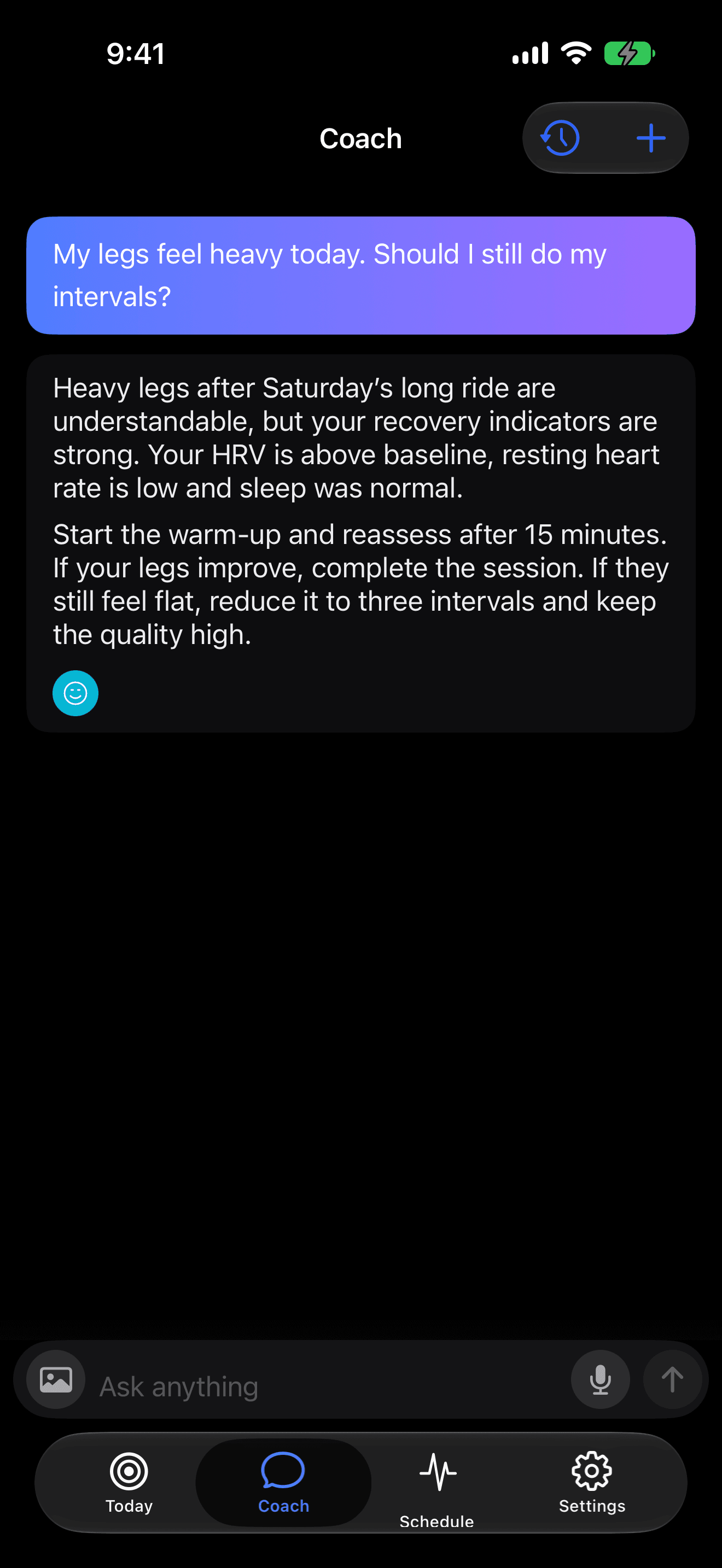
The Coach Message: "Your sleep duration was heavily compromised and HRV is 22% below baseline. Forcing threshold intervals today will dig a deep fatigue hole. We’ve swapped today’s ride to an easy 45-minute Zone 2 spin to maintain aerobic consistency and moved intervals to Thursday."
Scenario 2: Impending Illness (Temperature Spike & Elevated RHR)
You wake up feeling slightly off. You don't have a full-blown fever yet, but your wearable registers a nocturnal skin temperature elevation of +0.7°C, respiratory rate is up by 1.5 breaths/min, and resting HR is 6 bpm above baseline.
How a static plan reacts:
It leaves you to guess. Many athletes think, "I'll just sweat it out with some intervals," which can turn a mild 24-hour immune response into a multi-week respiratory infection or myocarditis risk.
How Primed adapts:
Primed has strict deterministic safety guardrails for illness markers:
- Hard Intensity Lockout: All intensity above Zone 1 is immediately blocked.
- Rest Enforcement: If temperature elevation exceeds threshold values, today’s activity is automatically swapped for active rest.
- Return-to-Play Ramp: When illness markers subside, the system does not jump straight back into peak volume; it enforces a gradual 48-hour ramp to verify cardiac stability before reintroducing threshold or VO2 max work.
Scenario 3: The Missed Session (The "Make-Up" Trap)
Thursday was supposed to be a 90-minute tempo ride, but a late client emergency meant you could not train at all.
The common athlete mistake:
Athletes try to "make up" the missed workout by doing Thursday's tempo ride and Friday's planned threshold intervals back-to-back, or by cramming four days of volume into a single weekend. This is the single most common cause of non-functional overreaching and overuse injuries.
How Primed adapts:
Primed's weekly adaptation engine enforces strict volume and ramp caps:
Planned Week: [Tue: VO2] -> [Thu: Tempo (MISSED)] -> [Sat: Long Ride]
                                    │
                                    ▼
       ❌ The Cramming Trap: [Fri: Heavy Tempo] -> [Sat: Long Ride] -> OVERREACHING
                                    │
                                    ▼
       ✅ The Primed Way:   [Fri: Easy 45m Z2]  -> [Sat: Long Ride + Tempo Block]
- No Retrospective Cramming: Missed volume is never blindly tacked onto the next day.
- Selective Key Stimulus Transfer: If the missed workout contained a critical phase-specific stimulus (e.g. key race-pace intervals), Primed intelligently integrates a shortened version of that stimulus into the weekend long session, provided recovery metrics allow it.
- Volume Floor Protection: The system recalculates weekly load so you remain within a safe Chronic Training Load trajectory without sudden acute spikes.
The Rule of Daily Adaptation
An adaptive training plan should feel like a seasoned coach sitting across from you at breakfast. It doesn't throw out your annual goals when you have a rough Tuesday, and it doesn't blindly demand execution when your physiology is compromised.
Adaptation is not about giving yourself an excuse to skip training. It is about ensuring every drop of sweat you invest produces positive adaptation rather than wasted fatigue.