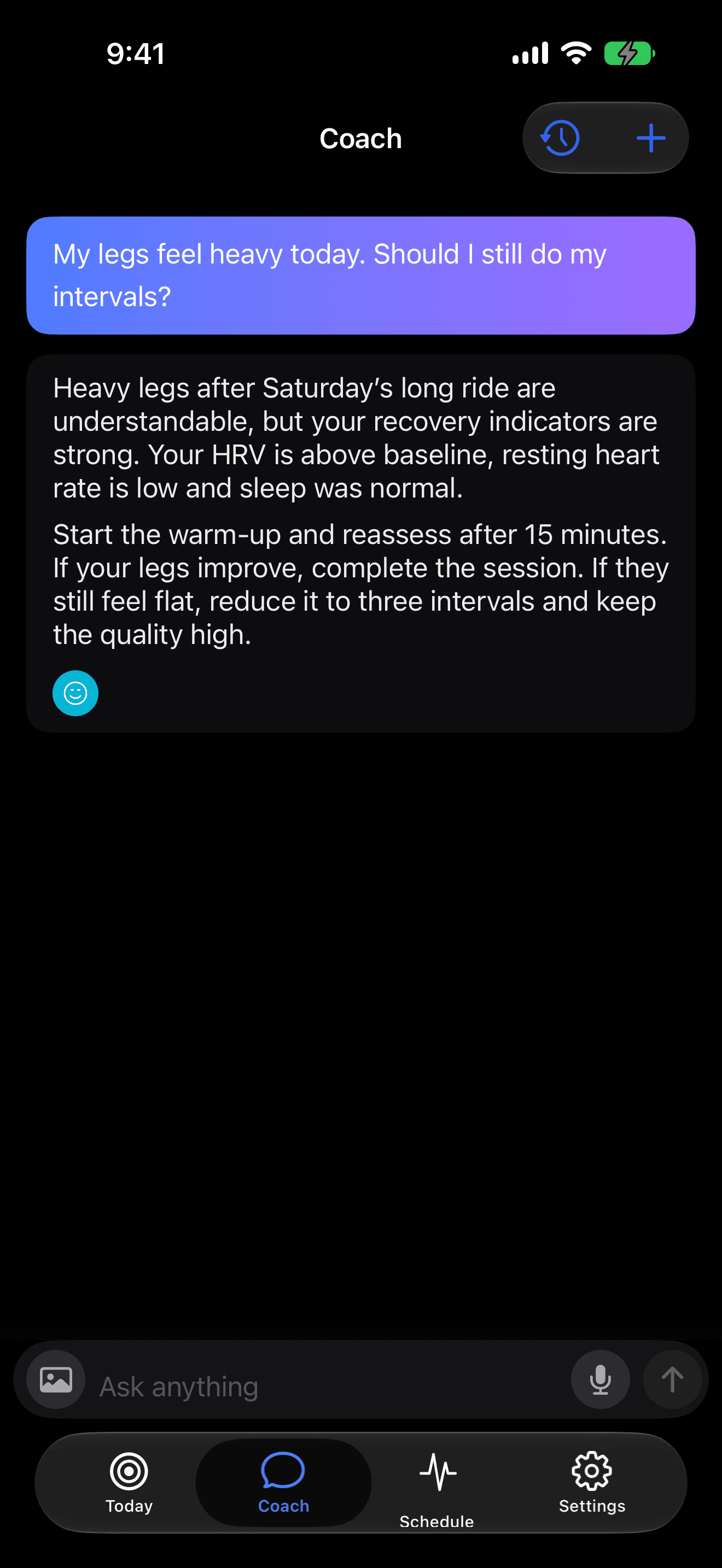
Your next training question might start outside your training app
With Primed now available in ChatGPT, your next training question can draw on your coaching context wherever the conversation starts.

You’re working out what you can fit into the weekend. Training is part of the picture, alongside everything else that needs to happen.
A useful question might be: “What training does Primed have for me this weekend?”
Today, the obvious place to look is your training app. Increasingly, it could be the assistant you’re already using to think through your plans.
That’s a small change in how you get an answer, but it points to something bigger in how we might use software.
Key takeaways
- Primed is now available in ChatGPT for read-only training questions.
- Connected context lets ChatGPT explain your actual Primed plan and schedule.
- The integration is read-only and cannot modify your training plan.
- Specialist coaching software still owns the underlying training rules and decisions.
- Clear boundaries and permissions matter as AI assistants connect to software.
Primed in ChatGPT
Primed is now available in ChatGPT, giving you another way to ask questions about your training.
Once you’ve connected Primed, you can ask questions such as:
- “What does Primed want me to do today?”
- “Why did my training change today?”
- “What training have I got this weekend?”
The integration gives ChatGPT a way to consult Primed for relevant information, so the conversation can draw on your training context.
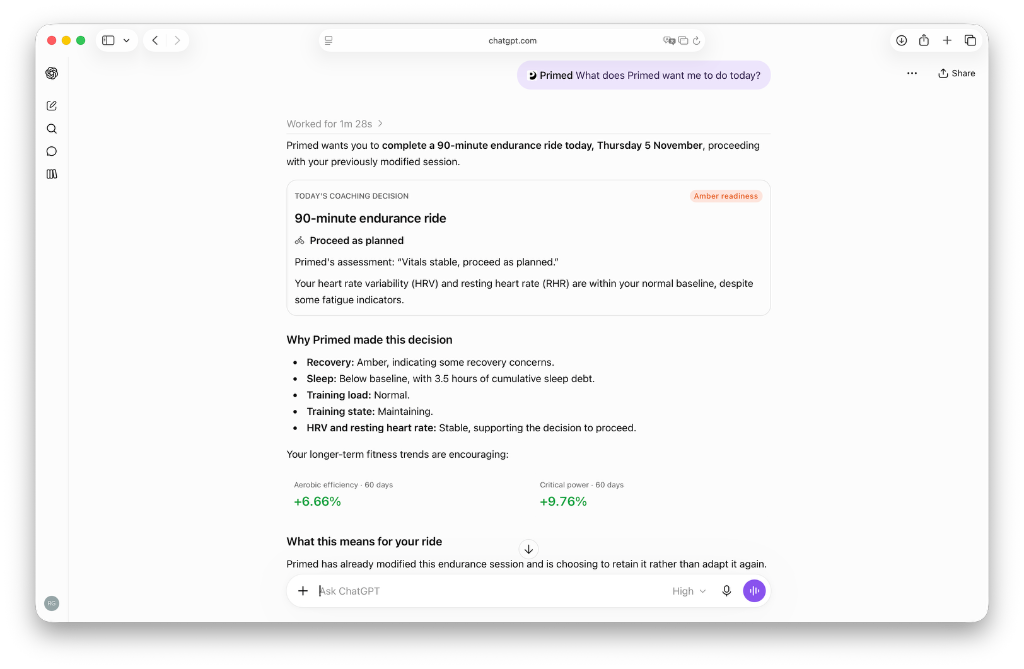
A general answer about what an endurance athlete might do today can be useful. But when you’re following a plan, you often want to know what your plan says and understand the reasoning behind it.
The current integration is read-only. It doesn’t change your training plan. It makes information from Primed available in another place where you might want to ask about it.
Software is getting another front door
Most of us have learnt to organise our digital lives around apps.
We open a calendar to check our commitments, a weather app to look at the forecast and a training app to see the next session. Each product has its own screens, navigation and way of presenting information.
That works well when we know exactly where to go. It becomes more cumbersome when a question crosses several parts of our lives.
“Can I fit my training into this weekend?” is partly a training question, partly a scheduling question and perhaps a weather question too.
AI assistants can offer another starting point. With the right connections, they can consult software on your behalf and bring relevant information into one conversation.
This is part of what people mean when they talk about AI agents: systems that can use tools and services to help with a task. The useful part is the connection between the question you ask and the software that has the information needed to answer it.
An app can still have a good interface of its own while also becoming accessible through an assistant.
Specialist software still matters
A conversational interface doesn’t remove the need for expertise behind the answer.
In endurance training, context matters. A session sits within a week, a training block and a longer-term goal. Understanding it may require more than looking at its duration or intensity in isolation.
Specialist products are built around those details. Their value includes the information they hold, the decisions they support and the rules they apply. Connecting them to an assistant can make that value easier to access.
For Primed, the immediate opportunity is straightforward: let an athlete ask about their training wherever that question arises, while keeping Primed as the source of its training information.
There’s a wider implication for software businesses. A product’s screens may become one of several ways people reach its capabilities. Clear, reliable access to the underlying information and expertise becomes an important part of the product experience.
That puts more weight on getting the substance right. A fluent answer is only useful if it accurately reflects what the specialist system knows.
Where this could go
The current Primed integration is an early starting point. The broader possibilities extend beyond asking what’s in the plan.
With suitable integrations and permission, a future assistant might help an athlete compare planned training with available time in their calendar. It might bring a forecast into a discussion about when to ride, or help them understand how an upcoming trip relates to the week ahead.
Those are possibilities, not claims about what the Primed integration does today.
Moving from reading information to taking action would be another step. Suggesting that a session might fit better on Saturday is different from actually moving it. Changing a training plan would require the relevant capability, appropriate checks and clear authority to make that change.
The appeal is easy to understand. Athletes spend time joining information together themselves. An assistant that can do some of that work accurately could make planning simpler.
The challenge is making sure convenience doesn’t obscure where an answer came from or what has happened.
Trust needs to be part of the experience
As assistants gain access to more software, a few practical questions become increasingly important.
What information can the assistant see? Is it reporting something from Primed, or offering its own suggestion? Can it make changes? How does the athlete review those changes and control the access they’ve granted?
Those questions deserve clear answers in the product experience.
Read-only access provides a useful place to start because it sets a limited scope: retrieve and explain information. It still needs care. The assistant should represent the source accurately, acknowledge missing information and avoid presenting an inference as a confirmed part of the plan.
When you use Primed in ChatGPT, relevant Primed coaching and training information is shared with ChatGPT to answer your question. You can review the requested read-only permissions and how to disconnect at any time in the connection guide.
As capabilities develop, the permissions and controls need to develop with them.
Start with a real training question
There’s plenty of discussion about agents and the future of software. A practical way to explore the idea is to start with something you already want to know.
What am I doing today? Why did my training change? What’s planned for the weekend?
Primed’s ChatGPT integration brings those questions into another familiar setting. It’s an early example of how specialist software can become available through the assistants people use.
Your next training question may still start in your training app. It may also start somewhere else, with Primed providing the context behind the answer.