Zwift Coach and conversational coaching: what should riders look for?
A training plan is useful. The real test of a coach is what happens when your week stops going to plan. Here is what riders should look for in conversational coaching.

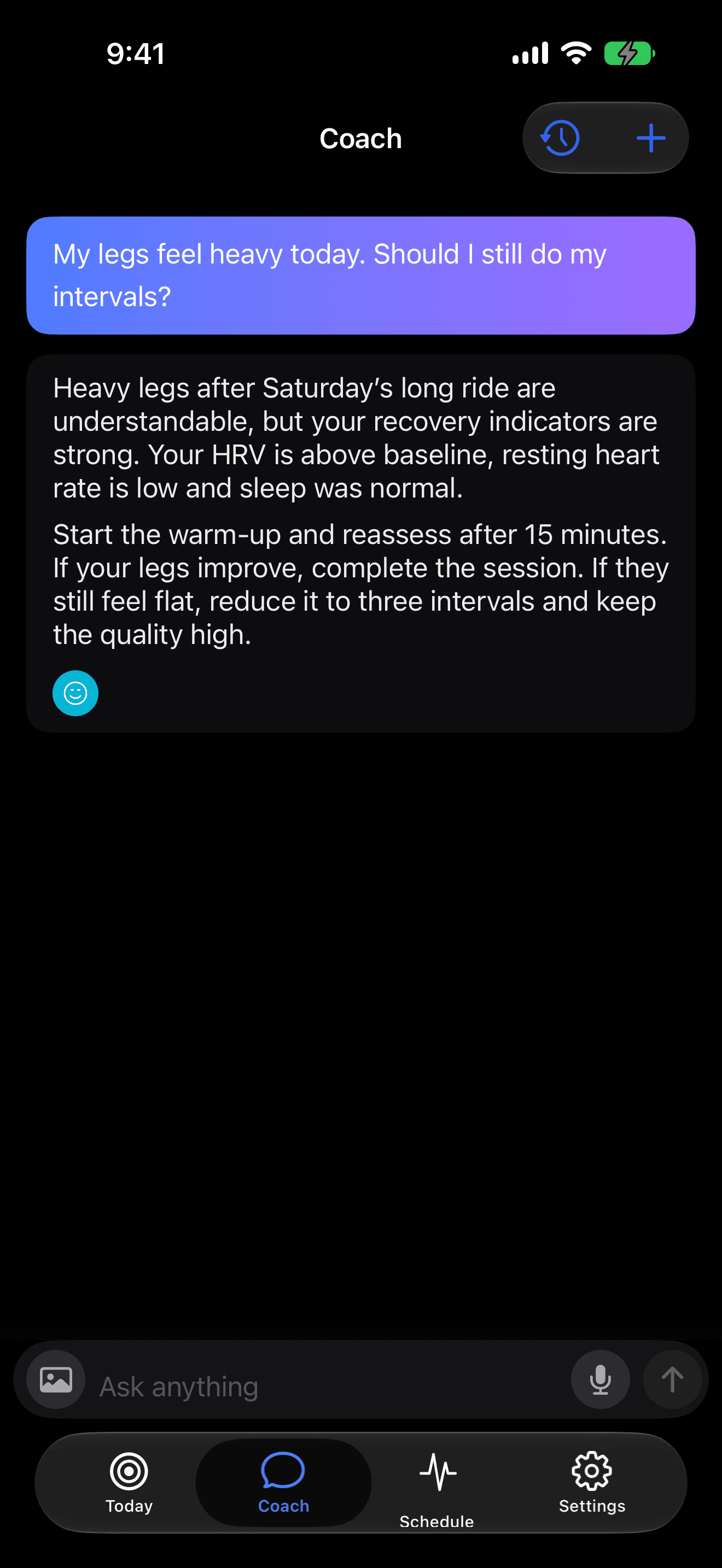
A training plan is useful. The real test of a coach is what happens when your week stops going to plan.
You have 45 minutes to ride today, rather than the hour you planned. You want to keep Saturday’s group ride, and your event is three weeks away.
What should change?
That is the sort of question I would use to assess a coaching app. Not whether it can produce an impressive-looking training calendar, or give a polished answer about intervals. Can it help you make a sensible decision about your actual week?
Zwift’s introduction of Coach through Zwift Plus makes this a timely question. Zwift says its coach builds personalised plans, adapts around changes in your schedule, and uses indoor rides, outdoor rides and wearable insights. It would be wrong to describe it as simply an indoor training plan with some chat attached.
I’m the founder of Primed, so I have a stake in this conversation. I think more riders having access to coaching is a good thing. It also gives us a reason to be more demanding about what we expect from it.
Key takeaways
- Judge a coach by how it handles a disrupted training week.
- Conversational coaching should clarify your next decision, not give generic reassurance.
- Good coaching makes missing context visible instead of assuming your schedule.
- Explanations must connect to your goals and match your actual calendar.
- Test any coaching app with a real trade-off from your week.
Start with the decision you need help making
A plan answers an important question: what am I meant to do?
Coaching also needs to handle questions such as: does that still make sense, given what has changed?
Sometimes an automatic adjustment is all you want. Sometimes you want to explain something, question a recommendation or weigh up two options. The value of conversation is being able to bring information into the decision that a calendar or activity file does not contain.
That does not make a conversational interface inherently better. A friendly answer can still be generic. A useful coach should leave you clearer about your next step, not just pleased with the conversation.
Does it understand your training and your life?
Look beyond the list of supported devices. Ask what information the coach has actually used.
Has yesterday’s ride arrived? Does it know Saturday is a social ride you want to keep, rather than an empty slot to fill? Is it working towards the event you care about now, or a goal you set months ago?
Some of that information comes from connected services. Some needs to come from you.
A good interaction should make missing context visible. If the coach does not know how demanding Saturday’s ride is likely to be, asking is more useful than confidently building a week around an assumption.
You should not need to repeat your entire training history every time. Equally, remembered information should be easy to correct when your priorities change.
Can it explain the trade-off?
Returning to that shortened ride: there may be several ways to change the week. What matters is understanding why one option has been suggested and what it means for the rest of your riding.
An explanation should connect to your circumstances. “This is optimal for your goals” tells you very little. Which goal? What information informed the recommendation? What would change if keeping Saturday’s ride mattered more than completing every planned session?
Zwift’s launch announcement describes a training model grounded in sports science, alongside pre-ride guidance and post-ride feedback. That is a useful reminder that the underlying training system matters, not just how naturally it writes.
As a rider, you should be able to question the recommendation without the system simply agreeing with whatever you say. Helpful coaching can explain why your preferred option may not support your goal.
Does the conversation match the plan?
There is a practical distinction between discussing a change and making one.
If a coach says it has moved a session, the calendar should reflect that. If it has only suggested a change, it should say so. If you still need to do something in another app, that should be clear too.
Check the result rather than relying on reassuring language. What changed? What stayed the same? Did you approve it? Are you now looking at one consistent plan, or conflicting instructions in different places?
This is not the most exciting feature to demonstrate, but it is fundamental to trust. A conversation that sounds right is not enough if the plan you follow says something different.
Does it know when to stop?
Confidence is not a substitute for judgement.
A coaching tool should acknowledge missing or uncertain information. It should not turn every question into another workout, or pretend a training recommendation can resolve something that needs qualified professional advice.
You should also understand what data you are sharing and how to control it. Training information can reveal quite a lot about your daily life. Convenience should not require guesswork about privacy.
Test it with your own week
Before paying for another coaching service, bring it a real question. Use the same situation when comparing options.
“I only have 45 minutes today. I want to keep Saturday’s group ride, and my event is three weeks away. What would you change, and why?”
Then assess the response. Did it use your actual training? Did it ask anything important? Was the reasoning understandable? Could you act on the answer, and verify any changes?
For some riders, coaching built into the platform they already use will be enough. An additional service needs to earn its place by helping with decisions that still feel difficult, not by offering another dashboard or a longer answer.
That is the problem I’m working on with Primed: making coaching useful in the conversations and decisions that sit around the training plan.
If that is what you are looking for, explore Primed. Bring a question from your own training week and judge the experience against the criteria above.
The best test is not how impressive the coach sounds. It is whether you understand what to do next, and why.