How to Race Smarter in Zwift: 10 Tips for Using Pack Dynamics to Your Advantage
You don't need steering controls to influence where you sit in a Zwift race. Learn 10 practical Pack Dynamics tips to draft efficiently, overtake cleanly and save energy for the finish.
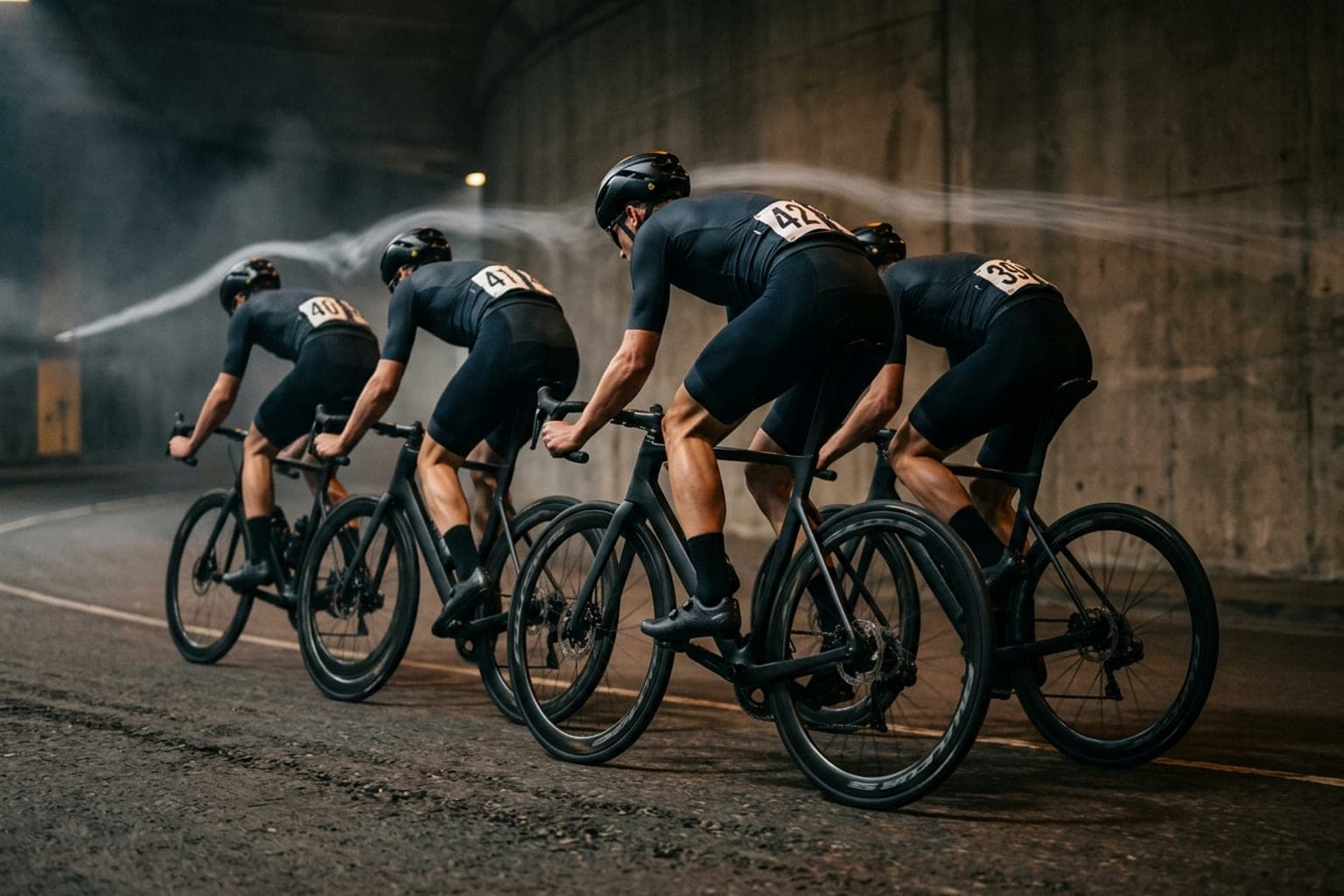
You don't need steering controls to influence where you sit in a Zwift race. Understanding how the game responds to your power, speed and the riders around you can make a real difference to how efficiently you race.
Anyone who's raced on Zwift knows the frustration. You're sitting comfortably in the bunch, putting out a reasonable amount of power, when suddenly your avatar moves towards the outside of the group. You find yourself pushing harder to stay with everyone, or you increase your power to move forward, only to discover that you've barely gained any places.
At other times, you seem to glide through the peloton with very little effort.
It can feel unpredictable, particularly when you don't have steering controls.
But much of this behaviour is intentional. Zwift's Pack Dynamics system manages how riders interact with one another, including drafting, overtaking, collision avoidance and positioning within a group.
Pack Dynamics 5 (PD5) improved the way avatars seek out drafting opportunities and move around other riders. While you can't directly choose your line without steering, you can influence what happens through your power and speed.
Understanding a few of these behaviours can help you conserve energy, avoid unnecessary efforts and put yourself in a better position when a race gets serious – complementing the physical preparation we cover in our guide on how to train for Zwift racing.
Here are ten things worth knowing.
Key takeaways
- Overtaking depends on speed relative to draft savings, not raw watts.
- Sustained accelerations beat repeated short surges under Pack Dynamics 5.
- Drafting in the middle of the bunch saves substantial energy.
- Position early before decisive climbs and sprints rather than chasing late.
1. You don't always need to produce more watts than the rider ahead to overtake
This is probably one of the most useful things to understand about Zwift racing.
Imagine you're sitting behind a rider producing 250 watts. Because you're benefiting from their draft, you might only need 180 watts to maintain the same speed.
If you increase your power to 250 watts, you're now producing substantially more power than you needed to maintain your previous speed. Depending on the conditions, that could be enough to accelerate past them, even though you're not producing more power than they are.
The important comparison isn't necessarily your watts against theirs. It's how much power you're producing relative to what you need to maintain your current speed.
Of course, once you move out of the draft, your aerodynamic resistance increases, so the effort required to complete the overtake can change.
Race tip: Don't assume you need to exceed the power of everyone ahead of you. Focus on creating enough speed to move forward, then avoid spending more energy than necessary once you've reached your intended position.
2. A sustained acceleration may work better than repeated short surges
One of the more frustrating experiences in Zwift is increasing your power, watching your avatar move towards the outside of the bunch, and then finding yourself back where you started.
Zwift's pack dynamics include virtual braking and collision avoidance. These systems are intended to stop riders repeatedly accelerating through one another and moving from the back to the front of a peloton without maintaining the necessary effort.
Your current power, recent power output, speed and proximity to other riders can all influence what happens.
This may help explain why a brief increase in watts sometimes produces very little forward movement.
If you accelerate and immediately ease off, you may lose the speed advantage before you've completed the overtake.
Race tip: When you genuinely need to move forward, try a deliberate, sustained acceleration rather than repeatedly increasing and decreasing your power. Once you're in a useful position, ease back towards the effort needed to maintain it.
That doesn't mean longer efforts are always better. The ideal duration will depend on pack speed, terrain and the riders around you. But repeated surges that achieve little movement can be an expensive way to race.
3. The middle of the pack can be much more efficient than the front
Everyone knows drafting saves energy. What's less obvious is how much the riders around you contribute.
Zwift's drafting system considers multiple riders ahead, rather than simply the closest wheel. Additional riders can improve your aerodynamic shelter, although each contribution has diminishing value.
This helps explain why sitting within a compact peloton can be more efficient than following a single rider.
Tests published by Zwift Insider have demonstrated substantial differences in the power needed to hold position in a single-file group.
In one four-rider test, with the lead rider producing 300 watts, the riders behind needed approximately:
| Position | Power required |
|---|---|
| First rider | 300 W |
| Second rider | 226 W |
| Third rider | 202 W |
| Fourth rider | 200 W |
These aren't fixed savings that apply to every race. Speed, equipment, terrain and group formation all affect the results. But they demonstrate just how valuable shelter can be.
Interestingly, the difference between the third and fourth rider was relatively small. Once you're well sheltered, moving further back doesn't necessarily deliver a proportionate improvement.
And being too far back introduces another problem: you're more vulnerable when the group splits.
Race tip: Aim to spend much of the race sheltered within the group, rather than sitting on the front or constantly fighting to be there. In a large peloton, the middle-to-rear portion can be efficient, provided you remain close enough to respond when the pace changes.
4. Let Zwift find the draft instead of fighting every sideways movement
Without steering controls, Zwift automatically manages your avatar's lateral position.
PD5 improved the system's ability to identify nearby drafting opportunities and move riders towards them. It also improved collision avoidance, reducing the tendency for avatars to pass through one another.
This means that when your avatar moves sideways, it isn't necessarily making a mistake. It may be navigating around another rider or attempting to find a better drafting position.
The system can also look ahead for potential wheels to follow, provided the riders are sufficiently close in position and speed.
However, automatically seeking a draft isn't the same as already receiving one. You still need enough speed to remain connected.
Race tip: Don't immediately increase your power every time your avatar moves towards the side of the road. Pay attention to whether you're actually losing contact with the group. If you're maintaining speed and position, an unnecessary acceleration may simply waste energy.
5. Close gaps early, before you lose the draft
Drafting doesn't simply switch from fully effective to completely ineffective at a particular distance.
The benefit progressively reduces as you move further away from the rider ahead.
Zwift's drafting behaviour also depends on your alignment with other riders, so a gap that looks manageable may provide considerably less shelter than you expect.
This matters when the group accelerates, particularly over short climbs or changes in gradient.
If you respond early, you may be able to close the gap while still receiving some aerodynamic assistance. Wait too long, and you can find yourself doing much more of the work alone.
The same problem occurs when you're towards the back of a large group. Small gaps can quickly become significant if riders ahead accelerate and others fail to respond.
Race tip: Watch the distance to the riders immediately ahead, especially when the pace increases. A small, early increase in power may be more economical than waiting until you've been detached and needing a much larger effort to reconnect.
6. Moving forward before a climb can be better than chasing on it
On flat roads at higher speeds, aerodynamic resistance is a major factor in how much power you need. That makes drafting particularly valuable.
On climbs, speed generally falls and the relative importance of gravity increases. Drafting can still help, but it often provides less benefit than it does at higher speeds.
That changes how you should think about your position.
If you enter a short climb at the very back of the bunch, you may have to respond to riders accelerating ahead of you while others are slowing down. Without steering, you can't simply choose a clear line through the group.
Arriving further forward can give you more room to absorb changes in pace.
Race tip: Before a decisive climb, gradually improve your position while you still have some aerodynamic shelter. Try to avoid arriving at the bottom with a large group of riders between you and the people you need to follow.
Be careful not to spend so much energy moving forward that you've compromised your ability to climb.
7. Don't expect to coast through the peloton on a descent
Descending in Zwift can be a great opportunity to recover, particularly when you're sheltered within a group.
But there's an important difference between recovering in the bunch and trying to overtake riders.
Zwift's pack dynamics include virtual braking behaviours designed to prevent riders from using accumulated speed to glide unrealistically through other avatars.
This is particularly relevant when you're travelling quickly downhill and easing off the pedals.
Rather than automatically moving through the peloton, your avatar may be prevented from overtaking riders unless you generate sufficient additional speed and maintain the effort.
Race tip: Use descents to recover when you're already in a good position. If you need to move towards the front before the next climb, don't assume that freewheeling will get you there. Plan your positioning effort before it becomes urgent.
8. Don't mistake avatar movement for race position
A rider's position within a Zwift bunch isn't always easy to judge by looking at their avatar.
You might move from the centre to the outside of the group without losing meaningful ground. Equally, you might appear to be well inside the bunch while gradually drifting towards the rear.
The game's automatic positioning system is balancing several competing objectives: keeping riders separated, finding useful drafting positions and accommodating speed differences.
Your avatar's sideways movement is only one part of that.
Race tip: Use several signals to judge your situation. Watch your position relative to the same nearby riders, whether gaps are opening, the speed of the group and how much power you're producing to stay there.
If you're still comfortably attached to the bunch, you probably don't need to react to every small movement.
9. Start positioning for the sprint before you actually sprint
In a real cycling race, a rider can choose a line and attempt to move through an opening.
Without steering, Zwift makes many of those decisions for you.
When you're surrounded by riders, collision avoidance influences how your avatar moves around them. Producing a huge burst of power doesn't guarantee an immediate clear path towards the front.
This can be particularly costly in a bunch sprint.
If you begin your sprint from too far back, you may spend valuable time and energy trying to get around riders rather than using your best power in a position where it can win places.
But going too early creates another problem. Sitting on the front before the sprint exposes you to more aerodynamic resistance and forces you to work harder while other riders remain sheltered.
The goal is to find a balance between being sufficiently far forward and remaining protected.
Race tip: Start thinking about sprint position well before the final acceleration. Move forward progressively, aiming to enter the finishing section close enough to the front to make your sprint count, but not so early that you spend an extended period riding into the wind.
The ideal timing will depend on your sprint power, the course and the speed of the group.
10. Understand that not every Zwift event uses identical drafting rules
Zwift supports different configurations for different types of rides and races.
Some events use double drafting, which increases the aerodynamic benefit of sitting behind other riders. Others may have different equipment rules, including whether time trial bikes can receive a draft.
Keep Everyone Together group rides are another special case. They use assistance to help riders remain together despite differences in power output.
These settings matter because tactics that work well in an ordinary race may behave differently in another event.
Double-draft racing, for example, can make staying sheltered even more valuable, while attacking alone may carry a greater aerodynamic cost.
Race tip: Before an event, check its rules and settings. Don't assume that the tactics that worked in your previous race will behave exactly the same way in every event.
So how much extra power should you use to move forward?
This is one question that deserves particular attention, especially for riders without steering.
Unfortunately, there's no universal answer.
A rider travelling at 40 km/h in the draft may need substantially less power to maintain speed than someone at the front of the same group.
If that sheltered rider increases their power by 50 watts, the effect depends on how much aerodynamic protection they're receiving, their weight, the gradient and the speed of the riders around them.
A 50-watt increase that makes a noticeable difference in one situation might achieve very little in another.
Then there's the way Zwift manages overtaking. Collision avoidance, automatic positioning and virtual braking can affect whether an acceleration translates into immediate forward movement.
It's therefore more useful to think about three stages of an overtake:
- Create the speed advantage. Increase power enough to begin moving forward relative to the riders around you.
- Maintain the advantage. Keep the effort going long enough for your avatar to move through or around the group.
- Settle into position. Once you've reached a useful position, reduce your effort towards what's required to hold it without immediately drifting backwards.
This is something worth experimenting with in your own races.
Try comparing a handful of brief accelerations with a more sustained effort. Pay attention to how far you move, how much energy you spend and whether you can hold the position afterwards.
There's no guarantee that one approach will always win, but understanding the difference can help you avoid repeatedly wasting energy on unsuccessful moves.
Putting it all together: race the group, not just your power numbers
Zwift racing has never been purely about who can produce the highest watts per kilogram.
Power matters enormously, of course. But knowing when to use it, where to position yourself and how the game's pack dynamics respond can make a significant difference.
Without steering, you don't control every movement your avatar makes. You do, however, control the power that influences its speed and how it interacts with the riders around you.
A few principles are worth remembering:
- Stay sheltered when there's no tactical reason to be exposed.
- Avoid repeatedly accelerating just because your avatar moves sideways.
- Close gaps before they become expensive to bridge.
- Move forward before important climbs and sprints.
- Make overtaking efforts deliberate rather than constantly surging.
- Remember that producing more watts doesn't always translate into immediate forward movement.
Ultimately, the objective isn't to minimise your power throughout a race. It's to spend it where it makes the greatest difference.
The best racers aren't necessarily the ones who do the least work. They're the ones who avoid unnecessary work, so they've still got something left when it matters.
And that's where understanding Zwift's pack dynamics can give you an advantage.
At Primed, we're interested in how understanding the relationship between an athlete's capabilities, race conditions and the way virtual cycling works can lead to better training and racing decisions. Pack dynamics is one part of that. Combining it with individual power-duration capabilities and race analysis creates opportunities for more personalised coaching.
Further reading
- How to Train for Zwift Racing: Workouts, Recovery and a Smarter Training Plan
- Zwift Insider – Pack Dynamics 5
- Zwift Insider – Pack Dynamics 4.1 drafting tests
- Zwift Insider – Independent testing, technical explanations and racing guidance.