How to Train for Zwift Racing: Workouts, Recovery and a Smarter Training Plan
Want to get faster at Zwift racing? Learn the best workouts, race preparation and recovery strategies, and how Primed adapts your training to your fitness.

Zwift racing looks simple enough. Get on your bike, join an event, and ride as hard as you can.
Then you enter your first race.
The pace is ridiculous from the start. You spend the next few minutes trying to hold a wheel, settle into something resembling a rhythm, and then someone attacks on a climb. You respond, recover briefly, and have to do it all again.
If you've raced on Zwift, you'll recognise the experience. You can have a perfectly respectable FTP, ride hundreds of kilometres a week, and still find yourself getting dropped in the first five minutes.
The problem isn't necessarily your fitness. It might be how you're training.
Zwift racing places particular demands on your ability to produce repeated bursts of power, recover while still riding hard, and manage fatigue across an entire race. Improving those abilities takes more than simply raising your FTP.
Here's how to train for Zwift racing, what workouts actually matter, and how an adaptive AI cycling coach like Primed can help you prepare.
Key takeaways
- Zwift racing demands repeated surges and recovery under load, beyond FTP.
- Combine Zone 2 endurance, VO2 max, over-unders, sprints and race simulation.
- Critical Power and W′ explain why similar FTPs race very differently.
- Primed adapts training to your recovery and exports structured .zwo workouts.
What is the best way to train for Zwift racing?
The best way to train for Zwift racing is to combine aerobic endurance, repeated high-intensity intervals, race-specific efforts and sufficient recovery. Your training should reflect the type of races you enter, your current strengths and weaknesses, and how your body responds to each session.
For most riders, that means:
- Building the aerobic fitness needed to sustain a high pace.
- Training short, hard efforts to survive starts, attacks and climbs.
- Improving your ability to recover between those efforts.
- Practising the demands of actual races.
- Adjusting your training when fatigue, poor sleep or life gets in the way.
The difficult part isn't knowing these things matter. It's knowing how much of each you need, when to do them, and when you're better off recovering.
Why Zwift racing is different from ordinary indoor training
A steady Zone 2 ride, an FTP test and a Zwift race might all happen on the same smart trainer, but they're very different physiological challenges.
During a race, you rarely get to choose your ideal power output. The group determines what you need to produce.
The start is often the hardest part
Many Zwift races begin at an intensity well above what you could sustain for the entire event.
If you aren't prepared, you can spend a considerable amount of energy in the opening minutes just trying to stay with the group.
The challenge is doing that without ruining the rest of your race.
You need to recover while you're still working
Outdoors, you may get opportunities to coast through corners or freewheel on descents. In Zwift, particularly in a fast group, you can spend long periods pedalling with little genuine relief.
You might attack at 400 watts, but your recovery could still require 200 watts or more.
That makes your ability to recover between hard efforts particularly important.
Different courses reward different strengths
A flat race may reward sustained absolute power, drafting and a strong sprint. A hilly race places greater demands on power relative to body weight and the ability to repeat hard climbing efforts.
A points race might require several maximal efforts throughout the event. A team time trial demands controlled, sustained power and effective teamwork.
There isn't one ideal Zwift racing training plan for every rider.
The five types of workouts that help you race faster on Zwift
A good Zwift training plan should develop several complementary abilities. The following workouts are examples rather than a prescription for every athlete. Your training history, fitness and recovery determine how frequently you should perform them.
1. Zone 2 endurance: Build the foundation
It's tempting to think the best preparation for hard racing is more hard racing. But aerobic endurance remains fundamental.
Zone 2 training develops the aerobic capacity that supports sustained power and helps you recover between harder efforts.
- Example workout: 60–90 minutes at a comfortable endurance intensity (roughly 60–75% of FTP), where conversation remains possible.
- Primary purpose: Build aerobic durability and improve recovery between surges without creating excessive fatigue.
These rides should feel manageable. The point isn't to finish every workout exhausted. It's to accumulate useful training without creating unnecessary fatigue.
2. VO2 max intervals: Survive the hard efforts
VO2 max training helps develop your ability to produce power at high aerobic intensities.
That matters during fast race starts, sustained attacks and demanding climbs.
- Example workout: 5 × 3 minutes at approximately 110–120% of FTP, with 3 minutes of easy recovery between efforts.
- Primary purpose: Expand high-end aerobic power for opening selections and punchy climbs.
The correct intensity varies between riders. Some will find the upper end of this range unsustainable, while others may need a different interval structure.
The goal is to spend meaningful time working at a high aerobic intensity, not to hit an arbitrary wattage at all costs.
3. Over-under intervals: Learn to recover under pressure
One of the most useful abilities in Zwift racing is recovering from an effort without dropping to genuinely easy power.
Zwift over-under workouts reproduce that challenge.
- Example workout: 3 × 10 minutes alternating between 2 minutes at 95% FTP and 1 minute at 110% FTP, with 5 minutes of easy recovery between sets.
- Primary purpose: Train lactate clearance and composure while holding upper-tempo or threshold power.
The harder segments create fatigue. The slightly easier segments challenge you to regain control while maintaining substantial power.
This resembles what happens when you respond to an attack and then settle back into the bunch.
4. Short anaerobic efforts: Handle attacks and accelerations
Not every important moment in a Zwift race lasts several minutes.
Sometimes you need a few seconds of substantially higher power to close a gap, hold position or accelerate over the top of a climb.
- Example workout: 2 sets of 6 × 15-second hard efforts, each followed by 45 seconds of easy pedalling, with 5 minutes between sets.
- Primary purpose: Develop neuromuscular power and repeatability for splits, corners and crest accelerations.
The exact targets depend on your sprint capability and the purpose of the session.
These workouts are demanding. Adding them indiscriminately to an already hard training week is unlikely to help.
5. Race simulation: Practise what you're training for
Structured workouts develop the underlying abilities. Racing teaches you when and how to use them.
You need to learn how the virtual draft works, when to anticipate a surge, how much energy to spend on a climb, and when to save something for the finish.
Zwift's official racing guidance recommends racing itself as one of the best ways to develop that tactical awareness and pacing experience.
A practice race can be useful training, but it also contributes significant load. It shouldn't automatically be treated as an extra session on top of an already full programme.
Is FTP enough to measure your Zwift racing fitness?
FTP, or Functional Threshold Power, remains a useful measure for setting training intensities and tracking aspects of cycling fitness.
But it doesn't tell the whole story.
Imagine two riders with identical FTPs of 250 watts.
One can produce enormous power for 15 seconds but struggles to repeat hard efforts. The other has a less impressive sprint but can repeatedly attack, recover and go again.
They may perform very differently in the same Zwift race.
One way of understanding this difference is through Critical Power (CP) and W′ (W prime) (Jones & Vanhatalo, Sports Medicine, 2017).
- Functional Threshold Power (FTP): An estimate of the highest average power you can sustain in a quasi-steady state for roughly an hour, commonly used to anchor training zones.
- Critical Power (CP): A physiological boundary modelling the relationship between power output and the duration for which it can be sustained without progressive exhaustion (Poole et al., Medicine & Science in Sports & Exercise, 2016).
- W′ (W prime): A modelled finite capacity for work performed above Critical Power, measured in kilojoules (kJ).
When you ride above your critical power, you draw on that W′ capacity. When your effort falls sufficiently below critical power, some of that capacity can reconstitute.
These models have limitations, and estimates depend on the quality of the underlying maximal efforts in your recent history. Nevertheless, they illustrate an important point: two riders with similar threshold power can have very different high-intensity capabilities.
For Zwift race preparation, understanding your power across different durations can be more useful than concentrating on a single FTP number.
How often should you train for Zwift racing?
For many recreational racers, two demanding sessions per week, supported by endurance riding and recovery, can be a sensible starting point. A race itself may count as one of those demanding sessions.
More experienced riders may tolerate more training, but that depends on their history and ability to recover.
Here's an illustrative week for someone racing on Tuesday evenings.
| Day | Training | Purpose |
|---|---|---|
| Monday | Easy spin or rest | Prepare for racing |
| Tuesday | Zwift race | Race-specific intensity |
| Wednesday | Recovery or easy Zone 2 | Absorb the race |
| Thursday | VO2 max or over-under intervals | Develop race-specific fitness |
| Friday | Easy endurance or rest | Manage fatigue |
| Saturday | Longer Zone 2 ride | Build aerobic endurance |
| Sunday | Endurance or rest | Support the next week |
This isn't a universal training plan.
If Tuesday's race was particularly demanding, Thursday's intervals might be a poor decision. If you've slept badly for several nights, or accumulated unusual fatigue, you may need more recovery – a challenge we explore in detail in how adaptive plans handle poor sleep, illness and missed sessions.
Equally, if you're well recovered and responding positively to training, there may be opportunities to progress.
That's where an adaptive training plan becomes useful.
Want a Zwift training plan that adapts to your recovery?
See how Primed builds and adjusts your personalised cycling training plan around your races, workouts and wearable data.
How Primed helps you train for Zwift racing
Zwift is excellent at giving you somewhere to train and race. It offers structured workouts, training plans, events and competition.
Primed serves a different purpose.
It's an AI endurance coach designed to understand your training over time, connect it with your recovery and goals, and help you decide what to do next.
Rather than simply following the same training schedule regardless of what's happened, Primed can help your training adapt.
1. Build your training around your Zwift goals
You might be preparing for your first Zwift race, trying to improve your results in the Zwift Racing League, or attempting to stay with the front group for longer.
Those are different goals and may require different training.
You can discuss your objectives, available training time and current ability with the Primed Coach. Primed uses your training history and the information available to it to help develop a plan suited to your circumstances, as shown in our walkthrough on moving from 12 weeks of data to today's workout.
When it's time to ride indoors, Primed lets you export structured cycling workouts in Zwift's .zwo format with one tap, complete with power targets (% of FTP or watts), interval ramps and timed text cues, or sync your planned sessions directly to your Intervals.icu calendar.
The aim isn't to give every cyclist the same collection of intervals. It's to build training around the athlete doing them.
2. Understand your strengths and weaknesses
Your FTP is only part of your cycling profile.
Primed uses your available training history – including power-duration curves and modelled Critical Power and W′ where sufficient maximal efforts exist – to consider how your performance has developed, what training you've completed, and how you have responded to different workloads.
For example, you might be comfortable maintaining threshold power but struggle with repeated high-intensity sessions.
Or perhaps your top-end power is strong, but your endurance is limiting your results in longer races.
Rather than assuming every Zwift rider needs more VO2 max intervals, the coach can help evaluate where your training attention would be best spent.
3. Connect training with recovery
Your smart trainer or power meter can tell you what work you've done.
A recovery device can tell you something about how your body is responding.
But those data points don't always tell the same story.
Primed brings together data from supported services including Garmin, Intervals.icu, Oura, WHOOP, Withings and Apple Health, helping the coach consider training load alongside signals such as sleep, HRV and resting heart rate. Because completed Zwift rides and races are typically recorded on or synced to Garmin Connect, Intervals.icu or Apple Health, your indoor racing load flows into Primed alongside your overnight recovery metrics (note that direct Zwift API sync and direct Strava integration are not currently offered). You can read more about how this multi-source synthesis works in how Primed combines Garmin, Oura, WHOOP and Apple Health.
That can be particularly valuable if you're racing regularly.
A hard Tuesday night race may look like one completed activity in your training history. Its effect on the rest of the week could be considerably more important.
4. Adapt when you're not ready for the planned workout
Imagine you're preparing for a Zwift Racing League event.
You've scheduled VO2 max intervals for Thursday. But Tuesday's race was harder than expected, Wednesday's recovery was poor, and you've had two nights of disrupted sleep.
A static plan still says to complete the intervals.
Primed can evaluate the available evidence and help adjust the planned training. That might mean shortening the session, reducing its intensity, moving it, or prioritising recovery – especially when wearable signals and how your legs feel don't agree.
The aim isn't to avoid hard training. You need hard training to improve.
It's to perform that training when you're in a reasonable position to benefit from it.
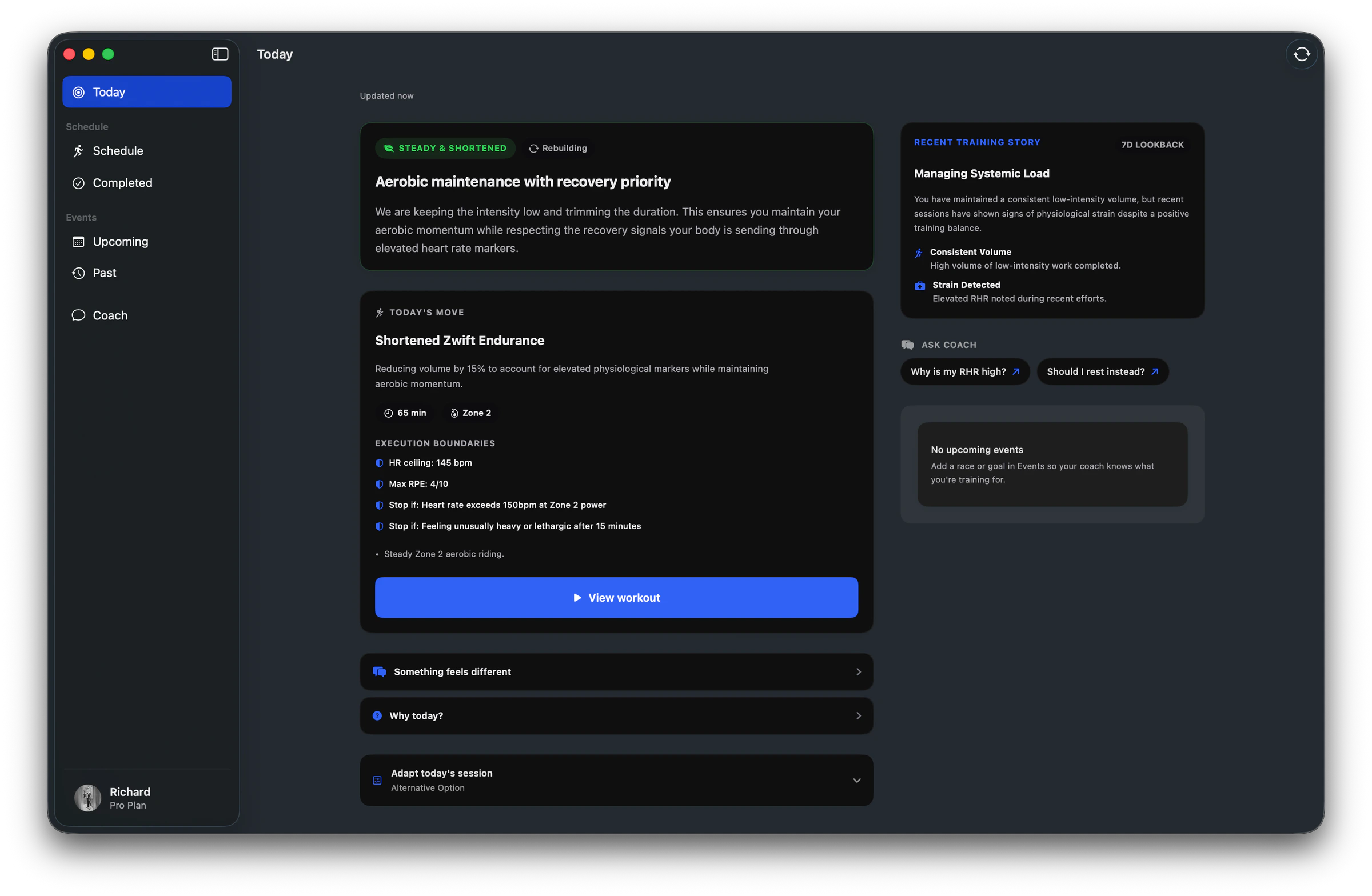
Here is a real example from the founder's own training account showing how Primed adapts an indoor session when recovery markers shift:
- Planned session:
Zwift Endurance · 75 min(following a 70-minuteZwift Quality Aerobic Temposession earlier in the week). - New recovery information: Elevated resting heart rate markers and accumulated 7-day physiological strain despite steady aerobic volume.
- Primed's resulting recommendation:
Shortened Zwift Endurance · 65 min · Zone 2(volume trimmed by 15%, with explicit execution boundaries:HR ceiling: 145 bpm,Max RPE: 4/10, and a stop boundary if heart rate exceeds 150 bpm at Zone 2 power or legs feel unusually heavy after 15 minutes). - Explanation of the decision: "Aerobic maintenance with recovery priority: we are keeping the intensity low and trimming the duration. This ensures you maintain your aerobic momentum while respecting the recovery signals your body is sending through elevated heart rate markers."
5. Learn from completed training
Training shouldn't be a process of endlessly repeating workouts and hoping they work.
Over time, your coach should be able to consider whether your fitness is progressing, whether you're tolerating the load, and whether your training still supports your goal.
Primed maintains an ongoing picture of the athlete rather than treating every workout as an isolated event.
You can also ask the coach questions in ordinary language.
For example:
- "Why do I keep getting dropped in the first five minutes of Zwift races?"
- "I race every Tuesday. How should I structure the rest of my week?"
- "My legs are still heavy from Tuesday's race. Should I do my intervals today?"
- "Should I focus on improving my FTP or my short-duration power?"
- "I've got a hilly race in four weeks. What should I prioritise?"
The answers consider your own available data and training context, rather than being generic advice for an imaginary cyclist.
Don't overlook cooling, hydration and your indoor setup
One of the easiest ways to undermine indoor performance is to get too hot.
Outdoors, movement provides airflow across your body. Indoors, that airflow needs to come from fans. Controlled laboratory cycling studies consistently show that convective airflow reduces thermal strain, lowers cardiovascular drift and improves sustained power output in warm indoor environments (Saunders et al., Acta Physiologica Scandinavica, 2005).
Without adequate cooling, your heart rate can rise at a constant power output, perceived effort can increase, and performance can deteriorate.
This is often described as cardiovascular drift.
Good preparation includes a strong fan, sufficient ventilation, accessible fluids, and a comfortable bike setup.
It's also worth checking that your trainer firmware is current and that your power readings are reliable. Consistent equipment and accurate data help you understand whether you're genuinely improving.
And avoid trying to manufacture a better watts-per-kilogram figure through dehydration or other rapid weight manipulation. That isn't a sensible performance strategy.
Preparing for Zwift Racing League
Zwift Racing League (ZRL) adds another dimension to training because you're racing for a team across a series of events.
The 2026/27 season includes points races, team time trials and the new draftless Race of Truth format.
Each rewards different abilities.
If you're racing a points event, the ability to repeat hard efforts at important moments may be particularly valuable.
In a team time trial, sustained power and pacing matter more.
In a draftless race, you can't rely on sitting in the bunch to conserve energy.
A Zwift Racing League training programme should take these differences into account, particularly when you know which events are coming up.
You also need to consider the cumulative fatigue from racing every week.
There's little value in arriving at the most important event of the series exhausted because you've treated every training session as another competition.
Can Primed replace Zwift's training plans?
Primed and Zwift aren't trying to solve exactly the same problem.
Zwift provides the virtual environment, workouts, plans and races. Its built-in training options can be an excellent starting point, particularly if you're new to structured cycling training.
Primed adds a broader coaching perspective.
It can help you understand what training makes sense for your goals, how that training fits with your existing workload, and when a planned session needs to change.
It also considers recovery information that may sit outside your Zwift experience.
You can continue using Zwift to ride and race – exporting Primed's structured .zwo workouts into Zwift when you want to execute a tailored session – while using Primed to help guide your wider training load and readiness decisions.
As we outline in what AI endurance coaching can and cannot do, Primed isn't a guarantee of faster race results, nor is it a substitute for learning race tactics. It's intended to make your preparation more individual, informed and adaptable.
Frequently asked questions
How do I get faster at Zwift racing?
Build your aerobic fitness, include race-specific high-intensity training, practise repeated surges, and race often enough to develop tactical experience. Pay attention to recovery rather than simply increasing the number of hard workouts you complete.
How many times a week should I race on Zwift?
That depends on your fitness, racing intensity and recovery. For many riders, one or two races per week can provide substantial high-intensity training. Count these races as part of your training load rather than adding them on top of every planned interval session.
What is the best workout for Zwift racing?
There is no single best workout. Over-under intervals are particularly relevant because they train your ability to respond to higher-power efforts while maintaining a demanding pace. VO2 max intervals, short anaerobic efforts and endurance riding also have important roles.
Can I train for Zwift Racing League with an AI coach?
Yes. An AI endurance coach such as Primed can help organise training around your racing goals, analyse available training and recovery data, and adapt your schedule when circumstances change. Racecraft and team tactics still require practice.
Should I improve FTP or sprint power for Zwift?
It depends on where you're losing time. Riders struggling to maintain the general pace may benefit from improving aerobic and threshold fitness. Riders who are repeatedly dropped during short accelerations may need to develop their high-intensity capability or tactical positioning. A broader power-duration profile helps identify the difference.
Train for your next Zwift race with a plan that understands you
Getting better at Zwift racing takes consistency, hard work and the ability to recover.
But there's a difference between completing more training and completing the right training.
The best programme for you depends on your current fitness, your racing goals, your training history and what your body is telling you today.
That's what we're building Primed to help with.
Primed is an AI endurance coach that brings your training, recovery and goals together, so you can make better decisions about what to do next.
If you're training for your next Zwift race, you can start with Primed for free on iPhone, iPad, Mac and the web.
Get Started with Primed or explore how Primed works to start building a training plan around you.