How to Use ChatGPT as Your Cycling Coach (And Where It Falls Short)
ChatGPT can be a genuinely helpful sounding board for cyclists if you supply structured training context. Here are four reusable prompts, the structural limits of standalone chatbots, and how connected read-only context works.
You can get genuinely useful cycling guidance out of ChatGPT today if you treat it as a structured sounding board rather than an autonomous coach. Standalone ChatGPT is strong at explaining physiological concepts, critiquing weekly intensity balance when you paste clean summaries, and helping you think through calendar trade-offs. Where it breaks down is anything that depends on verified longitudinal state and deterministic maths: it does not automatically read your Garmin, Wahoo, Oura, WHOOP or Apple Health data, it cannot reliably maintain rolling 42-day and 7-day exponentially weighted load averages in prose, and it often agrees too eagerly when a motivated athlete asks to cram missed hard work into a fatigued weekend.
Key takeaways
- ChatGPT works best as a structured sounding board, not an autonomous coach.
- Supply power, recent load, sleep and RPE context in every review.
- Standalone chatbots drift on load maths and tend toward sycophancy.
- Primed in ChatGPT adds live read-only training context without plan mutations.
- Verify every AI workout against a 6-point physiological safety checklist.
The minimum context block ChatGPT needs to give sensible advice
Typing "Give me a cycling workout today, my FTP is 260 W" forces any general-purpose model to guess. Paste a concise context block at the top of your chat so the model reasons from evidence rather than generic templates:
- Rider & target: Age, discipline (road, gravel, crit, Zwift racing, Gran Fondo), event date and realistic weekly riding hours.
- Thresholds & recent power: Current FTP (plus test protocol and date) and recent best 5-minute and 20-minute efforts if known.
- Last 14 days of completed load: Weekly hours, approximate TSS/load, key interval sessions, and whether power held steady or faded on final reps.
- Recovery & life load: Sleep duration over the past three nights, resting heart rate and overnight HRV direction relative to your 30-day norm, leg heaviness (1–10), and work or travel stress.
- Today's hard constraints: Exact time window (including warm-up and cool-down), indoor trainer vs outdoor road, and any illness or niggles.
Four reusable prompts for self-coached cyclists
1. Weekly training review
Act as a cautious, evidence-based cycling coach. Review my past 7 days and tell me:
1) whether my intensity distribution suits my weekly volume,
2) which signals point to productive load vs accumulated fatigue, and
3) two practical adjustments for next week.
If key context is missing, ask before guessing. Do not invent numbers.

Context:
- Goal: 120 km hilly sportive in 10 weeks; typical budget 7 h/week
- FTP: 255 W (indoor 20-min test 6 weeks ago)
- Completed week: Tue 60 min (3x12 min @ 90% FTP, RPE 7/10); Thu 60 min (5x4 min @ 108% FTP, failed rep 5, RPE 9.5/10); Sat 3 h endurance (NP 185 W, HR drifted +8% in final hour); Sun 90 min easy spin (RPE 4/10)
- Recovery: Sleep avg 6.3 h (normal 7.5 h), RHR +4 bpm above 30-day average since Friday, heavy legs on stairs.
2. FTP and power-trend diagnosis
My FTP appears flat across three tests. Help me separate measurement noise and protocol artefacts from a real training plateau before recommending harder intervals.
- Tests: 262 W (indoor ramp, 14 weeks ago), 258 W (20-min outdoor climb, 7 weeks ago), 260 W (indoor ramp, yesterday)
- Hardware: Direct-drive trainer indoors; single-sided crank power meter outdoors
- Routine: 6.5 h/week (two indoor sweet-spot rides + one fast Saturday bunch ride, no formal deload weeks in 10 weeks)
List the likeliest technical and testing explanations first, then ask 3 diagnostic questions.
3. Missed midweek session reshuffle
Work travel wiped out Wednesday's 60-minute threshold session and I slept 5 hours last night.
Remaining schedule: Thu (60 min available), Fri (rest), Sat (2.5 h fast group ride), Sun (90 min free).
Compare three options — moving threshold to Thursday, riding easy Zone 2 on Thursday, or resting today — and explain why cramming missed intensity before Saturday helps or hurts.
4. Conflicting wearable recovery signals
My morning signals conflict:
- Overnight HRV sits inside my normal 30-day range,
- Resting heart rate is +4 bpm above baseline,
- Sleep was 6 hours with two wake-ups,
- Legs feel heavy and flat.
Planned workout: 4x8 min at 98% FTP.
Give me a conservative option, a modified option, and an objective 12-minute warm-up check (heart rate + RPE) to decide whether to proceed or bail to Zone 2.
Four structural places standalone ChatGPT falls short
- Longitudinal context decay: Even with consumer ChatGPT Memory switched on, general memory stores short biographical facts ("trains for gravel, FTP ~255 W"), not a time-stamped 12-week ledger of workouts, zone time, illness days and HRV baselines.
- Token prediction vs deterministic physiology maths: Asking an LLM to calculate Normalised Power, Intensity Factor, CTL (42-day time constant) or ATL (7-day time constant) from pasted text routinely produces confident arithmetic errors. Calculations belong in deterministic code, not prose generation.
- Sycophancy under athlete ambition: General assistants are trained to be helpful and agreeable. Tell a standalone chatbot "I only have four weeks until my event, help me gain 25 watts" and it will often prescribe three or four brutal interval days a week without enforcing age-band ramp guardrails or recovery spacing.
- Privacy and account boundaries: Health, sleep and injury notes pasted into a consumer ChatGPT thread fall under OpenAI's privacy policy and your ChatGPT data-control settings. Avoid pasting sensitive clinical records into general chat histories.
How connected read-only context works: Primed in ChatGPT
If you already plan your week inside ChatGPT, Primed in ChatGPT removes manual copy-pasting while keeping training-plan rules inside specialist coaching software. Linking your Primed account via OAuth 2.1 with PKCE gives ChatGPT five strictly read-only tools:
get_primed_profileget_today_coachingget_upcoming_trainingget_training_statusget_recent_activity_summary
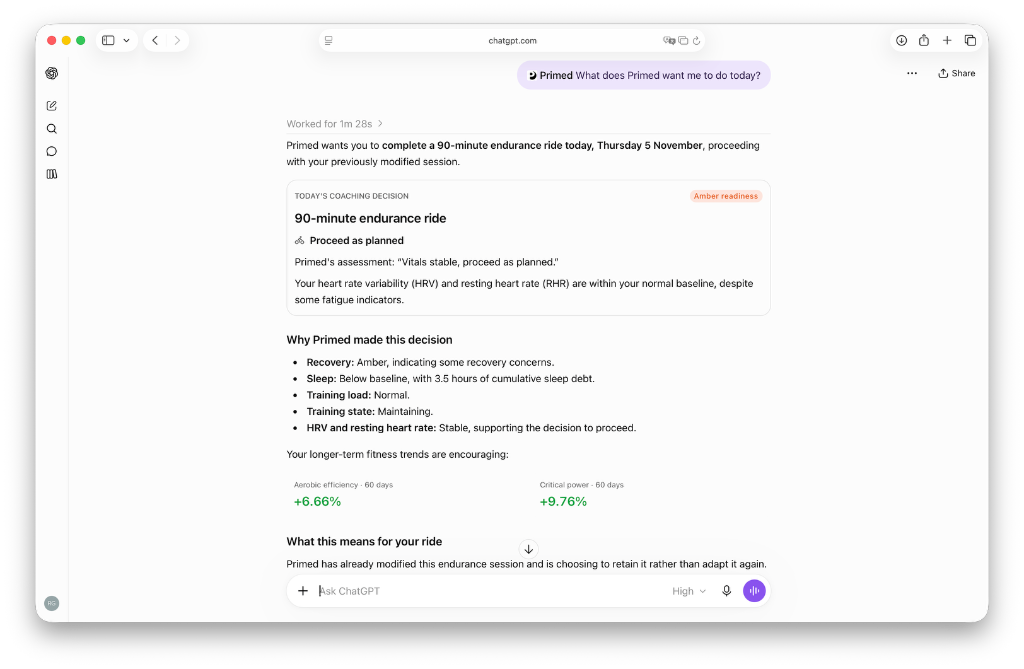
Illustrative example of Primed in ChatGPT retrieving a connected Today's Coaching Decision and 60-day aerobic efficiency and Critical Power trends.
Read-only vs action capabilities: Primed in ChatGPT can retrieve and explain your current Primed recommendation, load status and upcoming 7-day schedule so you can ask "What does Primed have me doing this weekend, and why?" right inside a broader planning chat. It cannot create, reschedule or edit workouts or mutate account state. Plan edits and .zwo workout exports happen inside Primed (on iPhone, iPad, Mac or app.beprimed.ai), where changes pass through Primed's deterministic load and safety guardrails. Note that OpenAI controls regional and tier availability of ChatGPT apps, and information shared into a ChatGPT thread is governed by OpenAI's privacy policy and your ChatGPT settings.
Six-point safety checklist for any AI workout recommendation
Run every AI-suggested cycling workout through six quick checks before riding:
- Recent-load awareness: Did the recommendation account for your last 72 hours of riding, or only your static FTP?
- Zone sanity: Do interval percentages match physiological reality (for example,
3 × 12 minat 95–100% FTP, never3 × 15 minat 112% FTP)? - Weekly hard-session cap: Does this push you past two genuinely hard sessions in the week (counting Zwift races and fast bunch rides)?
- Warm-up and bail-out criteria: Is there a progressive 10–12 minute warm-up and a clear rule to step down to Zone 2 if heart rate and RPE are off?
- Hard medical stops: Fever, systemic viral symptoms, chest pain, dizziness or sharp joint pain require stopping exercise and seeking clinical advice, never "dialling intervals down by 10%".
- No guaranteed outcomes: Neither ChatGPT nor Primed can guarantee FTP gains or race results; good coaching manages probabilities and trade-offs transparently.
Explore further
- Primed Journal — browse all cycling, recovery and AI coaching guides.
- Primed in ChatGPT Guide — inspect the read-only permissions, privacy notes and connection steps.
- Your Next Training Question Might Start Outside Your Training App — why specialist coaching engines still matter behind assistant interfaces.
- The Best AI Cycling Coaches — compare purpose-built AI cycling platforms against general chatbots.