Training load isn’t fitness: what your wearable’s numbers actually mean
Your watch can tell you how much work you’ve done, but not whether more training is what you need. Here’s how to separate effort, fitness and readiness.

You finish a big week on the bike. Your training load is up, your watch congratulates you for being productive, and your recovery app suggests you take it easy.
So, are you getting fitter, or just getting tired?
Both might be true.
We've become very good at collecting training data. Power meters measure every pedal stroke, watches follow our heart rate, and rings track what happens while we sleep. The problem is that these devices are often measuring different things, then presenting them as though they all answer the same question.
They don't.
Understanding the difference between training demand, aerobic fitness and readiness is one of the most useful things a self-coached athlete can learn.
Key takeaways
- Training load measures recent demand, not how fit you are.
- Aerobic fitness develops over time across threshold, endurance, efficiency and repeatability.
- Readiness reflects current recovery state, sleep, stress and how you feel.
- Cardiovascular effort scores can miss muscular soreness and mental fatigue.
- Coaching context connects training history, recovery, goals and subjective feedback.
Three questions, three different answers
1. Training demand: How much work have you recently asked your body to do?
Training load describes the demands of exercise over a given period. Depending on the platform, it might use power, heart rate, duration or perceived effort.
For cyclists, a power-based training stress score reflects the mechanical demands of a ride relative to an estimated threshold. A heart-rate-based measure looks at the cardiovascular response instead.
Neither is a direct measurement of how fit you've become.
2. Aerobic fitness: What can your body do?
Fitness is an adaptation developed over time. You might notice it through higher sustainable power, a better time on a familiar climb, or being able to hold the same pace with less effort.
VO₂ max is one useful measure of aerobic capacity, but it isn't the whole story. Threshold, efficiency, endurance and your ability to repeat hard efforts also matter.
3. Readiness: How prepared are you for today's demands?
Readiness concerns your current state, not just your training history.
Sleep, recent exercise, illness, stress, nutrition and how you actually feel can all influence your capacity to perform a session.
A wearable may estimate aspects of recovery through heart-rate variability (HRV), resting heart rate and sleep. It cannot directly measure every source of fatigue or establish from one score whether a particular workout is appropriate.
These three questions are related, but they operate on different timescales.
Oura's new Cardio Effort is a useful example
In October 2026, Oura introduced Cardio Effort and automatic VO₂ max.
Cardio Effort describes cardiovascular demand during recorded activities. It considers intensity and duration, using heart-rate information when available, then compares accumulated weekly effort with your recent history.
Oura uses five personalised categories: Light, Fair, Maintaining, Building and Reaching.
That distinction is useful. A Reaching week means cardiovascular demand was unusually high relative to your established pattern. It doesn't automatically mean you've gained fitness, and it certainly doesn't diagnose overtraining.
Importantly for cyclists, Oura says indoor cycling, strength work and other recorded activities can contribute. When heart-rate information is insufficient, the app may calculate an estimated value.
Oura's automatic VO₂ max feature addresses a different question: estimated aerobic capacity over time. As of October 2026, it remains experimental within Oura Labs.
It's a good illustration of why two numbers from the same device should not be treated as interchangeable.
Why more training load isn't always better
Training creates a stimulus. Adaptation happens as the body responds to that stimulus, with enough recovery and appropriate nutrition over time.
More work can be useful when it is manageable and serves a purpose. But adding load simply to keep a chart moving upwards is a poor training strategy.
In a 2002 experimental study of eight endurance cyclists, Halson and colleagues observed reduced cycling performance and changes in mood and perceived effort during an intensified training period.
The study was small, so it cannot establish a universal threshold for excessive training. It does, however, demonstrate something familiar to many cyclists: a harder training block can temporarily leave you performing worse rather than better.
A lighter week isn't necessarily lost fitness. Sometimes it's part of making the preceding work useful.
Maintaining your current fitness can also be a perfectly reasonable goal, particularly around work, family commitments or periods without a major event.
Your training history needs to be interpreted in relation to what you're trying to achieve, not against an assumption that every week should exceed the last.
Cardiovascular demand doesn't capture every kind of fatigue
Imagine two sessions.
One is a steady two-hour ride that keeps your heart rate elevated. The other is a gym session with heavy squats and relatively long rests.
The cycling session might produce a higher cardiovascular load score. Yet the gym session could leave your legs considerably sorer.
Neither measurement is necessarily wrong. They describe different dimensions of the work.
A 2020 study involving eight trained men found that perceived-exertion-based training load distinguished between two functional fitness sessions more clearly than the heart-rate-based methods examined. The small sample and exercise format limit how widely we can generalise the finding, but it illustrates why heart rate alone can miss important differences.
Fatigue isn't only muscular, either. In a randomised crossover experiment involving 16 participants, a demanding mental task increased perceived exertion and reduced subsequent cycling exercise tolerance compared with a control condition.
That doesn't mean every stressful workday ruins training. It means the rest of your life belongs in the conversation.
A hypothetical cyclist: what does a demanding week really mean?
The following example is fictional. It illustrates interpretation, not an individual training recommendation.
Amira is preparing for a 120 km cycling event.
Her week includes Tuesday intervals, a demanding Thursday tempo session, a four-hour Saturday ride and some hilly riding on Sunday.
By Sunday evening, her training load is well above its recent average. Oura shows a Reaching week.
Her first reaction is positive. She's done more than usual, and the chart confirms it.
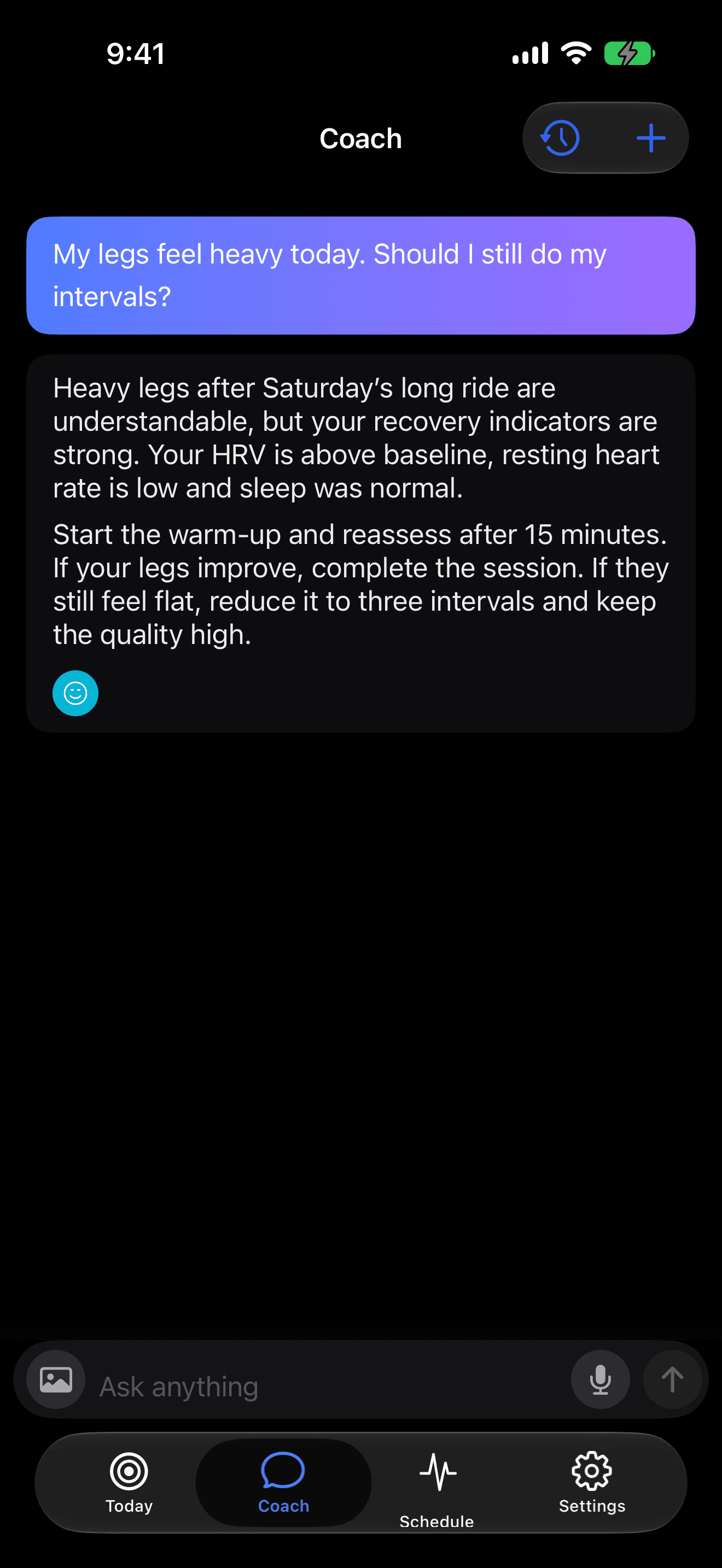
But on Monday, her legs feel heavy. She's slept less than normal, work has been stressful, and her next planned session is another set of intervals.
What does the data actually tell her?
The increased load confirms that she has accumulated substantial recent training demand. It doesn't establish how much adaptation will result.
Her existing aerobic capacity hasn't suddenly transformed because of one big week.
Her recovery information and subjective feedback raise additional questions about how she's responding, but neither provides a definitive answer on its own.
The useful questions are about context. Was this larger week intentional? How does it compare with previous blocks? Was the hard work spaced appropriately? Is she approaching an event? Has she been recovering normally?
The same Reaching category could have a very different meaning for an athlete completing a planned overload block and someone unexpectedly doubling their usual training.
Amira shouldn't be given a rigid instruction based on a single category. She needs to understand the whole picture before deciding what to discuss with her coach.
From collecting numbers to understanding them
This is where a conversational endurance coach can be useful.
Primed can bring supported training history, recovery information, goals and feedback into a coaching conversation. Its Oura integration currently lists sleep, readiness and HRV, alongside activity data from other supported sources.
That means you can explore questions such as why a familiar session felt harder, whether a demanding week was intentional, and how your schedule fits your current circumstances.
It doesn't mean Primed receives Oura's newly announced Cardio Effort or automatic VO₂ max fields, or that an AI coach can determine a medical condition from wearable readings.
For a closer look at one of the fitness measures behind these discussions, see Your VO₂ max is a trend, not a daily training verdict.
The takeaway
When a wearable gives you a number, ask what it actually measures.
Training load describes recent demand. Aerobic fitness describes developed capacity. Readiness concerns how prepared you may be for today's task.
The next useful question isn't necessarily how to make the number bigger. It's what the number means alongside your training history, recovery, goals and how you feel.
Explore how Primed connects training and recovery data, or start with Primed Free and compare Free and Pro to see which level of coaching context you need.