Your VO₂ max is a trend, not a daily training verdict
Your watch says your VO₂ max has dropped. Have you lost fitness, or has the estimate changed? Here's how to tell what the number is really saying.
Your watch tells you that your VO₂ max has dropped from 52 to 49.
You've been training consistently. Your power numbers look fine. You haven't suddenly forgotten how to ride a bike.
So what happened?
Possibly nothing significant.
VO₂ max is one of the most useful measurements in endurance sport, but there's an important difference between measuring it in a laboratory and estimating it from a wearable.
And even a good estimate doesn't deserve to become the verdict on every training session.
Key takeaways
- Wearable VO₂ max scores are model estimates, not direct laboratory measurements.
- Aerobic ceiling matters alongside threshold power, efficiency and sustainable endurance.
- Single readings vary with activity type, conditions, body mass and algorithms.
- Consistent multi-week trends and real-world performance outrank isolated daily shifts.
- Coaching context connects aerobic trends with training history, recovery and goals.
What VO₂ max actually measures
VO₂ max describes the maximum rate at which your body can take up and use oxygen during intense exercise.
It's usually expressed as millilitres of oxygen per kilogram of body mass per minute (ml/kg/min).
Think of it as one measure of your aerobic engine's capacity. Your heart, lungs, blood vessels and working muscles all contribute.
A higher VO₂ max generally indicates a greater capacity for aerobic energy production. For endurance athletes, that's valuable.
But it doesn't automatically make you a faster cyclist.
In a 1991 study of 15 competitive cyclists, Coyle and colleagues compared riders with different levels of time-trial performance. Although the groups had similar VO₂ max values, the stronger riders sustained more power and performed better in a 40 km time trial.
The study was small and involved trained competitors, but it illustrates why threshold power and other physiological characteristics matter alongside VO₂ max.
Your aerobic ceiling matters. So does how much of that capacity you can sustain, and for how long.
Measuring VO₂ max isn't the same as estimating it
In a laboratory, VO₂ max is assessed using a progressively harder exercise test, usually on a treadmill or cycle ergometer.
You wear a mask connected to equipment that measures respiratory gases. As the workload increases, the system measures how much oxygen you're consuming.
If the test meets the appropriate maximal-effort criteria, the result gives a direct assessment of your maximal oxygen uptake under those conditions.
The equipment, protocol and your ability to reach a sufficient effort all matter.
A wearable usually works differently.
Instead of measuring oxygen consumption directly, it estimates your aerobic capacity from physiological and activity information. The particular inputs and calculations depend on the device and manufacturer.
That's useful because most of us aren't going to a laboratory every few months.
But the resulting number is a model output, not a direct measurement.
Oura makes this distinction in its updated explanation of VO₂ max and measurement methods.
How accurate are wearable VO₂ max estimates?
The answer depends on the device, the algorithm and the person wearing it.
An independent 2024 validation study of the Apple Watch Series 7 compared estimates with laboratory measurements in 19 adults. The watch estimates were lower on average, and agreement for individual participants was imperfect.
That study used a laboratory cycling test and outdoor running estimates. Its small sample and different exercise modes limit how far its findings can be generalised.
A separate study published in 2026 tested the Garmin Forerunner 245 against laboratory respiratory-gas measurements in 35 moderately to highly trained endurance athletes.
The watch underestimated VO₂ max by approximately four to five ml/kg/min on average across two outdoor running assessments. Accuracy was better in the moderately trained subgroup than in the highly trained subgroup.
Neither study evaluated Oura's new automatic feature.
The broader lesson is not that wearable estimates are useless. It's that even a reasonably accurate average across a group doesn't guarantee an accurate reading for one athlete.
You might have a genuine VO₂ max of 55 and see something different on your watch. Another athlete might have a closer estimate.
Without a suitable reference measurement, you won't know the size or direction of your individual error.
What's changed with Oura in October 2026?
Oura has introduced automatic VO₂ max estimation, replacing the need for its earlier dedicated walking test when using the experimental feature.
As of 29 October 2026, automatic VO₂ max remains available through Oura Labs, where features are still being tested and may change.
It requires a compatible Gen3 or later ring, active membership and enrolment in the feature. Oura specifies at least 30 days of data and five qualifying GPS-enabled outdoor walks, runs or hikes before producing the first automatic estimate.
Oura Labs supports iOS and Android, but availability may vary by region, and Oura currently specifies English-language support.
There is an important distinction for cyclists: cycling is not currently listed as a qualifying activity for Oura's automatic VO₂ max calculation.
Your bike training remains relevant to your aerobic fitness, of course. It simply isn't one of the activities Oura currently identifies for generating these automatic estimates.
Oura says the estimates update as additional qualifying activities become available.
That's helpful context, but it is not independent evidence that Oura's algorithm measures individual VO₂ max changes as precisely as a laboratory test.
Why a single reading can be misleading
Imagine your estimated VO₂ max falls from 52 to 49 over a fortnight.
It might reflect a genuine change in fitness. It might reflect estimation variability. It might be a mixture.
When interpreting a wearable estimate, consider what has changed in the information available to the algorithm.
Have you used the same device and measurement method? Are there differences in the activities used to generate the estimates? Have the recording conditions changed?
Heart-rate measurements, GPS information, software updates and differences between activity types may affect wearable algorithms, depending on how they are designed. The precise sensitivity of Oura's new algorithm to these factors has not been independently established here.
Body mass also matters when reading relative VO₂ max. Because the usual unit is expressed per kilogram, a change in body mass can change the relative value without an equivalent change in absolute oxygen uptake.
A single movement in the number therefore deserves investigation, not an automatic change of training plan.
How to interpret the longer-term trend
For most recreational athletes, the more useful question is whether a consistent pattern emerges over weeks and months.
Start by keeping your comparisons as consistent as possible.
Compare estimates from the same device and method. Look for sustained changes rather than isolated points. Be especially careful when switching brands or when a manufacturer changes its estimation method.
Then compare the trend with what you're experiencing in training.
Are you holding more power during longer efforts? Does a familiar hill feel easier? Are your threshold efforts becoming more sustainable? Is your performance improving even though your estimated VO₂ max has barely moved?
Those observations can provide useful complementary evidence.
And remember that a stable VO₂ max isn't necessarily a disappointing result. You may improve endurance performance through adaptations that don't produce a large change in maximal oxygen uptake.
For a separate explanation of how recent effort relates to fitness and daily recovery, read Training load isn’t fitness: what your wearable’s numbers actually mean.
What about VO₂ max and long-term health?
VO₂ max is also relevant beyond sport.
A 2018 observational study of more than 122,000 adults referred for treadmill testing found that higher estimated cardiorespiratory fitness was associated with lower long-term all-cause mortality.
That's an important association, but not proof that increasing a wearable estimate causes better health outcomes.
The study assessed fitness using treadmill performance expressed as estimated metabolic equivalents. It did not validate Oura or other consumer VO₂ max algorithms.
A consumer score isn't a medical diagnosis or a substitute for appropriate clinical assessment.
Asking better questions about your fitness
This is where a coaching conversation can be more useful than another graph.
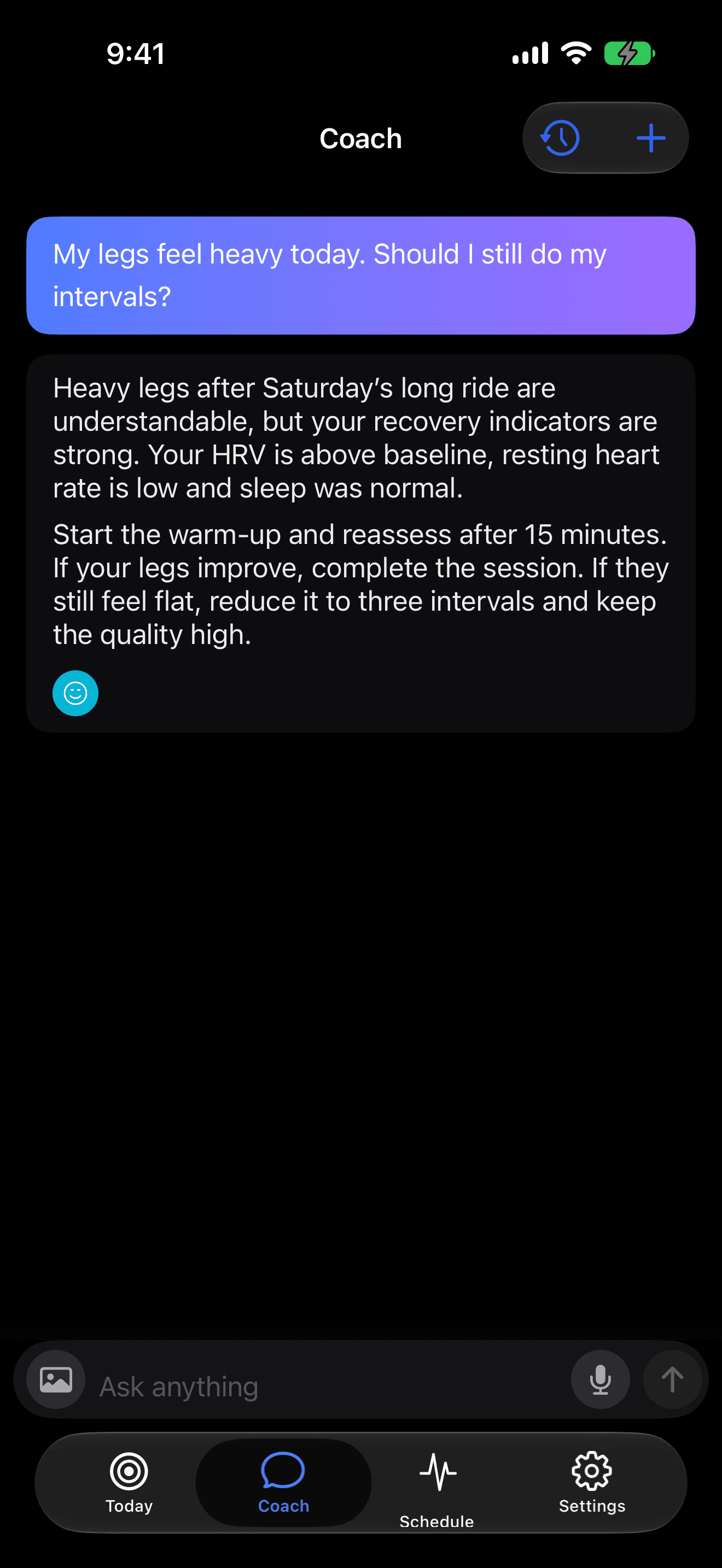
Primed can consider your supported training history, goals, recovery information and the feedback you provide. Rather than treating a VO₂ max estimate as a verdict, you can discuss how it relates to your training block and observed performance.
Perhaps your estimated aerobic fitness is stable while your sustained cycling power is improving. That's worth understanding.
Perhaps the estimate is falling alongside a longer-term decline in performance. That deserves a closer look, without assuming the number identifies the cause.
Primed's published integrations include activity and recovery data from supported sources, but do not currently confirm importing Oura's new automatic VO₂ max estimates.
The takeaway
VO₂ max is valuable. But a wearable estimate is an estimate, and one reading isn't a judgement on your training.
Use consistent measurements to look for longer-term patterns. Consider the uncertainty, compare the results with what you can actually do, and keep your goals in view.
The purpose of measuring fitness isn't to collect the biggest number.
It's to understand whether your training is taking you where you want to go.
See how Primed brings supported training data into one picture. You can start with Primed Free, with Pro available for longer-term coaching memory and insights.