Can You Get Faster Cycling Just Six Hours a Week?
Six hours a week is enough for most amateur cyclists to get measurably faster, provided you stop copying 15-hour pro templates and protect session purpose, consistency and recovery.

Yes: for the vast majority of amateur cyclists, six purposeful hours a week is enough to get measurably faster, lift threshold power, and climb or race noticeably stronger. What six hours can deliver depends honestly on where you are starting and what you are training for:
- Stepping up from 2–4 unstructured hours: Six structured hours across 12–16 weeks typically produces clear improvements in sustainable power, repeatability and 2–3 hour ride comfort.
- Maintaining from a 6–8 hour baseline: Shifting from unstructured "ride hard when you feel good" habits to deliberate session roles often unlocks new threshold and VO₂ max gains on the exact same hours.
- Stepping down from 12–15 hours or targeting 5–6 hour mountain marathons: Six hours can preserve surprisingly strong 5-to-60-minute power, though late-race durability in Hour 4 and Hour 5 has real volume limits that intensity alone cannot fully replace.
Key takeaways
- Six structured hours a week drives real gains for most amateurs.
- Expect strong 60–120 minute gains, with natural limits on 5-hour durability.
- Low-volume weeks often benefit from pyramidal rather than strict time-in-zone 80/20.
- Never stack a missed midweek interval session onto back-to-back hard days.
- Twelve steady 6-hour weeks beat erratic 10-hour hero weeks.
Why copying a 15-hour "80/20" pro plan misfires at six hours
In Stephen Seiler's foundational review of elite endurance training (Seiler, 2010) and Stöggl & Sperlich's 9-week trial in well-trained athletes (Stöggl & Sperlich, 2014), high-volume endurance athletes (frequently training 10–14+ sessions and 12–20+ hours per week) performed best when roughly 80% of sessions stayed below the first ventilatory/lactate threshold (LT₁) and ~20% of sessions targeted high intensity above LT₂.
Two misunderstandings trip up six-hour cyclists who read headlines about "80/20":
- Session count vs time-in-zone: Seiler's 80/20 observation primarily described sessions (for example, 8 easy sessions and 2 hard sessions out of 10), which translates to roughly 90% of total clock time in Zone 1 (in a 3-zone physiological model) because warm-ups, cool-downs and recoveries inside interval days are also low intensity.
- Total weekly strain at 6 hours: On 16 hours a week, 14 hours below
LT₁creates a massive aerobic stimulus on its own. On 6 hours a week spread across four or five rides, spending 5 hours 25 minutes pedalling very gently and only 35 minutes working hard often leaves recoverable capacity on the table — while the opposite extreme (riding hard on all four days) triggers rapid burnout.
In practice, many time-constrained riders thrive on a pyramidal or controlled two-quality-day structure: two focused hard sessions (threshold/sweet spot and VO₂ max, depending on block phase), one longer 2–2.5 hour steady Zone 2 anchor ride, and strictly easy Zone 1–2 on any remaining filler rides so you arrive at the two hard days genuinely fresh.
Two illustrative six-hour training weeks
These two schedules are illustrative examples showing how session roles balance across six hours, not universal prescriptions for every rider.
Example A: Hilly Gran Fondo / FTP build week (4 rides · 6 h 00 min)
Designed for a rider who prefers four focused days rather than squeezing short spins into every weekday:
| Day | Duration | Session | Physiological job |
|---|---|---|---|
| Monday | Rest | Off the bike | Absorb weekend volume; optional 25 min strength/mobility |
| Tuesday | 1 h 00 min | Threshold / Sweet Spot (3 × 12 min @ 90–95% FTP, 3 min easy) | Raise sustainable sub-threshold & threshold power |
| Wednesday | Rest | Off the bike (or 25 min strength) | Full recovery between midweek quality days |
| Thursday | 1 h 00 min | VO₂ max intervals (5 × 4 min @ 106–110% FTP, 4 min easy) | Lift aerobic ceiling and oxygen-uptake kinetics |
| Friday | 1 h 30 min | Strictly easy Zone 2 (60–68% FTP, smooth cadence) | Low-cost aerobic volume without blunting Saturday |
| Saturday | 2 h 30 min | Long Endurance + late tempo (2 h Z2 + 20 min @ 82–85% FTP) | Build glycogen efficiency and 2.5-hour fatigue resistance |
| Sunday | Rest | Off the bike | Family/life day and systemic recovery |
Example B: Crit / Zwift racer week (5 rides · 6 h 00 min)
Designed for a rider who races midweek indoors and rides with a club or solo on weekends:
| Day | Duration | Session | Physiological job |
|---|---|---|---|
| Monday | Rest | Off the bike | Clear weekend fatigue |
| Tuesday | 1 h 00 min | Zwift race or micro-bursts (15m warm-up, 35m race, 10m cool-down) | High-intensity W′ depletion/recovery and race execution |
| Wednesday | 0 h 45 min | Recovery / low Zone 2 spin (<62% FTP) | Blood flow and easy aerobic minutes without autonomic strain |
| Thursday | 1 h 00 min | Controlled Threshold (2 × 16 min @ 95–98% FTP) | Anchor steady aerobic threshold underneath race punch |
| Friday | Rest | Off the bike | Restore freshness for weekend endurance |
| Saturday | 2 h 15 min | Steady Zone 2 Endurance (conversational, steady power) | Maintain mitochondrial and capillary base |
| Sunday | 1 h 00 min | Easy aerobic spin (62–70% FTP, zero hill sprints) | Top up weekly volume while landing Monday fresh |
Three rules that protect progress on a tight time budget
- Never play "catch-up" with missed intensity: If work wipes out Tuesday's intervals, do not stack Tuesday's threshold session onto Wednesday and still attempt Thursday's VO₂ max session. Keep one quality session, let the missed hour go, and protect the spacing.
- Guard the easy days ruthlessly: On six hours a week, cyclists often feel fresh enough during the first 20 minutes of an easy spin to push 82% FTP "just to make the short ride count". That habit quietly ruins the power you can produce on Tuesday and Thursday.
- Keep deload weeks every 3–4 weeks: Busy amateurs carry full-time work and family stress alongside their six riding hours. Dropping volume by ~30–40% every fourth week lets adaptations consolidate instead of stalling.
Where an adaptive AI coach actually helps (and where it cannot)
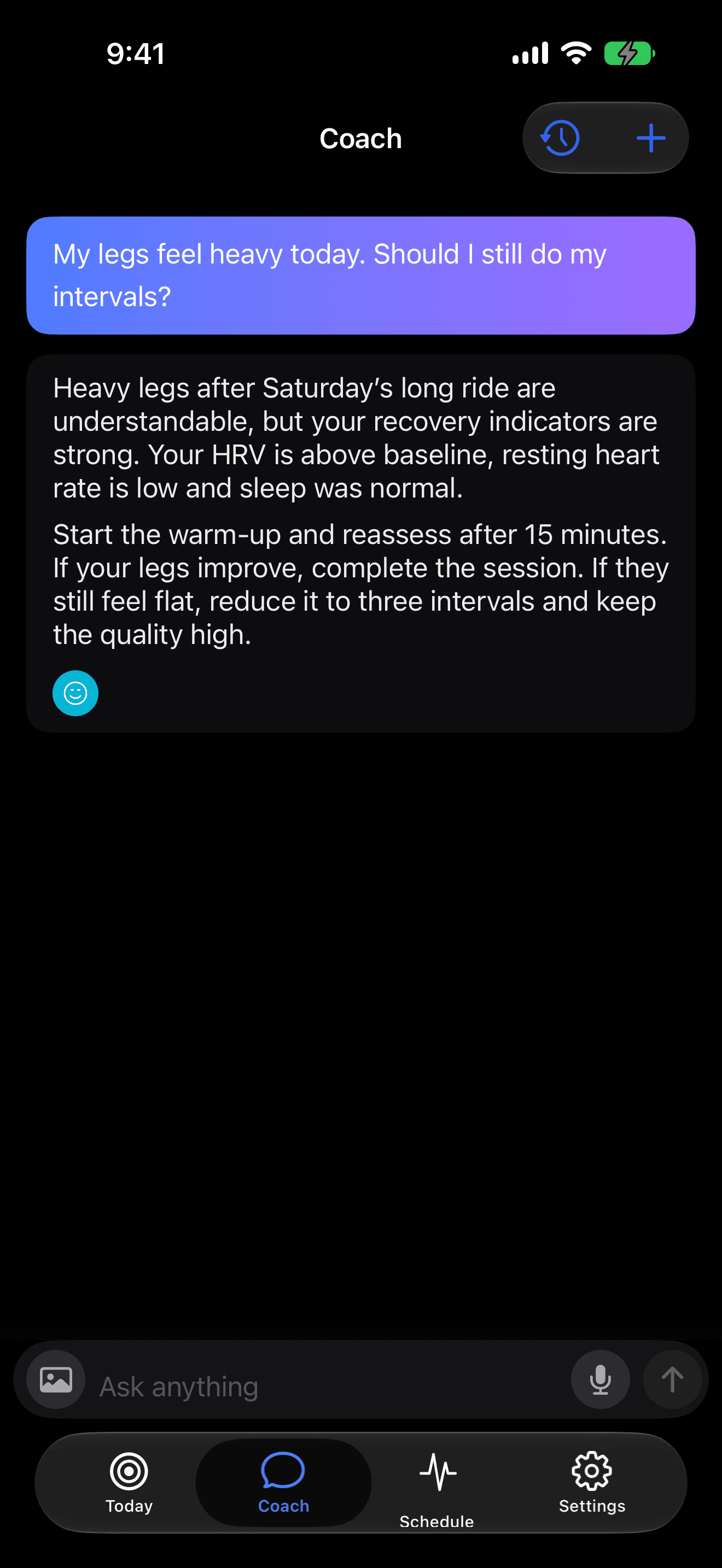
No AI coach can bypass human physiology or turn six hours into twenty. Where an adaptive coach like Primed earns its place for a time-crunched rider is preventing wasted hours when your calendar or recovery shifts:
- When a meeting trims Thursday from 60 minutes down to 40 minutes, you can ask Coach in chat to condense warm-up and intervals cleanly (for example,
3 × 8 mininstead of4 × 8 min) and export the.zwofile in seconds. - When overnight HRV, resting heart rate and five hours of sleep warn that forcing VO₂ max today will wreck your weekend ride, Today Briefing flags the trade-off before you waste a hard effort.
Explore further
- Primed Journal — browse all cycling, recovery and AI coaching guides.
- How Many Hard Cycling Sessions Should You Do Each Week? — find the right intensity ceiling for your hours.
- How to Create Custom Zwift Workouts With AI — turn a 45- or 60-minute window into a clean
.zwofile. - Primed for Cycling — build and adapt a plan around the days you can actually ride.