How Many Hard Cycling Sessions Should You Do Each Week?
For most amateur cyclists, two genuinely hard sessions a week is the sustainable sweet spot — and fast bunch rides or Zwift races count toward that cap. Here is how volume, recovery and training age shift the answer.

For most amateur cyclists, the sustainable answer is two genuinely hard sessions per week — stepping down to one during high-stress work weeks, heavy strength blocks or deload weeks, and only touching three for well-recovered athletes with high training age during a short, deliberate race-prep block. Where riders most commonly derail their season is not scheduling three interval workouts on purpose; it is doing Tuesday and Thursday intervals plus a flat-out Saturday bunch ride (or midweek Zwift race) and pretending the unstructured smashfest was "just endurance".
Key takeaways
- Most cyclists absorb two genuinely hard sessions per week sustainably.
- Fast bunch rides and Zwift races count as hard sessions.
- Recovery capacity, sleep and life stress matter alongside weekly hours.
- Three hard days a week rarely holds past a short block.
- Good AI coaches verify 'I feel fine' against recent load history.
What actually counts as a "hard" cycling session?
Sports scientists typically anchor intensity around two physiological thresholds: the first ventilatory or lactate threshold (LT₁, top of easy conversational riding) and the second threshold (LT₂, close to Functional Threshold Power or Critical Power) (Seiler, 2010). Any ride that crosses substantially above LT₁ — and especially above LT₂ — creates autonomic, glycogen and neuromuscular recovery demands that take 36 to 72 hours to clear:
- Unmistakably hard: VO₂ max intervals (105–120% FTP), sustained threshold blocks (
3 × 12–15 minat 95–100% FTP), anaerobic sprint/micro-burst sets, crits, Zwift races and fast bunch rides with repeated climbs or attacks above threshold. - Disguised hard (the common blind spot): Long 75–90 minute sweet-spot workouts (88–93% FTP), rolling "Zone 2" rides where every hill is climbed at 105% FTP, or heavy lower-body strength sessions performed the day before intervals.
- Genuinely easy: Steady Zone 1–2 riding below
LT₁(~55–70% FTP), where breathing stays calm, heart rate barely drifts and you step off the bike feeling fresher than you started.
Why two hard sessions beats four: what the physiology shows
Across observational studies of elite endurance athletes (Seiler, 2010) and prospective trials such as Stöggl & Sperlich's 9-week comparison of 48 well-trained endurance athletes (Stöggl & Sperlich, 2014), concentrating high-intensity work into roughly two key sessions per week alongside predominantly low-intensity aerobic riding produced stronger gains in VO₂peak, peak power output and time to exhaustion than threshold-heavy or high-intensity-heavy schedules.
Even WorldTour cyclists riding 20–25 hours a week rarely perform more than two or three truly maximal days in a non-race week. Adding a third or fourth hard session for a working amateur rarely adds stimulus; instead, residual fatigue drags Tuesday's 108% FTP intervals down to a laboured 98% FTP grind, dulling the very signal you wanted to create.
Example weekly structures across different training volumes
These rows illustrate typical spacing patterns rather than rigid rules for every athlete.
| Weekly riding budget | Sustainable hard-session cap | Illustrative weekly layout | Main trap to avoid |
|---|---|---|---|
| 5–6 hours/week | 2 hard (1 threshold/sweet spot + 1 VO₂ max or race) | Tue hard · Wed rest/easy · Thu hard · Sat 2–2.5 h Z2 · Sun easy | Stacking a missed Tuesday interval session onto Wednesday before Thursday's hard ride |
| 8–10 hours/week | 2 hard (plus optional controlled tempo inside Saturday) | Tue VO₂ max · Wed 75m Z2 · Thu threshold · Sat 3 h endurance · Sun 2 h Z2 | Letting both Saturday and Sunday drift into competitive Zone 3/4 bunch surges |
| 12–15+ hours/week | 2 hard (briefly 3 in short peak blocks if recovery is proven) | Tue hard · Wed 2.5 h Z2 · Thu hard · Fri easy · Sat 4 h aerobic · Sun 2.5 h Z2 | Chronic carbohydrate under-fuelling masking cumulative central fatigue |
| 50+ masters or high life stress | 1–2 hard (spaced 48–72+ hours apart, coordinated with gym) | Tue hard · Wed Z2 + strength · Thu rest · Fri/Sat hard #2 · Sun Z2 | Sandwiched heavy squats between two high-intensity bike sessions |
Five signs your current hard-session count is too high
Drop from three hard sessions to two (or from two to one for a week) whenever two or more of these markers show up together:
- Interval repeatability drops: You fade on rep 3 or 4 at wattages you held cleanly a fortnight ago.
- Blunted peak heart rate with high RPE: Legs burn at an RPE of 9/10 while heart rate refuses to climb into your normal threshold or VO₂ max band.
- Multi-day autonomic shift: Resting heart rate sits 4–6 bpm above your 30-day average or nocturnal HRV stays suppressed across 3+ consecutive mornings.
- Heavy legs on easy spins: 60% FTP feels sticky and stairs feel laboured.
- Restless sleep or irritability despite high physical tiredness.
Why a trustworthy AI coach cannot take "I feel fine" at face value
Ask a generic chatbot on Friday morning — after hard sessions on Tuesday and Thursday — "I feel good after coffee, give me a tough interval workout today" and it will almost always generate one. That sycophancy is dangerous in endurance coaching.
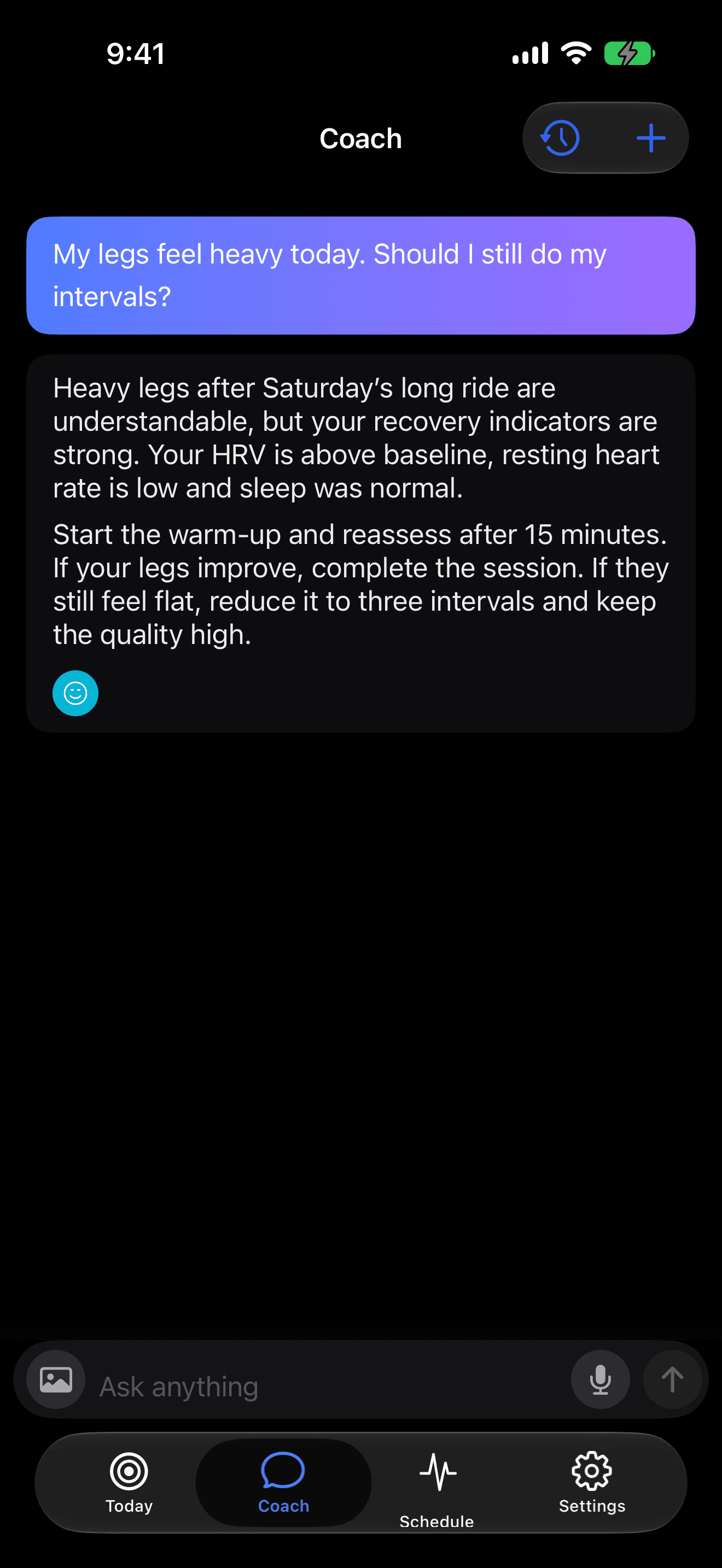
Subjective feel matters enormously when your legs say stop, yet feeling upbeat at breakfast is a lagging, noisy indicator of whether your muscular glycogen and autonomic nervous system are ready for a third severe-domain session in five days. A grounded AI coach like Primed checks "I feel fine" against your longitudinal record:
- How much time above
LT₁andLT₂have you already accumulated over the past 7 and 14 days? - What happened two months ago the last time you stacked three hard rides before a long Saturday ride?
- Do your overnight HRV, resting heart rate and sleep continuity agree with your morning optimism?
Sometimes feeling great on Friday is proof that your recovery spacing is working — and the smartest coaching call is keeping Friday easy so Saturday's three-hour ride actually lands.
Illustrative example: fitting a Thursday crit and a Saturday bunch ride
The scenario below is an illustrative planning example, not an attributed athlete log.
If you ride 8 hours a week and love both a 45-minute Thursday evening crit and a fast Saturday morning bunch ride, keeping Tuesday VO₂ max intervals on top gives you three high-strain days in five days. Two clean ways to keep progress moving without burning out:
- Option 1 (prioritise the crit): Ride structured threshold on Tuesday (
Hard #1), race the Thursday crit (Hard #2), take Friday off, and ride Saturday's bunch ride strictly sheltered in the wheels (or ride solo steady Zone 2). - Option 2 (alternate weeks): Keep Tuesday intervals + Saturday fast bunch in Week A, and swap Saturday to steady Zone 2 in Week B when racing Thursday night.
Explore further
- Primed Journal — browse all training, recovery and AI coaching articles.
- Can You Get Faster Cycling Just Six Hours a Week? — structure limited weekly hours cleanly.
- Why Is My FTP Not Improving? — check whether intensity monotony is stalling your threshold.
- High HRV, Heavy Legs: Should I Train? — how to arbitrate when wearables and subjective feel disagree.