Cycling Training After 50: What Should Actually Change?
Turning 50 does not mean retiring from fast bunch rides or VO₂ max intervals. Here is what endurance physiology says should actually shift, and how to separate age from training history and available time.
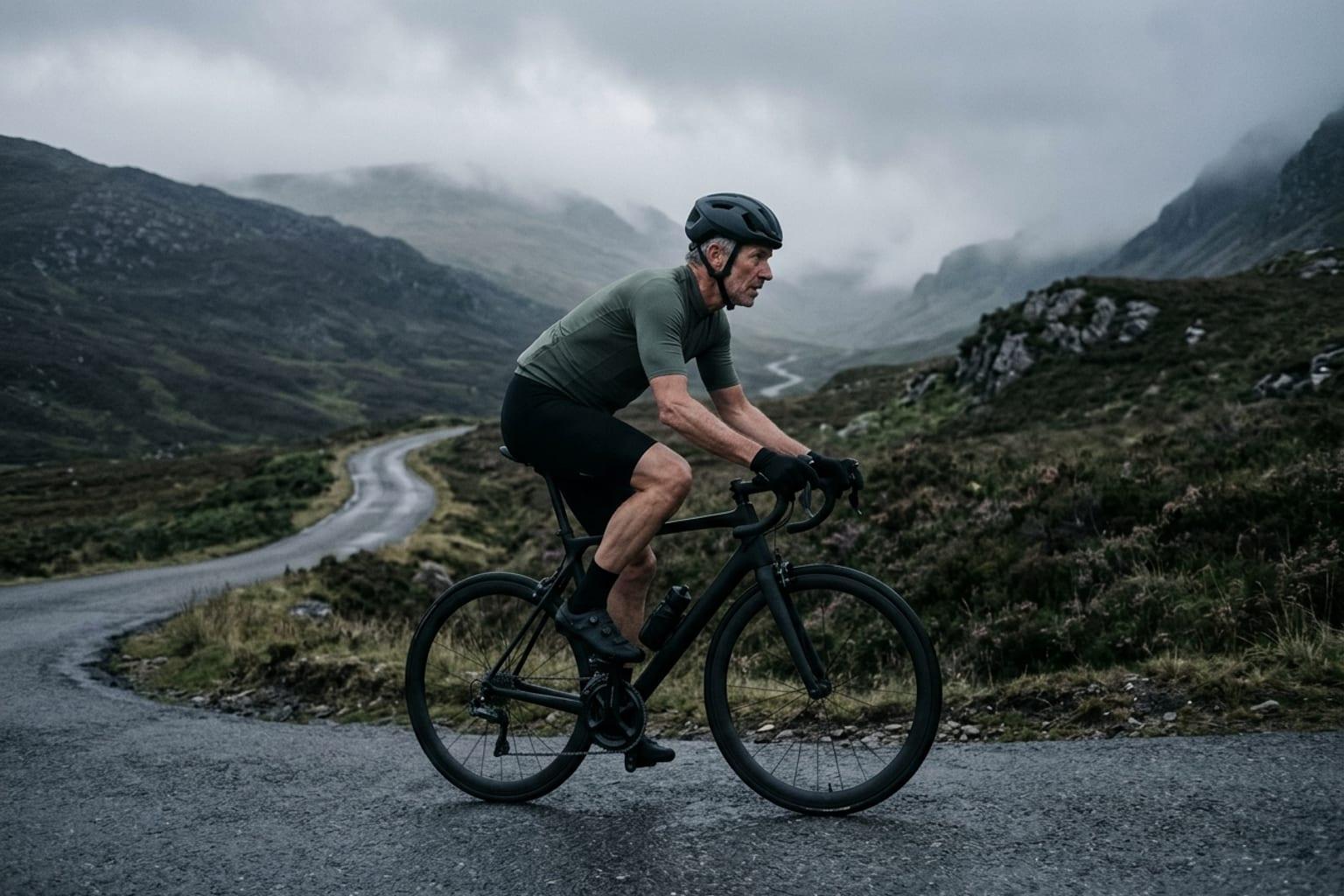
Turning 50 is not a physiological cliff, and it certainly does not mean trading structured intervals for gentle coffee spins. Across masters endurance research, what genuinely shifts past 50 comes down to three practical adjustments: inter-session recovery takes slightly longer, preserving muscle mass and bone mineral density requires heavy off-bike resistance work, and per-meal protein intake needs a slightly higher trigger to drive muscle repair. Keep high-intensity stimulus in your plan — simply earn it with cleaner 48–72 hour spacing, deliberate strength work and fewer wasted moderate-hard "grey-zone" rides.
Just as importantly, do not confuse chronological age with training age or available time. A 55-year-old cyclist with 15 uninterrupted years of 9-hour weeks will absorb load very differently from a 55-year-old returning after a decade away, or a 35-year-old sleeping five hours a night with young children. Age informs recovery margins; your individual history sets the plan.
Key takeaways
- Training history and available hours often outweigh chronological age.
- Consistent intensity roughly halves the sedentary VO₂ max decline rate.
- Space hard sessions 48–72 hours apart to absorb systemic fatigue.
- Heavy strength work protects cycling economy, sprint power and bone density.
- Consult a doctor on heart-rate medications, symptoms or persistent pain.
Four findings from masters physiology worth building around
1. Preserving intensity slows aerobic decline
In Hirofumi Tanaka and Douglas Seals' classic synthesis of masters endurance performance (Tanaka & Seals, 2008), VO₂ max declined by roughly ~1% per year in sedentary adults after their early 30s, whereas masters athletes who maintained vigorous, structured training roughly halved that trajectory to around ~0.5% per year across multi-year spans. Abandoning VO₂ max and threshold work out of caution accelerates the exact ceiling loss masters riders want to slow.
2. Recovery kinetics change more than single-day capacity
Reviews of ageing skeletal-muscle recovery in athletes (Fell & Williams, 2008) note that well-trained older cyclists often perform remarkably close to younger peers on a single fresh effort, yet experience slower repair of exercise-induced muscle damage and compounded fatigue when hard days sit too close together. What felt manageable at 30 (Tuesday intervals, Wednesday gym squats, Thursday bunch smash) frequently leaves a 54-year-old flat by Saturday.
3. Heavy strength training protects both watts and longevity
Studies led by Bent Rønnestad and colleagues in well-trained and elite cyclists demonstrated that adding heavy lower-body strength training (such as 3–4 sets of 4–10 RM squats, leg press and hip-dominant lifts with controlled eccentric lowering and maximal concentric intent) twice weekly during a 12-to-25-week preparatory phase improved pedalling economy, peak power, 40-minute time-trial power and 5-minute all-out power after three hours of submaximal riding, without reducing VO₂ max (Rønnestad et al., 2015; Rønnestad et al., 2011). Crucially for busy riders, dropping to once-weekly maintenance lifting in-season preserved those gains (Rønnestad et al., 2010).
While those controlled trials studied younger competitive riders, heavy axial resistance work carries an extra dividend past 50: road and indoor cycling are non-weight-bearing, making progressive resistance training essential insurance against sarcopenia (age-related muscle loss) and declining bone mineral density.
4. Higher per-meal protein overcomes mild anabolic resistance
Experimental breakpoint analysis comparing healthy older (~71 years) and younger (~22 years) men found that maximally stimulating post-meal myofibrillar protein synthesis required roughly 0.40 g of protein per kg of body mass in older adults versus 0.24 g/kg in younger men (Moore et al., 2015). While individual nutrition needs vary, aiming for roughly 30–40 g of quality protein in post-ride and post-gym meals — alongside adequate on-bike carbohydrates during hard rides — is a straightforward, low-risk habit.
Two adaptable schedule patterns for active 50+ cyclists
The two patterns below are illustrative templates showing spacing principles, not individual prescriptions.
Pattern 1: Standard 7-day week (7–8 riding hours + in-season strength maintenance)
- Monday: Rest or 20 min mobility
- Tuesday: Hard #1 — VO₂ max / short intervals (60 min, e.g.,
4 × 4 min@ 105–108% FTP or3 × (8 × 30s/15s)) - Wednesday: Easy Zone 2 spin (60 min) + Heavy Strength maintenance (35–40 min, performed after the easy ride or later that day so Thursday stays genuinely light)
- Thursday: Rest or 45 min recovery spin (<60% FTP)
- Friday: Hard #2 — Controlled Threshold / Sweet Spot (60–75 min, e.g.,
3 × 12 min@ 90–95% FTP) - Saturday: Long Steady Endurance (2.5–3 h conversational Zone 2, fuelled at 50–70 g carbs/hour)
- Sunday: Rest or 60–75 min relaxed social coffee ride
Pattern 2: The 9-day masters microcycle (when 7 days feels crowded)
If fitting two hard bike sessions, one long ride and heavy strength into seven days leaves your legs perpetually heavy, stretching the cycle to 9 days creates breathing room without dropping intensity quality:
- Day 1: Hard intervals (VO₂ max) · Day 2: Easy Z2 · Day 3: Heavy strength · Day 4: Steady 90m Z2 · Day 5: Rest · Day 6: Hard session #2 (threshold or fast bunch) · Day 7: Easy 45m spin · Day 8: Long 3 h Z2 ride · Day 9: Rest.
Illustrative example: trading a third hard day for fresher Saturdays
This example is illustrative rather than an attributed athlete record.
Consider an experienced 56-year-old cyclist riding 8 hours a week who felt slower every month despite grinding through Tuesday intervals, a fast Thursday bunch ride and a hilly Saturday group ride, plus Sunday gym work. Keeping total weekly riding at 8 hours while making three structural edits changes the recovery equation completely:
- Convert Thursday's fast bunch into a strictly easy 60-minute Zone 2 ride, leaving Tuesday (
Hard #1) and Saturday (Hard #2) separated by 96 hours. - Move heavy lower-body strength to Wednesday afternoon (48+ hours before Saturday's hills).
- Switch from a 3:1 to a 2:1 build-to-deload week rhythm (two progressive weeks followed by five lighter days).
Fewer competing midweek stressors lets Tuesday's intervals and Saturday's climbs return to genuine high-quality power.
Health, medications and pain: general informational boundaries
Nothing in this article is personalised medical advice. As a masters athlete, speak with your GP, cardiologist or sports physician before ramping intensity or heavy lifting if:
- You take medications that modify heart rate or blood pressure — for example, beta-blockers lower maximal and submaximal heart rate, which invalidates standard percentage-of-max-HR formulas and wearable VO₂ max estimates (power and RPE become much more reliable daily guides),
- You manage cardiovascular, metabolic, bone-density or joint conditions, or
- You notice chest pressure, unexplained breathlessness, dizziness, irregular heartbeat or persistent tendon/joint pain during or after rides.
How Primed adapts around history and recovery rather than age clichés
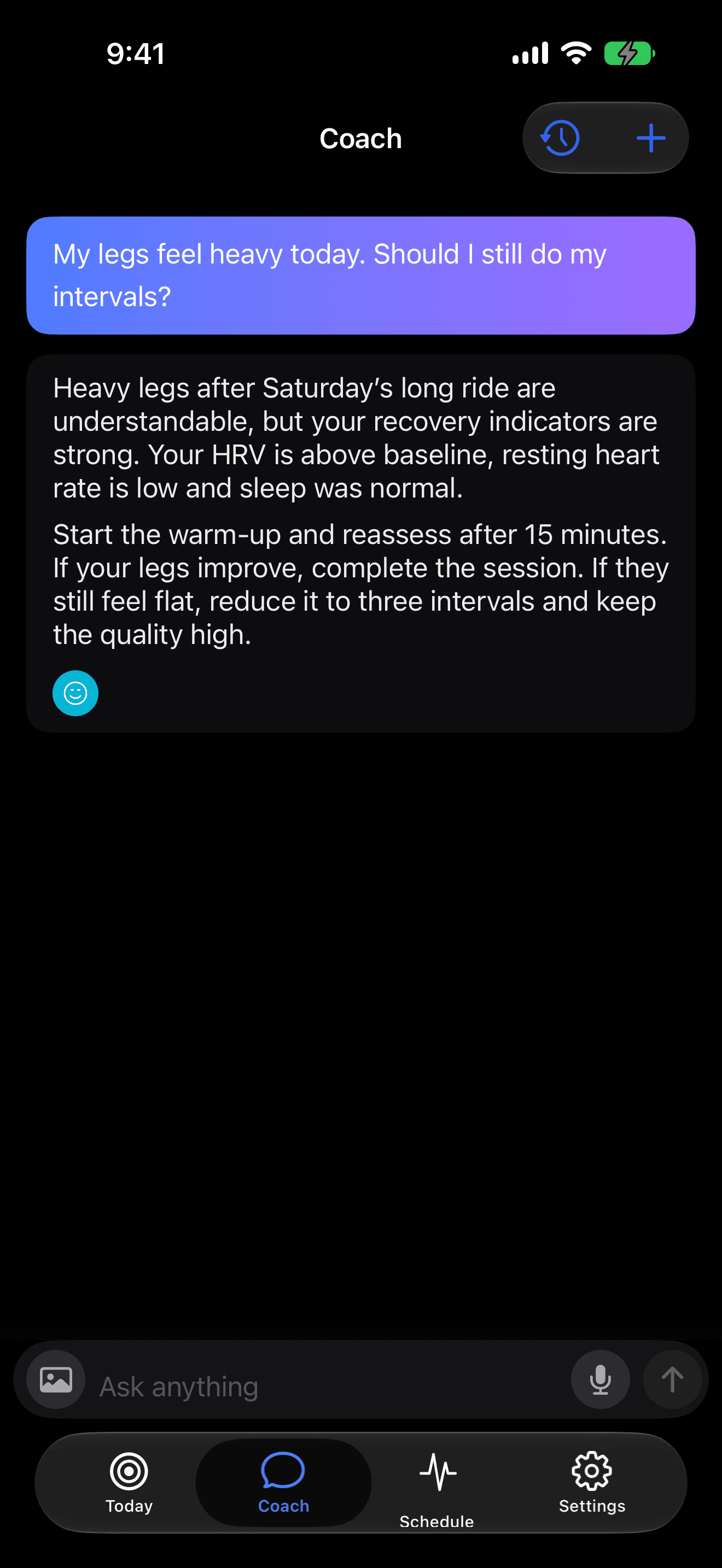
In Primed, age is handled as a sensible safety boundary (via deterministic age-band ramp-rate defaults), never an arbitrary cap on ambition. Daily coaching decisions draw on your actual connected rides, Critical Power (CP, W′, Pmax) trends, overnight HRV, resting heart rate, sleep and how your legs feel. On Primed Pro, cross-week coaching memory also retains your strength days, equipment and recurring niggles across weeks (editable anytime in Coaching Memory settings).
Explore further
- Primed Journal — browse all cycling, recovery and AI coaching articles.
- Can an AI Coach Train a Masters Cyclist? — explore a full masters cycling case walkthrough.
- How Many Hard Cycling Sessions Should You Do Each Week? — dial in weekly intensity spacing.
- Primed for Cycling — build a structured plan around your training history and schedule.