Garmin Says My Training Is Unproductive: Should I Change My Plan?
Seeing 'Unproductive' on your Garmin screen after a solid week of riding stings, yet reacting by pushing harder usually backfires. Here is what Garmin's algorithm actually measures, why weather and base blocks fool it, and how to decide your next ride.

No — do not rewrite your training plan solely because Garmin displays "Unproductive". In Garmin's Training Status model, Unproductive has a specific, narrow definition: your 7-day Acute Training Load sits inside your recommended range, while your estimated VO₂ max has trended downward over roughly the past one to two weeks.
Treat that banner as a prompt to check the surrounding evidence, never as an instruction to ride harder. Responding to an Unproductive status by forcing extra high-intensity intervals is one of the most reliable ways to tip mild fatigue — or harmless warm-weather noise — into genuine overreaching.
Key takeaways
- Unproductive means acute load is optimal while estimated VO₂ max declined.
- Heat, humidity and Zone 2 base blocks commonly trigger false flags.
- Never chase away an Unproductive banner by adding extra hard intervals.
- Cross-check repeatable power, HRV, sleep and RPE before changing plans.
- Use a 3-step decision tree to hold steady, ease back or rest.
Why Garmin flags "Unproductive" when nothing is wrong with your plan
Garmin estimates cycling VO₂ max by comparing your heart rate against your mechanical power output across qualifying rides (and incorporates overnight HRV Status on compatible watches). Because wearable VO₂ max is an algorithmic estimate rather than direct respiratory gas analysis — with validation studies showing meaningful individual error even in trained endurance athletes (2026 Garmin validation study) — anything that raises your heart rate per watt makes the model think your aerobic fitness slipped:
- Sudden heat, humidity or indoor cooling gaps: When ambient temperature jumps (or your indoor fan setup is weak), blood diverts to the skin for thermoregulation, reducing cardiac stroke volume and raising heart rate by 6–12 bpm at the exact same wattage. Garmin sees higher heart rate per watt and nudges estimated VO₂ max down.
- Shifting into a Zone 2 aerobic base phase: Moving out of a punchy interval block into steady low-intensity riding gives the algorithm fewer near-maximal calibration efforts, often causing estimated VO₂ max to drift down 1–2 points while your actual aerobic durability improves.
- Skewed Maximum Heart Rate setting: If an erroneous heart-rate spike nudged your watch's auto-detected Max HR upward (or your configured Max HR sits too low), every submaximal HR-to-power ratio shifts.
- Incomplete ecosystem visibility: Riding a commuter or gravel bike without a power meter, or wearing an Oura Ring or WHOOP strap to sleep instead of your Garmin watch, leaves Garmin inferring status from partial data.
- Genuine under-recovery or early illness (when the flag is right): Four nights of five-hour sleep, heavy work stress, glycogen depletion or an incubating virus also elevate submaximal heart rate. Here, Garmin is spotting real systemic strain — which calls for more recovery, not harder intervals.
What "Unproductive" can and cannot prove
| What the Unproductive banner establishes | What it cannot establish by itself |
|---|---|
| Heart rate ran higher relative to power (or pace) across recent sessions | Whether heat, base-phase riding, poor sleep or real deconditioning caused that shift |
| Your 7-day load volume sits in range rather than detraining | Whether your sustainable threshold power or 3-hour durability actually fell |
| A worthwhile cue to inspect sleep, HRV, weather and RPE | Whether today's scheduled workout should stay as planned, scale down or become rest |
Illustrative multi-signal walkthrough: one banner, two opposite calls
The two cases below are illustrative examples showing how wider context reverses the coaching decision, not attributed athlete records.
Case A: Spring heat spike (keep the plan)
- Garmin status: Unproductive (cycling VO₂ max edged from 56 down to 55 over 10 days; Acute Load optimal).
- Power & RPE: Tuesday's
4 × 10 minthreshold intervals held target 275 W cleanly at RPE 7/10. - Overnight recovery: 7.6 hours sleep; nocturnal HRV centred inside 30-day baseline; resting HR unchanged.
- Environmental note: Afternoon outdoor rides jumped from 16 °C to 29 °C this week.
- Coaching call: Change nothing in the plan. Increase fluid and sodium intake, strengthen indoor fan airflow, and give plasma-volume heat adaptations 7–14 days to stabilise heart rate.
Case B: Sleep debt & rising autonomic strain (pull back now)
- Garmin status: Unproductive (cycling VO₂ max dropped from 56 to 54; Acute Load optimal).
- Power & RPE: Faded to 260 W on rep 3 of Tuesday's threshold set at RPE 9/10; legs felt wooden on Wednesday's easy spin.
- Overnight recovery: 5.8 hours average sleep during a demanding work deadline; overnight HRV suppressed 13% across four mornings; resting HR +5 bpm.
- Coaching call: Scale intensity down immediately. Swap the next 3–4 days to rest and strictly easy Zone 1–2 spinning, restore sleep and carbohydrate availability, and resume intervals only once HRV, resting HR and leg feel settle.
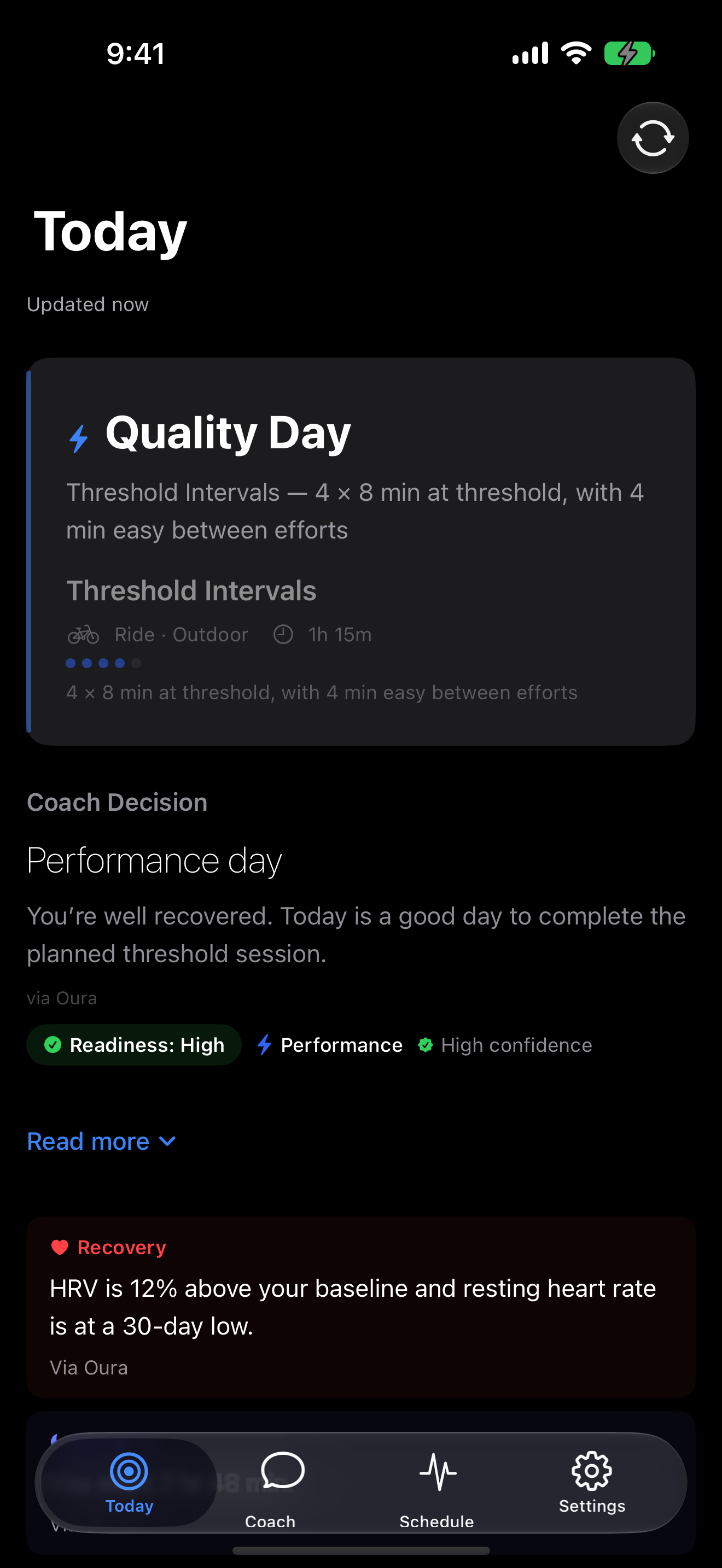
Putting recent training load, overnight biometrics and subjective feel side by side turns an isolated status label into a clear daily decision.
A 3-step decision tree before you touch your schedule
- Step 1 — Check environment, hardware & phase: Did heat/humidity rise, did you travel to altitude, did your Max HR setting shift, or did you enter a deliberate Zone 2 block? If yes, and your sleep, HRV and RPE look normal, stay on plan.
- Step 2 — Check overnight recovery & interval RPE: Are HRV and resting heart rate off baseline across 3+ mornings, is sleep short, or did your last workout feel 1–2 RPE points harder at normal watts? If yes, ease back for 3–5 days (Zone 1–2 or rest).
- Step 3 — Check 4–6 week repeatable power: Only if conditions are cool, recovery signals are steady, and your actual repeatable interval power has stalled or slipped across 4–6 weeks should you adjust your block structure or fuelling (see Why Is My FTP Not Improving?).
Important caveats on wearable data and uncertainty
When you connect Garmin Connect to Primed (available on Primed Free), Primed imports your completed rides, power/heart-rate streams and Garmin health summaries via OAuth so Coach can weigh them alongside any other connected sources (such as Wahoo, Oura, WHOOP, Withings, Intervals.icu or Apple Health). Remember that no wearable or AI coach directly measures muscle glycogen, psychological burnout or sub-clinical infection. If elevated exercising heart rate, breathlessness or unusual fatigue persists after a light week, stop training and seek clinical medical advice.
Explore further
- Primed Journal — browse all recovery, Garmin and AI coaching articles.
- Your VO₂ Max Is a Trend, Not a Daily Training Verdict — why wearable VO₂ max estimates fluctuate week to week.
- Why Recovery Scores Disagree — how to arbitrate conflicting readiness numbers across devices.
- Primed vs Garmin Coach — how Garmin's native coaching tools compare with multi-source AI coaching.