Why Is My FTP Not Improving? How to Diagnose a Cycling Plateau
A flat FTP test rarely means you simply need to suffer harder. Here is how to separate normal 2–3% test variation and protocol blind spots from a real physiological plateau, and what to change first.

If your FTP has barely moved across two tests, resist the urge to immediately cram an extra interval day into your week. Start by asking whether you are looking at a genuine physiological plateau or normal measurement and protocol noise. In competitive cyclists, standardized 20-minute FTP testing shows a typical test-retest coefficient of variation around 2.9% (Borszcz et al., 2020) and a typical error near 4.6 W on 20-minute time trials (MacInnis et al., 2019), layered on top of ±1% to ±2% power-meter hardware accuracy. For a cyclist whose true threshold sits around 270 W, readings between 262 W and 278 W can occur from sleep, glycogen, cooling or pacing variation alone.
Treat stagnation as real only when your repeatable interval power, heart-rate-to-power efficiency and multi-duration power curve have all stayed flat across 8 to 12+ weeks — and even then, breaking the plateau usually means changing the stimulus or clearing fatigue, not pushing the exact same workouts harder.
Key takeaways
- A 2–3% FTP swing often reflects normal test noise, not lost fitness.
- 20-minute and ramp tests can hide aerobic gains when W′ shifts.
- Chronic moderate-hard monotony stalls progress faster than low effort.
- Audit sleep, carbohydrate fuelling and deload weeks before adding intervals.
- Lingering unexplained fatigue warrants medical review, not harder blocks.
Step 1: Rule out a "fake" plateau
Four testing artefacts routinely disguise real aerobic progress:
- Normal biological & hardware variance (~2–3%): A 4 W drop or 0 W change between two tests six weeks apart sits squarely inside measurement noise.
- The 95% multiplier & ramp-test blind spot: While 20-minute power correlates strongly with 60-minute power across groups, Bland-Altman analyses in trained cyclists show wide individual limits of agreement between
95%of 20-minute power and true 60-minute power or individual anaerobic threshold (Borszcz et al., 2018). Both 20-minute tests and ramp tests draw partly on W′ (finite work capacity above Critical Power). If an endurance block grew your aerobic base while slightly trimming your 3-minute anaerobic punch, a ramp test can look completely flat even though you can hold 92% FTP for 25 minutes longer than before. - Indoor vs outdoor environment mismatch: Heat load, weaker fan airflow, rigid trainer mounting and lower flywheel inertia commonly leave cyclists producing 3–6% less sustainable power indoors than on a steady outdoor climb. Never compare an outdoor hill-climb FTP directly against an indoor ramp test.
- Zero-offset drift & split power meters: Testing on a smart trainer's internal sensor while training outdoors on a single-sided crank arm — or forgetting manual zero-offset calibration after garage temperature drops — easily introduces a 5–15 W offset.
What to check instead: Look at Critical Power, W′, aerobic decoupling (Pw:Hr) and submaximal heart rate at a fixed wattage (see Beyond FTP). Holding 3 × 15 min at 250 W with 6 bpm lower heart rate and lower RPE is fitness progression, regardless of what a single ramp test says.
Step 2: Work through the 6-point diagnostic
Once measurement artefacts are ruled out, genuine plateaus almost always trace back to one of six causes:
1. Stimulus monotony ("the sweet-spot ceiling")
Repeating the same weekly menu — two indoor sweet-spot workouts plus a brisk weekend ride — produces rapid early gains over 6–10 weeks and then flattens out. Once fractional utilisation (how close your threshold sits to your VO₂ max ceiling) is already well developed, grinding more sub-threshold work yields tiny returns until you either raise the aerobic ceiling with a focused VO₂ max block or expand aerobic durability with genuine low-intensity volume.
2. Fatigue masking fitness
Intensified training without adequate recovery temporarily depresses performance rather than lifting it — a classic finding illustrated even in small controlled overload studies of endurance cyclists (Halson et al., 2002). If you test at the end of five heavy weeks without a taper or deload week, you are measuring residual fatigue, not your adapted ceiling.
3. Broken multi-month consistency
Count how many of the past 12 weeks actually went to plan. Four big weeks followed by ten days off with a cold, repeated twice, feels busy in your head while delivering very little cumulative progressive overload.
4. Under-fuelled quality sessions
Attempting VO₂ max or threshold progressions on depleted muscle glycogen — or running a persistent daily energy deficit to chase watts per kilogram — blunts interval output and slows autonomic recovery. Fuelling demanding 90-minute+ sessions at 60–90 g of carbohydrate per hour often unlocks wattages an athlete assumed were physiologically out of reach.
5. Easy days ridden too hard
When Wednesday's "recovery spin" turns into 78% FTP and Sunday's endurance ride turns into chasing strava segments on every rise, you arrive at Tuesday's intervals too flat to hit ceiling-raising power.
6. Allostatic life stress and sleep debt
Long work weeks, travel and six-hour nights draw from the same autonomic recovery budget as threshold intervals. Even mental fatigue alone has been shown in laboratory crossover trials to elevate perceived exertion and shorten cycling time to exhaustion (Marcora et al., 2009).
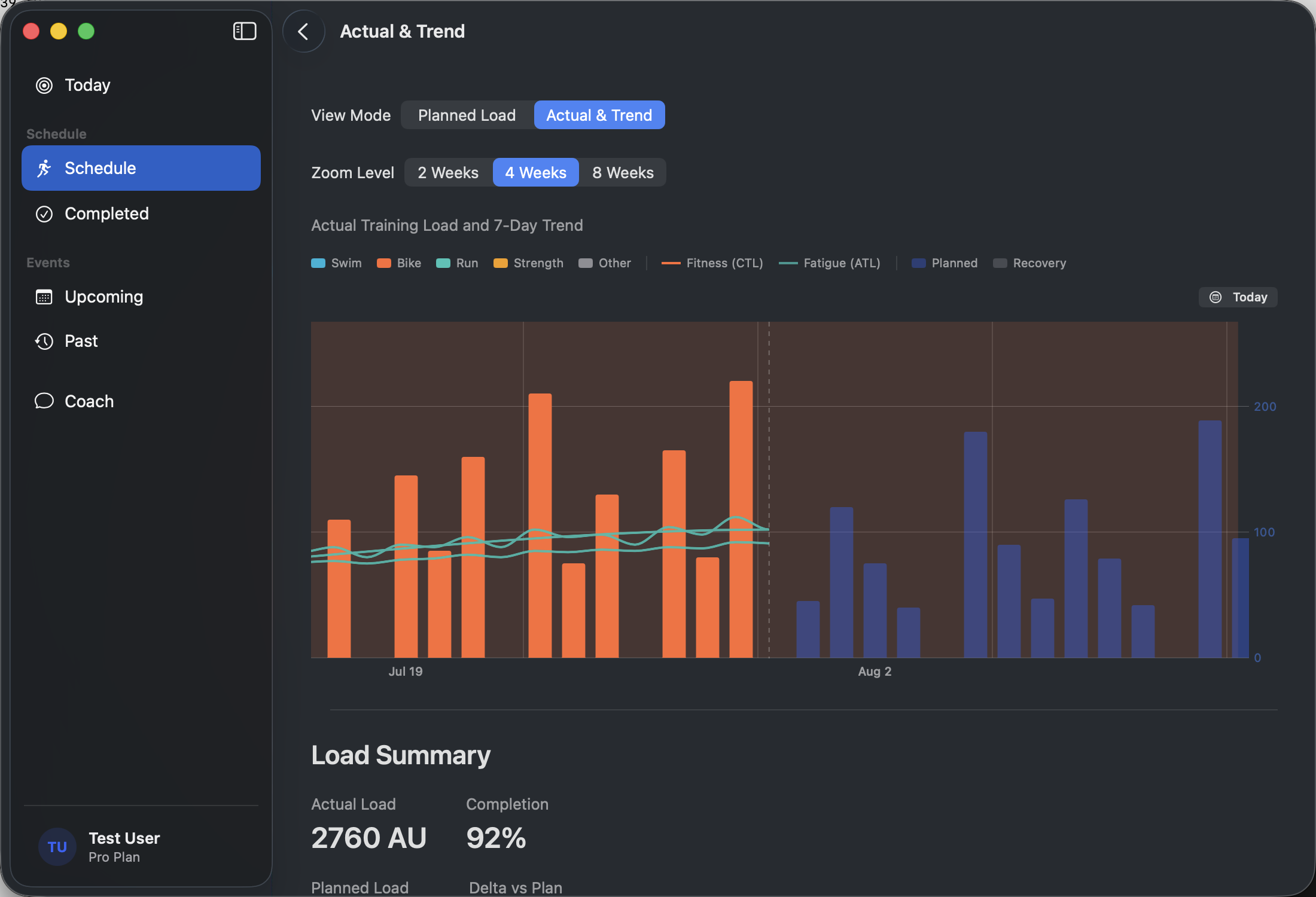
Reviewing 42-day load, 7-day fatigue and recovery trends side by side helps distinguish under-recovery from monotony.
Illustrative worked example: changing the stimulus instead of riding harder
The example below is an illustrative diagnostic walkthrough, not an attributed athlete case study.
- The stuck pattern: A 42-year-old cyclist riding 7.5 hours a week sits at a 260 W FTP across 16 weeks. Every week looks identical: Tuesday 60 min sweet spot, Thursday 60 min sweet spot, Saturday 3 h hard group ride (heavy Zone 3/4 surges), Sunday 2.5 h rolling endurance. Zero recovery weeks in three months; sleep averaging 6.3 hours.
- What the data reveals: High load monotony, worsening third-hour cardiac drift on Saturdays (+9%), and repeated failure whenever 4-minute VO₂ max efforts above 280 W appear.
- The defensible intervention (zero extra weekly hours):
- Take a 7-day deload week immediately (~4.5 hours total, strictly Zone 1–2) to clear accumulated fatigue.
- Run a focused 3-week ceiling block: one sharp VO₂ max session (
5 × 4 minat 106–110% FTP) on Tuesday, one progressive threshold session (3 × 12 min→3 × 15 min) on Thursday, and strictly conversational Zone 2 on Sunday — capping Saturday's bunch ride to sitting cleanly in the wheels every second week. - Fuel Tuesday, Thursday and Saturday rides deliberately (60–75 g carbs/hour on longer hard rides) and protect a 3:1 build-to-recovery week rhythm.
Removing chronic grey-zone fatigue creates the freshness required to actually execute the high-intensity work that nudges the ceiling upward.
What coaching data cannot see: when to seek clinical advice
Power files and wearable trends can highlight load monotony, cardiac drift, HRV suppression and sleep debt. They cannot see blood chemistry or medical conditions.
Pause hard training and speak with a qualified medical professional rather than tweaking interval plans if a plateau comes with:
- Persistent exhaustion that does not lift after 10–14 days of genuine rest,
- Unexplained breathlessness, chest discomfort, dizziness, palpitations or abnormally high heart rate at easy watts,
- Frequent colds, post-viral symptoms, or signs of low iron/ferritin, thyroid issues or Relative Energy Deficiency in Sport (RED-S).
Explore further
- Primed Journal — browse all cycling training, recovery and AI coaching guides.
- Beyond FTP: What Modelled Power Reveals About Your Cycling — how Critical Power, W′ and durability expose gains single FTP tests miss.
- How Many Hard Cycling Sessions Should You Do Each Week? — escape the three-hard-days-a-week fatigue trap.
- Training Load Isn't Fitness — separate work completed from actual adaptation.