When Should You Attack in a Zwift Race? Climbs, Crests and Breakaway Tactics
Should you attack on a climb, over a crest, downhill or on the flat? Learn when a Zwift breakaway can stay clear of a drafting pack and when to sit in.
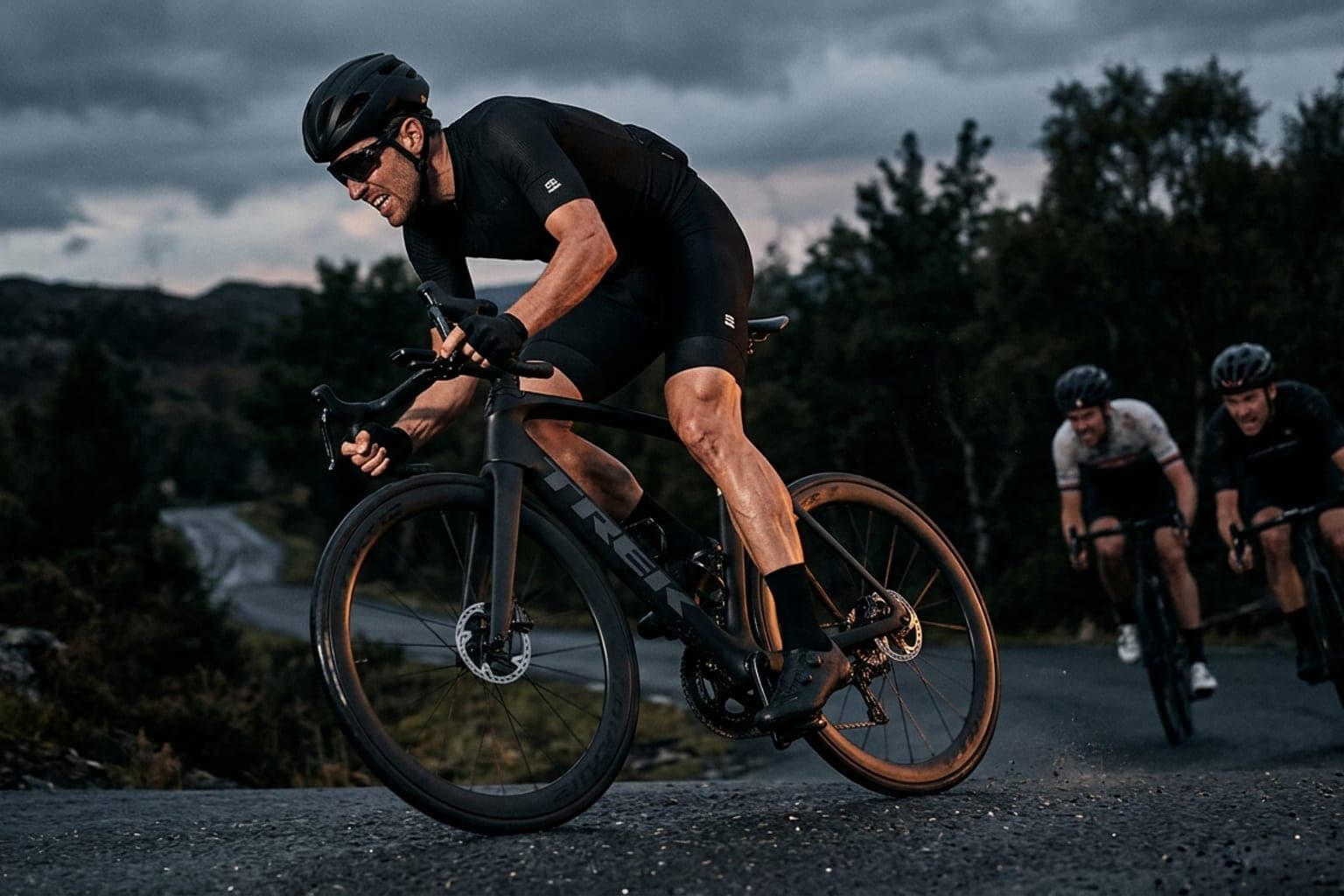
Every Zwift racer has watched someone launch a massive attack ten kilometres from the finish, open a four-second lead, and then get swallowed back up by the peloton ninety seconds later – only to get dropped on the very next climb.
When should you actually attack in a Zwift race? The right moment to attack depends on four things: the size and organisation of the chasing group, how much draft benefit the terrain provides, where riders are naturally easing off, and your own physiology. In most Zwift races, solo attacks on fast flat roads or into steep descents fail because a chasing pack enjoys huge aerodynamic savings. By contrast, attacking late on a climb and accelerating over the crest, countering a stall in a small front group, or splitting a group before a fast downhill can force decisive gaps that never come back.
Here is how to evaluate whether an attack is worth the energy – building on the mechanics in our Zwift Pack Dynamics 5 guide and our analysis of why moving up in the bunch requires sustained speed.
Key takeaways
- Solo flat attacks rarely survive against a large chasing peloton.
- The highest-leverage attack window is accelerating over a climb crest.
- Post-November-2025 downhill drafting makes packs 10 to 15% faster on descents.
- Small-group breakaways succeed when three or more riders share turns.
1. Why getting a gap is easy – and staying away is hard
Opening an initial two- or three-second gap in Zwift is relatively straightforward if you launch from a sheltered position with momentum. Staying away is an entirely different physics problem.
Once you are clear of the pack on a flat road at 42+ km/h, you pay 100 per cent of the aerodynamic drag cost for every metre you ride. Meanwhile, the chasing peloton behind you benefits from multi-rider draft shelter – which in Zwift Insider's single-file drafting tests reduced the power required for sheltered riders by roughly 25 to 33 per cent compared with the rider on the nose of the group.
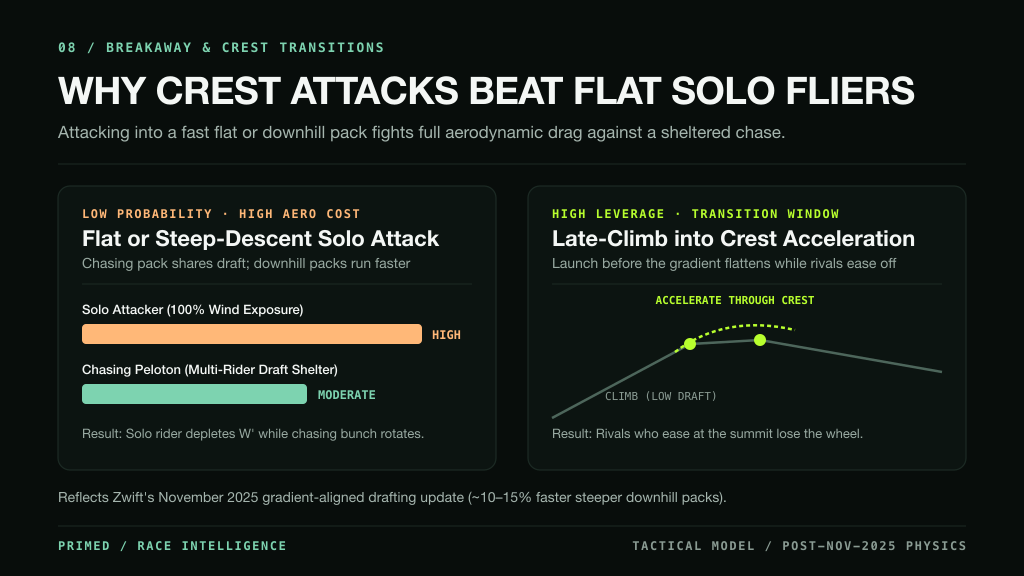
That asymmetry explains why group size dictates breakaway survival:
- Solo vs a 25+ rider peloton on the flat: Almost impossible to sustain unless the bunch behind completely stops chasing (which rarely happens in standard Zwift scratch races).
- 3 to 5 committed riders vs a small or fractured chase group: Once three or more riders roll through together, the breakaway itself forms a moving draft pocket. If the group behind is small (say 5 to 8 riders) or hesitates over who should chase, a small breakaway can hold or extend its lead at a manageable threshold pace.
2. How terrain transitions and the November 2025 drafting update change attack selection
To choose the right place to attack, you have to understand how drafting changes across flats, climbs, crests and descents in the current version of Zwift:
Steep climbs (5%+ gradient): Where watts per kilogram separate the group
As road speed drops on a steeper climb, gravity becomes the dominant resistive force and aerodynamic draft savings shrink. Although Zwift's November 2025 drafting update aligned draft shadows with the slope of the road, the lower speed on a climb still means rivals cannot hide as cheaply behind your wheel as they can at 42 km/h on the flat.
If your 1- to 5-minute watts per kilogram are among the strongest in the field, sustained pressure on a steep climb forces heavier or more fatigued riders above their Critical Power ($CP$) until their above-threshold work reserve ($W'$) runs dry.
Climb crests and false-flat summits: The highest-leverage attack window in Zwift
The single most effective tactical move in Zwift racing is the over-the-top crest attack.
Most riders pace a climb to reach the KOM banner and instinctively ease off the pedals for three to five seconds to catch their breath at the summit. If you begin accelerating 15 seconds before the crest and hold high power for 10 to 15 seconds past the arch onto the flat or downhill transition, two things happen simultaneously:
- Your speed jumps from climbing pace (20 km/h) to flat/descent pace (45+ km/h) while rivals are still in recovery mode.
- Any rider who lets a three- or four-metre gap open at the summit loses the draft just as aerodynamic drag becomes the dominant force again.
Descents after the November 2025 update: Group splits work, solo fliers get caught
In November 2025, Zwift corrected how road pitch is factored into drafting calculations (Zwift Insider analysis). Because draft wakes now align with the downward slope, descending packs hold the draft much more easily and travel roughly 10 to 15 per cent faster on steeper descents.
This has two major tactical consequences:
- Attacking solo off the front of a large pack on a steep descent rarely works: Even if you drop into a Supertuck (which requires a -3% or steeper gradient, roughly 57–58 km/h, near-zero watts, and no draft ahead), a compact chasing pack behind you will draft down the mountain at higher collective speed and reel you in.
- Splitting a small front group over the crest into a steep descent is devastating: If you crest a climb with three or four riders and force a 5-second gap over the top, your small front group immediately gets the fast post-November-2025 downhill pack speed while dropped solo chasers behind have zero chance of closing the gap on the descent.
3. Decision guide: When to attack vs when to sit in
Use this decision table to match your race situation and physiological profile to the right tactical choice:
| Race scenario | Recommended decision | Why it works (and what to watch out for) |
|---|---|---|
| Final 15 s of a punchy climb leading into a flat or fast descent | Attack through the crest (if with the front group) | Rivals naturally ease at the KOM banner; opening a 3–4 s gap before speed rises forces dropped riders into an expensive solo chase. |
| Small front selection (4–8 riders) where everyone stops pedalling after a bridge | Counter-attack immediately from 3rd or 4th wheel | In small groups, hesitation is real. Launching with momentum while rivals look at each other can establish a winning 1–2 km move. |
| 30+ rider peloton travelling at 42+ km/h on a flat circuit | Sit in and save matches | Multi-rider draft shelter makes the peloton too fast to hold off solo. Save your anaerobic capacity for the final-kilometre sprint. |
| Double Draft event on a flat or rolling course | Do not attack solo; only follow multi-rider splits | Double Draft magnifies the peloton's speed advantage; solo breakaways pay an enormous penalty. |
| Long uphill finish (3–8 min climb to the line) | Pace progressively from the bottom; attack inside the final 60–90 s | Going all-out in the first 30 seconds depletes $W'$ too early and slows you down on the upper slopes. |
| Strong 3–5 min aerobic engine, weak 5–10 s peak sprint | Attack 1.5–3 km out on the final rise or roller | Arriving at the final 200 m with pure sprinters guarantees defeat; force a selection before the bunch sprint winds up. |
4. How to execute an attack cleanly in Zwift
When the conditions are right to go, how you launch determines whether you snap the elastic or tow the entire group along on your wheel:
- Launch from 3rd to 5th wheel, never from 1st wheel: If you are already riding on the front, everyone behind you is glued to your draft and will see your watts rise immediately. Start your acceleration from a few wheels back so you build a 4 to 6 km/h speed differential inside the draft before passing the leader.
- Use an Aero (helmet) or Feather PowerUp strategically: An Aero PowerUp reduces your wind resistance for 15 seconds, making it ideal for extending a crest transition or late solo flyer, while a Feather PowerUp reduces your weight on the steep pitch right before the summit.
- Commit for 15 to 25 seconds, then transition to threshold: A 4-second spike only alerts the bunch. Once you hit the front at speed, hold a hard 15- to 20-second effort until the gap stretches beyond draft range (roughly 4 to 5 seconds on the Riders Nearby board), then settle into a sustainable high-tempo or threshold posture rather than blowing up completely.
Know your own attack profile before you race
Deciding whether to attack from two kilometres out or wait for a bunch sprint comes down to knowing your own power-duration strengths and how recovered you are on race day. Primed connects your historical training and recovery from Garmin, Intervals.icu, Oura, WHOOP, Withings and Apple Health, models your Critical Power ($CP$), $W'$ and sprint profile across your completed rides, and builds adaptive training plans with
.zwoworkout exports for Zwift (note that Primed analyses your completed activities and readiness rather than live in-race Zwift telemetry).
Frequently asked questions
Can a solo breakaway stay away in a Zwift race?
Solo breakaways are very difficult to sustain against a large, fast peloton on flat roads because the chasing group shares multi-rider draft savings while the lone rider faces full wind resistance. A solo move has the best chance of succeeding when launched over the crest of a late climb inside the final two to three kilometres, or from a small, tired front selection of five to eight riders where the chase hesitates.
Why is attacking over the crest of a climb so effective in Zwift?
On a steep climb, speeds are low and riders are working near their physiological limit; as soon as they reach the KOM arch, many racers instinctively ease off for several seconds. If you accelerate through the crest and keep pushing for 10 to 15 seconds onto the flat or descent, you open a gap right as speeds climb above 40 km/h – cutting rivals off from your draft when aerodynamic shelter matters most.
Did Zwift's November 2025 drafting update make downhill attacks harder?
It made solo downhill attacks against a large group much harder to sustain, because aligning draft wakes with road slopes increased steeper downhill pack speeds by roughly 10 to 15 per cent (Zwift November 2025 update). However, it made small-group crest attacks before a descent even more decisive: if three or four riders gap the rest of the field over the summit, that front group now descends much faster than any solo chaser behind.
Continue reading the Primed Zwift racing series
- Zwift Sprint Strategy: Final-Kilometre Positioning, Timing and Launch
- How to Race Smarter in Zwift: 10 Tips for Using Pack Dynamics to Your Advantage
- Why You Can't Move Up in a Zwift Race (Even When You Increase Your Watts)
- Why You Keep Getting Dropped in Zwift Races (Even With a Good FTP)
- Inside a Zwift Race: How One Over-Paced Climb Cost the Front Group
- How to Train for Zwift Racing: Workouts, Recovery and a Smarter Training Plan