Zwift Sprint Strategy: Final-Kilometre Positioning, Timing and Launch
When should you move up in the final kilometre, when should you launch your sprint, and why does peak 5-second power often lose in Zwift? Learn practical sprint tactics.
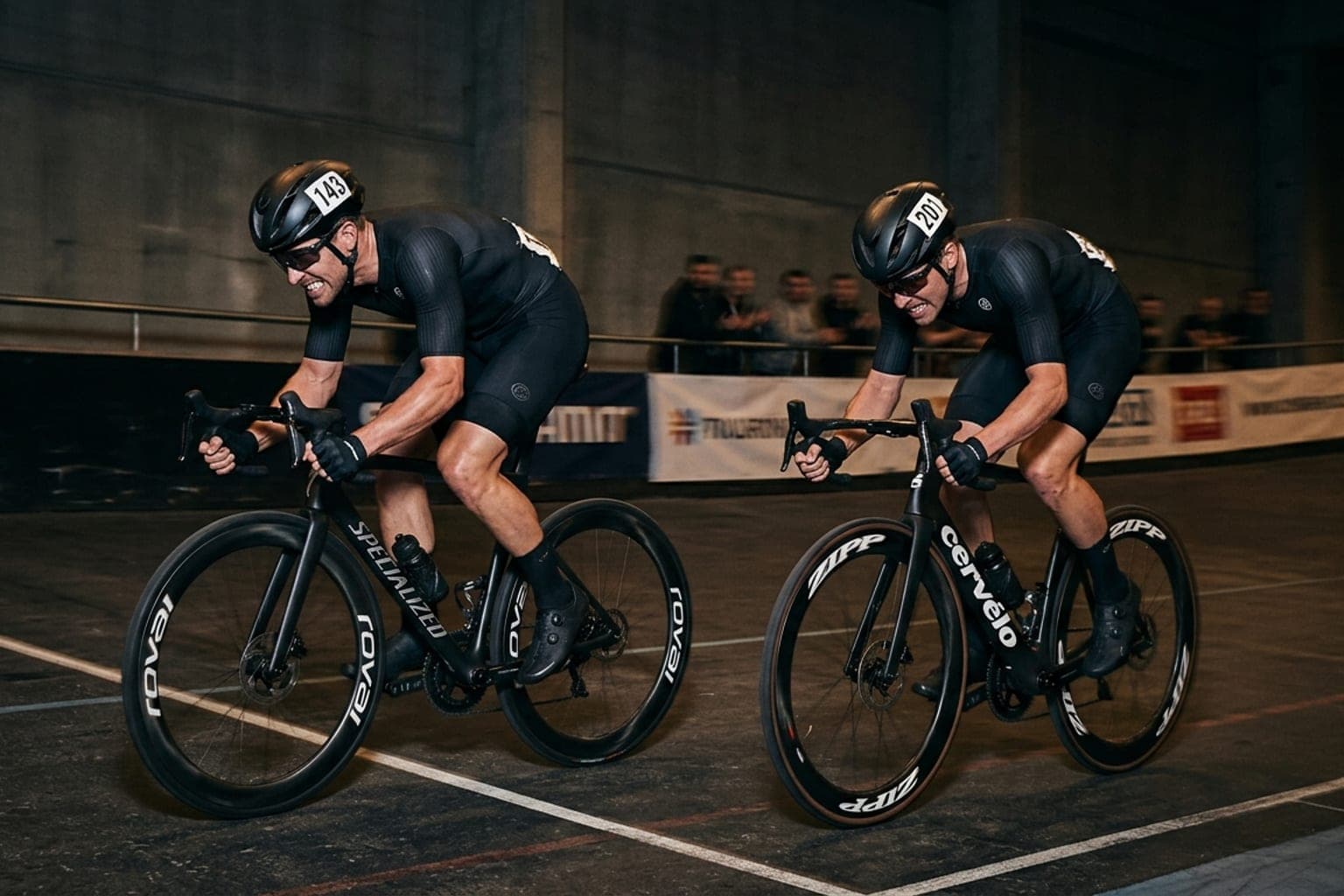
Look at the results of almost any flat Zwift race and you will notice something striking: the rider who recorded the highest 5-second peak watts frequently finishes fourth, sixth or tenth, while someone with a lower peak number wins by two bike lengths.
How do you win a bunch sprint in Zwift? Winning a Zwift sprint depends on four linked decisions: arriving in the final kilometre with your above-threshold work reserve ($W'$) intact, moving into the front five to eight wheels before 500 metres to go, winding up your acceleration inside the draft so you hit the wind with a speed advantage, and timing your launch to match the course speed and your personal 5- to 30-second power profile.
Here is how to navigate the final kilometre of a Zwift race – building on our Pack Dynamics 5 race guide and our breakdown of how to move up in the bunch without wasting watts.
Key takeaways
- Move into the front five to eight wheels before 500 metres remain.
- Launch from the draft with momentum rather than sprinting from first wheel.
- Match your launch distance to your 5-second versus 20-second power profile.
- Fresh legs at the finish beat a higher fatigued peak sprint number.
1. The final kilometre: step-by-step positioning without steering
In a real-world criterium, a sprinter can dive through a narrow gap if they have the bike-handling nerve. In a Zwift race without manual steering, Pack Dynamics 5 (PD5) governs collision avoidance and lateral spacing around the riders ahead of you.
If you start your sprint from 22nd wheel at 250 metres to go, your avatar has to steer around multiple rows of riders who are also accelerating. By the time PD5 routes you to clean air, the front three riders are already crossing the line at 60 km/h.
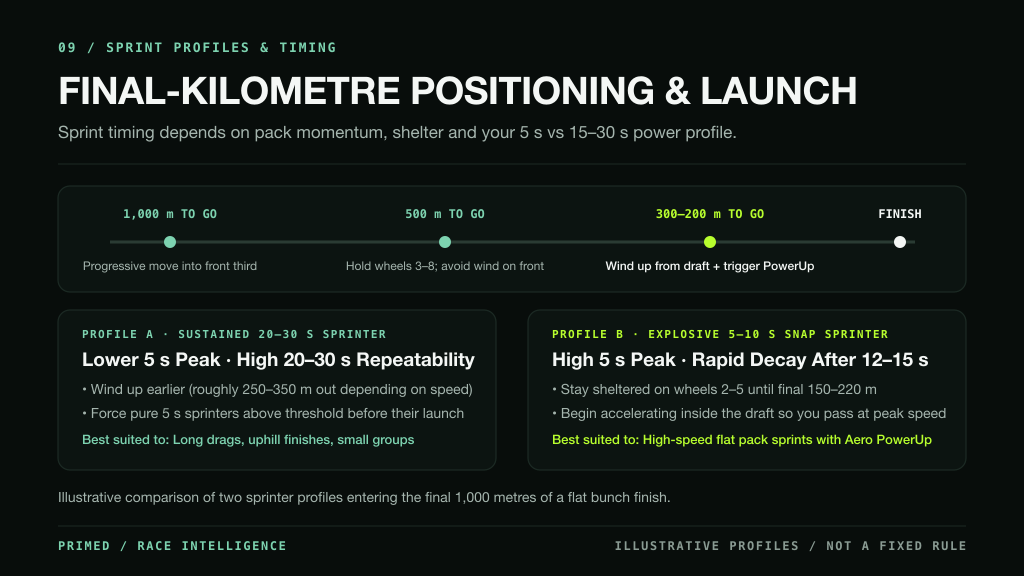
Use this four-stage countdown to manage the final 1,500 metres:
- 1.5 km to 1.0 km to go – Assess and position early: Check the group size, finishing gradient and your PowerUp. If you are sitting behind 15th wheel in a large bunch, use a smooth 10- to 15-second effort now – before the pace spikes – to move into the front third of the group.
- 1,000 m to 500 m to go – Hold wheels 3 to 8: The pace almost always lifts inside the final kilometre as nervous riders surge early. Your single goal here is to stay near the front without touching first wheel. Let early physiological fliers tow the group at 46 km/h while you stay sheltered in third to eighth position.
- 500 m to 300 m to go – Anticipate the launch wave: Watch the watt-per-kilogram numbers of the riders immediately ahead and in the right-hand Riders Nearby list. In a large pack, the winning sprint wave usually starts when two or three riders between 4th and 10th wheel jump simultaneously.
- 300 m to 150 m to go – Wind up inside the draft, then trigger your PowerUp: Begin spinning up your cadence and power one to two seconds before you come off the wheel ahead so you pass the lead rider with a 4 to 6 km/h speed differential.
2. Why 5-second peak power is not enough: comparing two sprinter profiles
Two riders can both consider themselves "sprinters" while having completely different power-duration profiles over 5, 15 and 30 seconds. How you time your launch must reflect which profile you actually have:
| Dimension | Profile A: Sustained 20–30 s ("Diesel") Sprinter | Profile B: Explosive 5–10 s ("Snap") Sprinter |
|---|---|---|
| Power signature (illustrative) | Moderate 5 s peak (e.g. 11–13 W/kg), but holds 85–90% of that output across 20–30 seconds. | High 5 s peak (e.g. 14–16+ W/kg), but power decays steeply after 12–15 seconds. |
| Biggest tactical mistake | Waiting until 150 m to go in a fast flat sprint and getting out-accelerated over the final 8 seconds. | Launching into the wind at 350 m to go, fading at 80 m, and getting swamped before the line. |
| Ideal launch window (flat finish) | 250 to 350 m to go ( roughly 18–24 seconds of effort depending on speed). | 150 to 220 m to go (roughly 10–14 seconds of effort coming off a fast wheel). |
| Tactical objective | Make the sprint long and hard from 350 m out so pure 5 s sprinters have to burn their snap just to hold your wheel. | Surf the wheel of an early launcher until 180–200 m remains, then slingshot past out of the draft. |
| Best finishing terrain | Long false-flat drags, uphill sprints (2–4% grade), and small tired breakaway groups. | High-speed flat or slightly downhill bunch finishes with a strong lead-out wave. |
3. Small-group sprint vs 40-rider peloton sprint
The size of the group completely changes how fast the final 500 metres unfolds:
- In a small group (3 to 6 riders): Pack speed is lower (often 36 to 40 km/h on the flat), nobody wants to work on the front, and riders frequently soft-pedal at 500 metres to go. Because the starting speed is lower, a given distance takes more seconds to cover – and a rider who launches first from fourth wheel with a committed jump can open a three-metre gap before rivals react.
- In a large peloton (25+ riders): Pack speed is already high (45 to 52 km/h) because of multi-rider draft shelter and early lead-out surges. At 50 km/h, you cover nearly 14 metres every second, meaning 250 metres takes roughly 18 seconds. Here, sitting too far back is fatal, but hitting the wind at 400 metres is almost always too early unless you have a 30-second Aero PowerUp or a steep downhill tail.
4. Using PowerUps in a Zwift sprint
In events where PowerUps are enabled, timing your activation in the final 400 metres can be worth several bike lengths:
- Aero Boost (Helmet): Reduces aerodynamic drag for 15 seconds (or 30 seconds in special long-PowerUp events). Because aerodynamic drag scales sharply with speed, trigger the Aero Helmet right as you step out of the draft into the wind at 50+ km/h – not while you are still sitting sheltered on fourth wheel at 600 metres to go.
- Draft Boost (Van): Increases the draft benefit you receive from riders ahead. Trigger it at 450 to 300 metres to go while surfing a fast lead-out wheel so you save watts and carry extra momentum into your final jump; once you hit first wheel in clean air, the Draft Van provides zero benefit.
- Anvil or Feather: Use a Feather on an uphill sprint finish (such as the Libby Hill or Innsbruckring rises), or an Anvil if the final 500 metres pitches downhill at -3% or steeper.
5. Why fatigued sprints look nothing like fresh sprints
Many riders test their 5- and 15-second power when fresh at the start of a ride and assume those watts will be there at the end of a 45-minute race.
In reality, your sprint at the end of a race is governed by fatigue resistance and how much of your finite above-threshold work capacity ($W'$) you spent in the final five minutes. If you had to burn a 20-second effort at 600 watts just to move from 30th wheel to 8th wheel at 800 metres to go, your peak sprint 30 seconds later may be 150 to 250 watts lower than your fresh best.
That is why staying sheltered in the bunch and avoiding repeated wasted surges during the middle of the race is actually the first step of your sprint strategy.
Train your fresh and fatigued sprint profile with Primed
Knowing whether to launch at 300 metres or 180 metres starts with understanding your own 5-, 15- and 30-second power curve across your training history. Primed connects your completed rides and recovery signals from Garmin, Intervals.icu, Oura, WHOOP, Withings and Apple Health, tracks how your short-duration power holds up under training load, and exports structured
.zwoworkouts directly into Zwift (Primed analyses your completed activities and readiness rather than live in-race Zwift telemetry).
Frequently asked questions
How far out should I start my sprint in a Zwift race?
There is no single fixed distance because sprint duration depends on road speed, gradient and your personal power decay. On a fast flat finish at 48 to 50 km/h, 200 to 250 metres takes roughly 14 to 18 seconds – a good target for most riders launching from a sheltered wheel. On an uphill finish where speed drops to 25 km/h, 250 metres can take over 30 seconds, meaning you must wait until 120 to 150 metres to go or pace a progressive effort.
Where should I sit in the final kilometre of a Zwift bunch sprint?
Aim to sit between 3rd and 8th wheel entering the final 500 metres. Sitting on 1st or 2nd wheel exposes you to the wind too early, while sitting behind 12th to 15th wheel without steering leaves you vulnerable to pack splits and collision-avoidance delays when the sprint opens.
Why do I lose Zwift sprints even when I hit my best 5-second power?
Usually for one of two reasons: either you launched from too far back and spent your best 5 seconds overtaking mid-pack riders while the leaders were already sprinting for the line, or you jumped from first wheel with no draft slingshot and faded over the final 10 seconds as riders with better 15- to 20-second speed came past you out of your slipstream.
Continue reading the Primed Zwift racing series
- How to Race Smarter in Zwift: 10 Tips for Using Pack Dynamics to Your Advantage
- Why You Can't Move Up in a Zwift Race (Even When You Increase Your Watts)
- When Should You Attack in a Zwift Race? Climbs, Crests and Breakaway Tactics
- Why You Keep Getting Dropped in Zwift Races (Even With a Good FTP)
- Inside a Zwift Race: How One Over-Paced Climb Cost the Front Group
- How to Train for Zwift Racing: Workouts, Recovery and a Smarter Training Plan