Why You Keep Getting Dropped in Zwift Races (Even With a Good FTP)
Have a solid FTP for your category but still lose the bunch on starts, short climbs or crests? Learn how to diagnose whether you are getting dropped tactically or physiologically.

Few things in indoor cycling are more discouraging than checking a race results table, seeing that your Functional Threshold Power (FTP) and average watts per kilogram match the riders on the podium, and knowing you were dropped fifteen minutes before the finish.
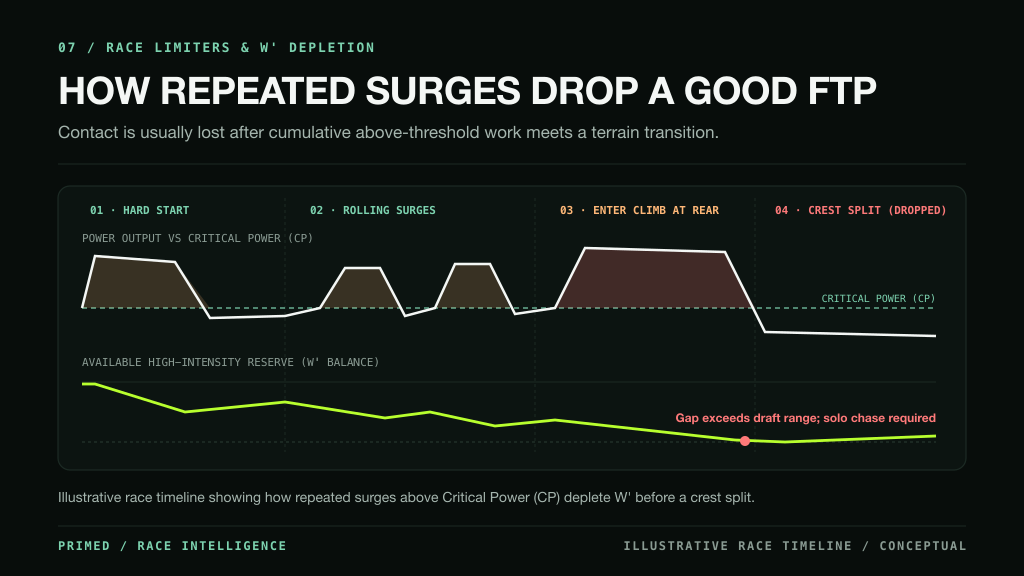
Why do you keep getting dropped in Zwift races when your FTP is competitive for your category? Because Zwift races are rarely decided by steady one-hour power. Riders lose contact when repeated surges above Critical Power ($CP$) deplete their finite high-intensity work reserve ($W'$), or when poor pack positioning forces them to bridge splits alone in the wind – often right as the bunch accelerates over the crest of a short climb.
Instead of blindly trying to add another ten watts to your FTP, you need to diagnose how and where the elastic snapped. This guide shows you how to separate a tactical positioning mistake from a trainable physiological limiter, complementing the workout structures in our Zwift racing training guide and the bunch skills in our Pack Dynamics 5 guide.
Key takeaways
- Zwift races drop riders through repeated surges, not steady threshold pace.
- Entering short climbs at the back turns small splits into solo chases.
- Depleting your W′ reserve early leaves nothing for decisive crest accelerations.
- Reviewing power history alongside recovery separates positioning mistakes from fitness limiters.
1. Why a good FTP doesn't guarantee staying with the bunch
Your FTP estimates the highest power you can sustain in a steady state for roughly 40 to 60 minutes. A Zwift scratch race is almost the exact opposite of a steady state:
- The start is a 60- to 180-second VO2 max effort: Out of the pens, the peloton accelerates to 42 to 48 km/h. Even if the pace settles two minutes later, a rider with limited 1- to 3-minute repeatability starts the race deeply in debt.
- Drafting hides the gap until it is too late: Inside a compact peloton, drafting saves roughly 25 to 33 per cent of the power required at the front. The moment a two- or three-metre split opens ahead of you, your aerodynamic drag jumps while the group ahead continues sharing shelter.
- Recovery happens near threshold, not at rest: When you surge at 130% of FTP to hold a wheel on a roller, the bunch rarely slows to an easy spin afterwards. If the group settles back at 88 to 95% of your FTP, your above-threshold reserve ($W'$) reconstitutes very slowly (Poole et al., Medicine & Science in Sports & Exercise, 2016).
2. Tactical gap vs physiological limiter: how to tell the difference
Before changing your training plan, inspect what happened in the 90 seconds leading up to the moment you lost the group. Most race detachments fall into one of five patterns:
| Where you lost contact | What your race file usually shows | Primary root cause (Tactical vs Physiological) | Immediate fix for your next race |
|---|---|---|---|
| First 2–4 minutes out of the start pen | Heart rate and power pinned well above 5-minute best from second zero; dropped before the bunch settles. | Both: Inadequate warm-up + insufficient 1–3 min high-intensity tolerance. | Complete a progressive 15-min warm-up with two 20-second openers; spin up 5 seconds before the banner drops. |
| Mid-pack on a flat or rolling section | Average power looks modest, followed by a sudden 15-second spike after a split opened two wheels ahead. | Tactical positioning: Late reaction to the Close the Gap prompt or sitting behind a tiring wheel. | Watch riders two to three wheels ahead; close gaps in the first 1–2 metres while still inside partial shelter. |
| Halfway up a 1–3 minute punchy climb | Entered the bottom of the climb in the back quarter; had to surge harder than the leaders just to pass dropped riders. | Tactical entry + 2-min power: Starting at the rear left zero buffer to slide back on the grade. | Move into the front third during the final 30–45 seconds of flat road before the climb (overtaking guide). |
| Over the crest of a climb or onto a descent | Held the group all the way to the KOM arch, eased power for 4–6 seconds to breathe, and watched the pack disappear at 55+ km/h. | Tactical transition: Easing at the summit right as leaders pushed through into the post-November-2025 downhill draft. | Never ease at the arch. Pedal hard for 5–10 seconds past the crest until tucked safely inside the descending bunch. |
| Late in the race on the 4th or 5th climb/surge | Handled the first three climbs at the same wattage, then legs emptied at a power you normally hold easily when fresh. | Physiological durability / recovery: Cumulative $W'$ depletion, inadequate cooling, or entering the race fatigued. | Audit earlier wasted surges in the bunch, check indoor fan cooling, and review your 7-day training load before racing. |
3. What a real post-race debrief looks like
You do not need live in-race telemetry of your opponents to understand why you were dropped. Your own completed activity file – power, heart rate, cadence, speed and elevation – tells a remarkably clear story when paired with your historical power-duration curve.
In our companion pilot case study, Inside a Zwift Race: how one over-paced climb cost the front group, we examine a consented founder race activity where the rider averaged a competitive threshold wattage for the category but lost the front group at minute 18:
- The hidden pre-fatigue (minutes 0–14): Four short, reactive surges in the rolling bunch (chasing sideways avatar movement without gaining net places) burned above-threshold work before the decisive climb even began.
- The bad entry position (minute 15): Entering the 2-minute climb in 32nd of 38 riders forced a sustained effort well above Critical Power just to bridge around splitting wheels in traffic.
- The decisive mistake at the crest (minute 17:30): Upon reaching the summit 3 metres behind the front group, the rider eased for 5 seconds to recover. Because Zwift's November 2025 drafting update allows a compact pack to descend 10 to 15 per cent faster on steeper gradients, that 3-metre gap immediately ballooned into an unbridgeable 15-second split.
Notice the coaching lesson: the rider did not fail because their 20-minute FTP was too low. They were dropped because early wasted surges, a rear-of-pack climb entry and a 5-second ease at the crest combined to sever the draft right as pack speed jumped.
4. Matching your physiological limiter to the right training direction
When your positioning and crest discipline are solid and you still lose contact on decisive selections, looking across 6 to 12 weeks of your power-duration history helps isolate which physiological system needs attention:
- If 30- to 90-second accelerations drop you: Your anaerobic capacity ($W'$) or neuromuscular repeatability is likely the bottleneck. Prioritise controlled short anaerobic repeats (such as sets of 15- to 30-second hard efforts with active recovery) rather than more steady sweet-spot riding.
- If 2- to 5-minute punchy climbs drop you: Your maximal aerobic power ($\text{VO}_2\text{ max}$) is limiting the ceiling above your threshold. Structured 3- to 4-minute intervals at 110 to 120% of FTP build the headroom needed to survive selective climbs.
- If you handle the first surge but fail on the third or fourth: Your ability to clear lactate while pedalling near threshold – or your underlying aerobic durability – needs work. Over-under intervals and consistent Zone 2 endurance volume improve how quickly you recover between surges while staying in the draft.
- If your numbers in races are 15 to 25 watts below your recent bests: The limiter is often under-recovery or indoor overheating, not fitness. Racing twice a week on top of hard interval sessions, sleeping poorly, or riding with inadequate fan airflow will blunt your repeatability long before it lowers your resting FTP estimate.
For concrete workout examples and weekly scheduling around a race night, see how to train for Zwift racing: workouts, recovery and a smarter training plan.
5. Pre-race and in-race checklist to stop getting dropped
Before your next Zwift race, run through these five checks:
- Warm up your oxygen kinetics: Never start a Zwift race cold. Spend 12 to 15 minutes spinning progressively, including two or three 15- to 20-second high-cadence accelerations so the opening two minutes out of the pen do not shock your system.
- Protect the bottom of your Watt Wasting Window: Once the start settles, find the lowest power that keeps you safely in the front half of the bunch (see our overtaking guide). Every watt saved in minutes 5 to 15 is a watt available on the climb at minute 20.
- Surf into the front third 45 seconds before every climb: Pay a moderate aerodynamic cost on the flat approach so you can slide backward five to ten places on the climb and still crest with the leaders.
- Sprint through the arch, not to the arch: Treat the first ten seconds past every KOM banner as part of the climb.
- Audit your recovery before blaming your fitness: If your legs feel heavy in the warm-up and your overnight heart rate or HRV markers are strained, race conservatively inside the wheels rather than forcing early moves.
Diagnose your race limiters from your own training history
One race rarely tells the full story. Primed connects your completed activities and recovery data from Garmin, Intervals.icu, Oura, WHOOP, Withings and Apple Health, tracks your power-duration profile ($CP$ and $W'$) alongside your 7-day physiological load, and helps you adjust your training week after demanding races – with one-tap
.zwoworkout export back into Zwift (Primed analyses your connected historical activities and readiness rather than live in-race Zwift telemetry).
Frequently asked questions
Why do I get dropped in the first five minutes of a Zwift race?
Zwift races launch out of the start pens at speeds well above steady threshold power, requiring a hard 1- to 3-minute effort just to hold the group until the draft forms. If you start without a thorough 15-minute warm-up, wait too long to spin up before the gate drops, or lack short-duration VO2 max and anaerobic repeatability, you can lose the wheel before the peloton settles into a sustainable pace.
Why am I getting dropped on short climbs when my W/kg matches the category?
Category limits are primarily anchored to longer threshold efforts, whereas a 1- to 3-minute climb is decided by your power above Critical Power ($W'$) and where you enter the gradient. If you start a short climb near the back of a large group, you have to push higher watts than the leaders just to navigate around splitting riders – and if you ease off at the summit, the front pack will pull away rapidly on the descent.
How do I know if getting dropped was a positioning mistake or a fitness limiter?
Compare the power you produced in the 60 seconds before getting dropped against your recent 60-second and 5-minute bests. If you lost the group while riding well below your normal capability – or had to spike hard after a gap opened ahead on a flat or crest transition – positioning and delayed reaction were the primary causes. If you entered the climb near the front, paced smoothly, and still lost contact at your best 2- to 5-minute power, focus on building high-intensity repeatability and checking your pre-race recovery.
Continue reading the Primed Zwift racing series
- Inside a Zwift Race: How One Over-Paced Climb Cost the Front Group (Case Study)
- How to Race Smarter in Zwift: 10 Tips for Using Pack Dynamics to Your Advantage
- Why You Can't Move Up in a Zwift Race (Even When You Increase Your Watts)
- When Should You Attack in a Zwift Race? Climbs, Crests and Breakaway Tactics
- Zwift Sprint Strategy: Final-Kilometre Positioning, Timing and Launch
- How to Train for Zwift Racing: Workouts, Recovery and a Smarter Training Plan