Why You Can't Move Up in a Zwift Race (Even When You Increase Your Watts)
Understand why extra watts don't always move you forward in Zwift races, how Pack Dynamics 5 and the Watt Wasting Window affect overtaking, and how to improve your positioning.
Every Zwift racer has experienced the same baffling moment. You are sitting 25th wheel in a fast group, you push 50 or 80 watts harder to move toward the front, your avatar swings wide toward the edge of the road – and ten seconds later you are still 25th wheel, breathing harder with nothing to show for it.
Why doesn't increasing your watts automatically move you forward in a Zwift race? Because overtaking in Zwift is governed by your speed advantage after accounting for draft shelter, collision avoidance and virtual pack braking – not simply whether your power number went up. If your extra power stays inside the holding window of the wheel ahead, or if you surge briefly and ease off as soon as your avatar steps into the wind, your speed advantage disappears before the pass completes.
Here is how bunch movement actually works under Pack Dynamics 5 (PD5), when to commit to a pass, and when you are better off holding your wheel – building on the core principles in our 10 tips for using Zwift Pack Dynamics to your advantage.
Key takeaways
- Extra watts inside the Watt Wasting Window don't create an overtake.
- Brief two-second surges often lose momentum once your avatar hits wind.
- Deliberate 10 to 15 second efforts pass riders far more reliably.
- Moving up early before climbs and sprints saves precious high-intensity energy.
1. The three reasons extra watts fail to move you forward
When you increase your power inside a Zwift bunch and fail to gain places, one of three mechanisms is usually responsible:
You are still inside the "Watt Wasting Window"
Sitting behind other riders reduces your aerodynamic drag substantially. In Zwift Insider's Pack Dynamics 4.1 single-file drafting tests, a rider sitting second wheel behind a 300-watt leader on a flat road needed roughly 226 watts to hold the same speed, while the third and fourth riders needed roughly 202 and 200 watts.
Because Zwift's pack positioning is designed to keep groups stable rather than having avatars constantly oscillate past one another, there is a band of power where you can pedal harder than the minimum required to hold the wheel without generating enough excess speed to initiate a pass. Community testers call this the Watt Wasting Window.
As an illustrative example, if 210 watts is enough to hold your current sheltered position at 40 km/h and 275 watts is needed to accelerate cleanly past the riders ahead, pushing 245 watts for thirty seconds may simply burn an extra 35 watts while keeping you pinned to the exact same wheel.
Virtual braking and pack churn damping
Under Pack Dynamics 5, Zwift uses virtual braking and collision-avoidance logic to stop riders from slingshotting unrealistically from the rear of a peloton to the front on momentum alone.
Whether your avatar is slowed behind a wheel or allowed to pass depends on a combination of your current power, how your power has changed over the last several seconds, your speed relative to the riders ahead, and whether there is a physical lane around them. A sudden two-second stab on the pedals often triggers lateral movement around the rider ahead without sustaining the speed needed to clear their front wheel.
Stepping out of the draft increases your drag mid-pass
While you are tucked behind a dense bunch, your aerodynamic resistance is low. The moment PD5 moves your avatar sideways to pass a cluster of riders, your wind exposure increases.
If you surged for three seconds and immediately eased back to your previous wattage as your avatar swung wide, your speed will drop right as your aerodynamic drag rises. The pack then rolls back past you on the inside.
2. Short power spikes vs sustained accelerations
To see why pacing your overtake matters, compare two ways of spending the same amount of energy above your holding power in a steady flat bunch:
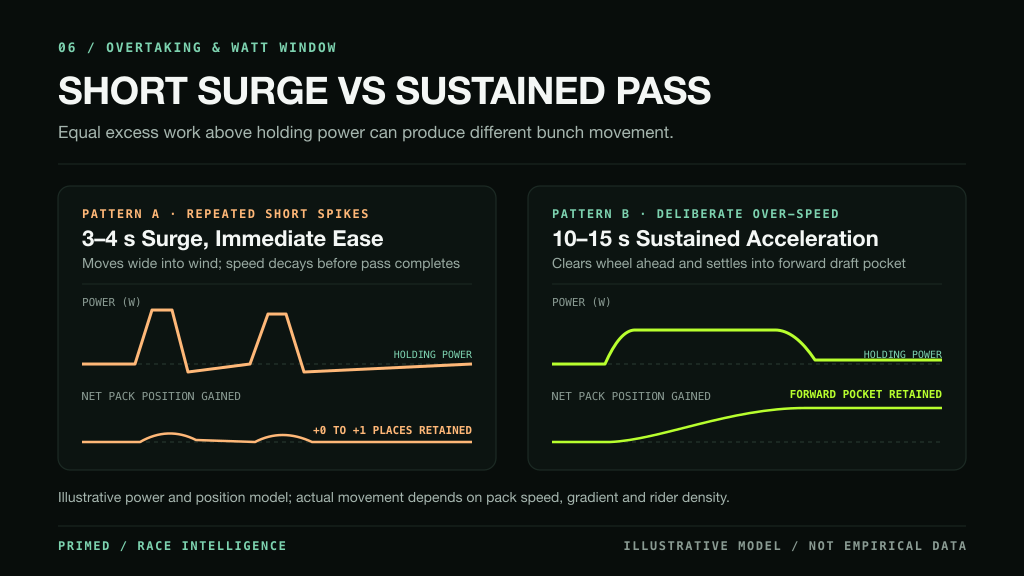
The diagram above illustrates the difference conceptually (actual wattage and timing always depend on pack speed, gradient, rider mass and bunch density):
| Overtaking approach | What happens in the pack (illustrative scenario) | Energy cost vs position outcome |
|---|---|---|
| Pattern A: Repeated 3–4 s spikes (e.g. two brief surges above holding power, easing immediately after each) | Avatar steps sideways out of shelter; speed decays before clearing the riders ahead; pack closes the lane. | High physiological cost, low return: burns anaerobic reserve ($W'$) for zero to one net places retained after 20 seconds. |
| Pattern B: Deliberate 10–15 s pass (e.g. a smooth, sustained rise above holding power, then settling over 2–3 s) | Builds a real speed differential, holds momentum while exposed on the outside, and slots into a draft pocket further up. | Controlled cost, durable gain: advances multiple wheels and retains the forward draft pocket once settled. |
| Pattern C: Drifting up inside the Watt Wasting Window (e.g. 20–30 W above minimum holding power) | Avatar stays locked behind the same cluster of wheels without triggering a pass. | Pure wasted work: higher heart rate and kilojoule burn with no change in pack rank. |
Practical takeaway: Either ride at the bottom edge of the power needed to hold your wheel safely, or commit to a 10- to 15-second deliberate acceleration that finishes in a better draft pocket. Avoid living in the middle ground between the two.
3. Passing a single rider vs moving through a 40-rider peloton
Moving past one rider in a four-rider breakaway is very different from moving from 35th to 8th in a crowded scratch race:
- In a small single-file group (3–6 riders): The draft is narrow and the speed of the group is usually dictated by one or two riders on the front. Coming off a wheel immediately exposes you to nearly full wind resistance, so you should only pass when you intend to take a turn on the front, bridge a split that is opening ahead, or launch an attack (see when to attack in a Zwift race).
- In a large peloton (25+ riders): Multiple columns of riders create a wide canopy of draft shelter. Even when your avatar moves toward the side of the bunch to overtake, you often retain partial draft assistance from the riders ahead and beside you. However, because riders ahead are constantly accelerating and decelerating, a half-hearted pass leaves you stranded on the outside edge when the front of the bunch surges.
4. Racing without steering: what Zwift controls vs what you control
Most Zwift races include riders without dedicated steering hardware alongside riders using Zwift Play controllers, Zwift Click or steering risers.
If you race without manual steering, it helps to separate what the game automates from what remains entirely under your control:
| Controlled automatically by Zwift (PD5) | Controlled by you (through power and timing) |
|---|---|
| Lateral road position (left, centre or right lane) | Your longitudinal speed relative to the riders immediately ahead |
| Steering around slower riders to avoid avatar pass-through | Whether you sustain an acceleration long enough to complete an overtake |
| Seeking nearby draft pockets when within range | When you initiate your move relative to upcoming climbs, crests and sprints |
| Activating Supertuck on steep descents when at 0 W and out of the draft | How quickly you react when the Close the Gap prompt appears |
If you race with manual steering, you gain the ability to choose your lateral lane and follow specific wheels around corners – but steering sideways out of a draft line while riding at steady power will immediately increase your aerodynamic drag and slow you down. Steering is an aid to finding or leaving a draft line, not a substitute for the speed needed to pass.
5. When not to spend watts moving up
Trying to stay in the top five wheels for an entire 40-minute race is one of the fastest ways to empty your legs before the finish. In many situations, spending energy to move forward is a tactical mistake:
- When the bunch is strung out single-file at 45+ km/h: When the pace is already stretched thin, draft savings remain high but the speed required to pass a long line of riders is enormous. Unless a gap is opening directly in front of you, hold your wheel and wait for the pace to lull slightly before moving up.
- Simply because your avatar drifted sideways: As we show in Tip 8 of our Pack Dynamics guide, lateral movement toward the kerb does not mean you are losing places. Check your numeric rank in the Riders Nearby panel first.
- Mid-descent inside a compact pack: Since Zwift's November 2025 drafting update aligned draft wakes with road slopes, descending packs travel roughly 10 to 15 per cent faster on steeper downhills. Fighting virtual pack braking to move from 15th to 5th on a fast descent burns watts while everyone else recovers. Do your positioning before the climb crest or wait until the gradient levels out near the bottom.
6. How to train repeatability for bunch positioning
Knowing when to make a 12-second positioning effort only helps if your legs can absorb that effort and still recover while pedalling at threshold or upper-tempo power.
In our guide on how to train for Zwift racing, we highlight two session types that directly build this capability:
- Over-under intervals (such as alternating 2 minutes at 95% FTP with 1 minute at 110% FTP), which train your ability to clear lactate and settle your breathing while holding fast pack power after a positioning push.
- Short anaerobic repeats (such as 15-second hard accelerations followed by 45 seconds of active endurance or tempo pedalling), which build the neuromuscular repeatability needed to move up before climbs and sprints without depleting your entire Critical Power and $W'$ reserve.
Build the repeatability to move up when it counts
Tactical awareness saves wasted watts in the bunch; adaptive training gives you a larger reserve when you have to make a move. Primed connects your historical training and recovery from Garmin, Intervals.icu, Oura, WHOOP, Withings and Apple Health, analyses how you handle repeated high-intensity surges across your completed rides, and exports structured
.zwoworkouts directly into Zwift (Primed works from your connected activity history and readiness rather than live in-race Zwift telemetry).
Frequently asked questions
Why does my power go up in Zwift without my position changing?
When you are drafting inside a bunch, you need significantly less power than the leaders to travel at the same speed. If you increase your power modestly, you may remain inside the Watt Wasting Window – pedalling harder than the minimum needed to hold the wheel ahead, but not hard enough or long enough to overcome aerodynamic drag and virtual pack braking to complete an overtake.
Is a short surge or a steady push better for moving up in a Zwift bunch?
A deliberate, sustained acceleration of roughly 10 to 15 seconds is usually far more effective than repeated 2- to 4-second spikes. Brief surges often cause your avatar to step sideways into the wind and lose momentum as soon as you ease off, whereas a sustained effort builds enough speed difference to clear the wheels ahead and settle into a forward draft pocket.
How do I stop losing places at the bottom of climbs in Zwift?
Move forward during the final 30 to 45 seconds of flat road before the gradient begins, while draft shelter is still strong and pack speed is steady. Entering a short climb in the front third gives you a buffer to absorb pace changes and avoids getting caught behind splits in the rear of the peloton.
Where should I go next in the Primed Zwift racing series?
- Master the core mechanics: How to Race Smarter in Zwift: 10 Pack Dynamics Tips
- Fix getting detached on surges and climbs: Why You Keep Getting Dropped in Zwift Races (Even With a Good FTP)
- Turn positioning into race-winning moves: When Should You Attack in a Zwift Race? and Zwift Sprint Strategy: Positioning, Timing and Launch
- See a real post-race analysis: Inside a Zwift Race: How One Over-Paced Climb Cost the Front Group